The UK is looking to allow AI-based weapons systems to kill without the approval of a human being.
Al Carns, the armed forces minister, said there are circumstances where AI-powered weapons systems can make targeting decisions for themselves.
Speaking to the FT from the sidelines of a drone conference in Riga, Latvia, he said: ‘I always say there must be a human in the loop.
‘But you must have the ability to take the human out of the loop when required, because our adversaries won’t care about having a human in the loop.’
The UK’s current military policy on the matter, published in 2022, said there should be ‘context-appropriate human involvement’ in the selection and engagement of targets.
And a government submission to the UN’s Office of Disarmament Affairs in 2024 claimed that the UK does not possess any fully autonomous weapon systems, defined as armaments that ‘operate without context-appropriate human involvement or outside of human responsibility and accountability, and has no intention of developing them.’
The UN bluntly states of autonomous weapons systems: ‘No state should develop or deploy such systems.’
And the international body’s secretary-general António Guterres said these systems are ‘politically unacceptable and morally repugnant.’

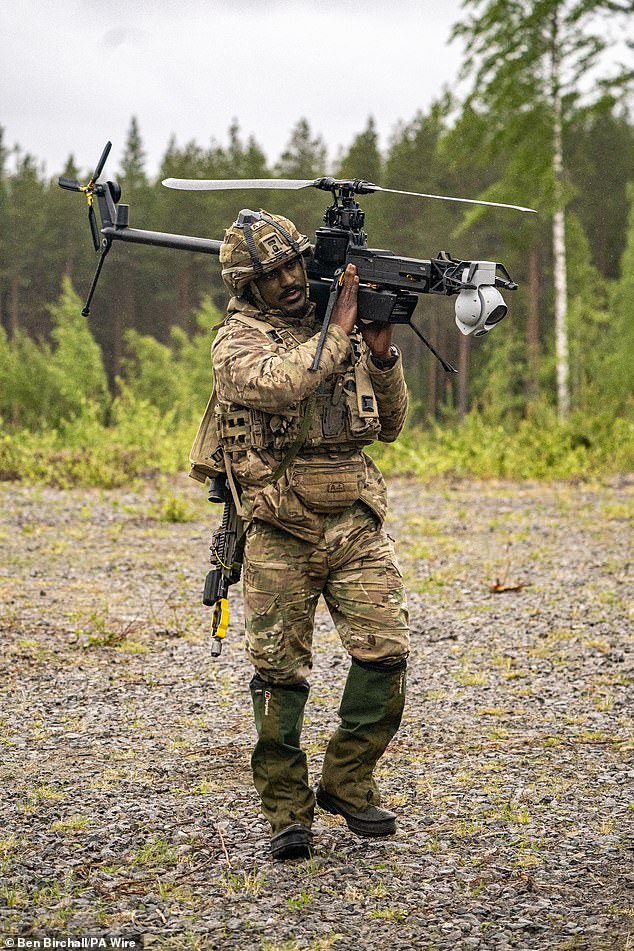
British Army soldiers from 3 Rifles carry a single-rotor helicopter style Ghost drone, made by Anduril, which uses AI software to help soldiers to let the drone autonomously identify, classify, and track objects of interest in a battle

An RAF counter unmanned aerial system at RAF Leeming
But with the rapid adoption and development of drones in warfare, many states across the world, including the UK, are looking to redraw what once may have been considered a red line.
Carns said at the drone summit that some British weapons systems already operate with significant autonomy, including ‘missile systems [that] can fly forward and identify targets and strike them.’
In February, the government launched a review of the regulatory system overseeing the use of unmanned and autonomous systems.
It said that policy must be ‘updated to be fit for the current era of threat.’
But many fear that increasing the use of autonomous weapons systems may backfire.
Early last month, Latvia was infuriated after two Ukrainian drones accidentally struck an oil facility.
Ukraine blamed the matter on Russian interference.
But Latvia’s military reportedly discussed the theory that the drones, which were aimed at a Russian oil facility, instead autonomously locked onto the Latvian facility by mistake.
A February poll run by Politico found that nearly two in three British people would prefer humans as the primary decision-makers for weapons systems, even if they were slower.
Similar results were found in Canadian, American and French respondents.
But one in three Germans said that they would prefer AI systems in weapons, ‘even if they are less transparent.’
Less than 50% of those polled in Germany said they would prefer human beings in charge of weapons systems.