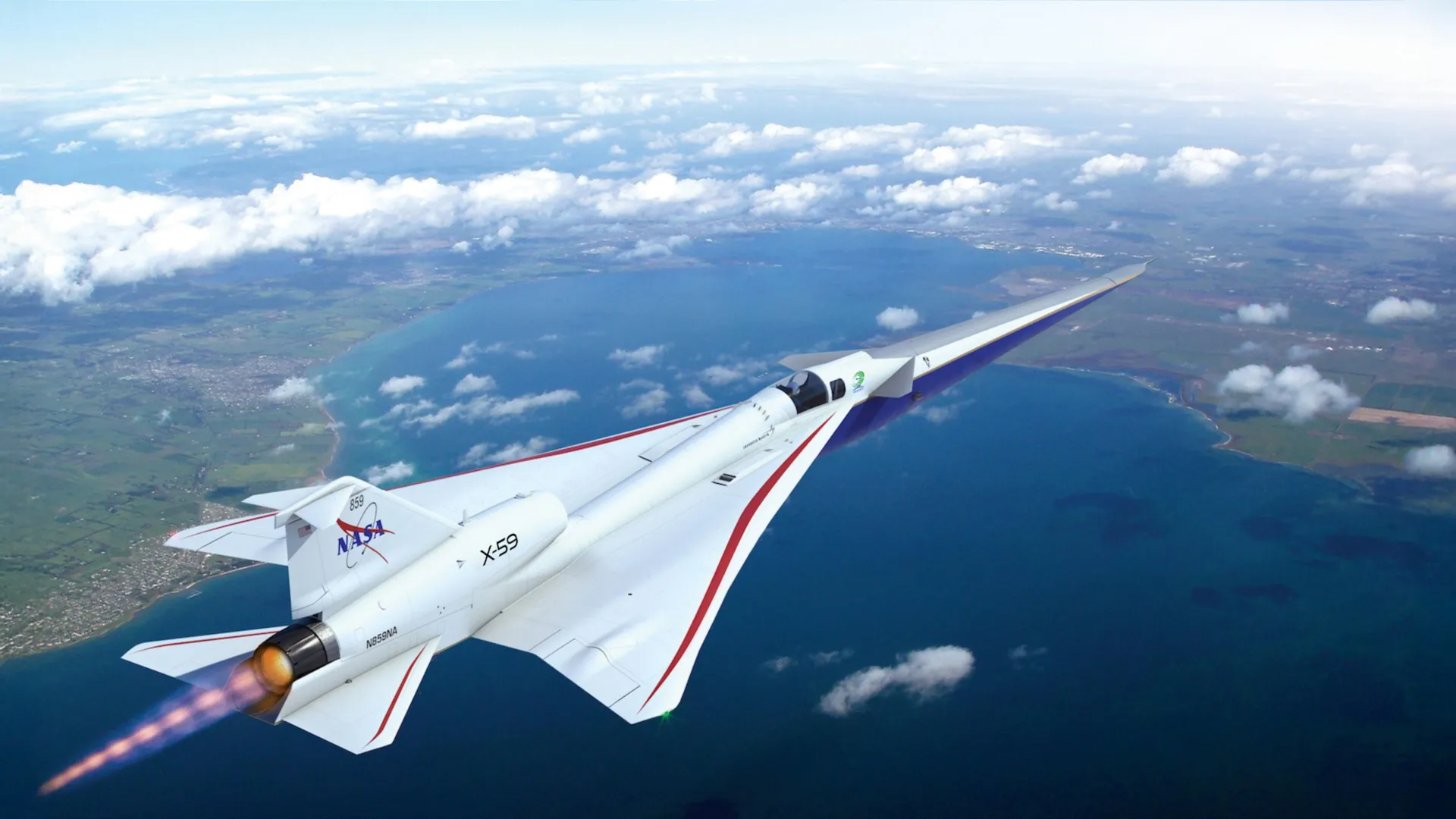
NASA’s X-59 quiet supersonic research aircraft is approaching one of the most important stages of its development. The experimental X-plane is set to begin a new series of test flights that will include its first trip beyond the speed of sound, along with several other key objectives for the mission.
“What comes next is the first time this one-of-a-kind aircraft will fly supersonic,” said Cathy Bahm, project manager for NASA’s Low Boom Flight Demonstrator. “We are starting toward the mission conditions test point that X-59 was designed for.”
Following months of flight testing, the X-59 team reviewed its progress in late May and is now preparing for a new phase that will push the aircraft to greater altitudes and higher speeds. These flights are intended to show how the aircraft performs under the operating conditions required for NASA’s Quesst mission, which aims to collect data on quiet supersonic flight.
First Supersonic Flights Ahead
NASA expects the X-59 to exceed the speed of sound for the first time during test flights scheduled for early June. The aircraft is expected to fly at more than 630 mph at an altitude of about 43,000 feet, marking a major milestone in the program.
The aircraft will then attempt a “mission conditions” flight, reaching Mach 1.4 (925 mph) at approximately 55,000 feet. Those performance targets are important because they match the conditions NASA plans to use when flying the X-59 over U.S. communities. During those future flights, researchers will gather public feedback about the aircraft’s quieter sonic “thump” and evaluate how people respond to it.
Although the X-59 was designed to minimize the disruptive sonic boom typically associated with supersonic aircraft, these initial supersonic flights are not intended to demonstrate that capability. A conventional supersonic chase aircraft will accompany the X-59, and the louder sonic booms produced by the chase plane will mask any quieter sound generated by the experimental jet.
During supersonic testing this summer, the chase aircraft will also carry a specialized shock-sensing probe that will collect the first measurements of the X-59’s shock waves.
What NASA Learned From Earlier Flights
The aircraft’s first phase of testing successfully met a number of important objectives and produced valuable data for engineers.
After its maiden flight in October 2025, the X-59 underwent a planned maintenance period before returning to flight testing in March 2026. Since then, the aircraft has completed 14 additional flights and achieved several notable milestones, including:
- Completing its first gear swing, retracting its landing gear and revealing its distinctive aerodynamic profile in flight.
- Reaching altitudes of up to 43,000 feet and speeds approaching the sound barrier at Mach 0.95, roughly 627 mph.
- Conducting its first dual-flight day and later making multiple flights per day a routine part of testing.
- Transitioning from increasingly fast and high-altitude flights to slower, lower-altitude testing to evaluate performance across a wider range of operating conditions.
Information gathered during these flights has helped engineers evaluate key systems, including fuel delivery, hydraulics, environmental controls, and the aircraft’s eXternal Vision System. This unique camera-based system replaces a traditional forward-facing windshield by providing the pilot with a live display view ahead of the aircraft.
Teams also closely monitored how the X-59 performed during takeoffs, landings, and flight operations. Strain gauges installed throughout the aircraft measured structural loads and recorded how the airframe responded to various forces encountered during testing.
Expanding the Flight Envelope
The next set of flights will challenge the aircraft in a new way. Pilots will continue working through planned test points while engineers evaluate performance in true supersonic conditions.
“Flying at supersonic speeds is a major milestone for the X-59 team,” Bahm said. “Every step of envelope expansion brings us closer to demonstrating the quiet supersonic capability that is at the heart of the Quesst mission. Completing the first mission-conditions flight is especially meaningful — it’s the moment where we begin validating the aircraft in the environment it was designed for.”
Along with reaching mission conditions, the aircraft is expected to achieve its top planned performance targets during this testing phase, including a maximum speed of Mach 1.6 (1,218 mph) and a maximum altitude of 60,000 feet.
Even so, not every flight will take place at supersonic speed. Engineers will continue conducting a mix of subsonic and lower-altitude flights to monitor the aircraft’s behavior under a variety of conditions.
“These flights not only deepen our confidence in the X-59’s performance — they mark our progression toward the future phases of the mission that will ultimately help shape the future of supersonic travel,” Bahm said.
Preparing for Phase 2 of the Quesst Mission
All flights completed so far, along with the upcoming test campaign, are part of Phase 1 of NASA’s Quesst mission. This stage focuses on proving the aircraft’s performance and airworthiness.
Some flights will also involve the early use of specialized equipment, including a probe mounted on one of NASA’s F-15 research aircraft. The instrument is designed to measure the X-59’s unique shock wave signature.
The information collected during these early measurement flights will help engineers prepare for Quesst Phase 2, scheduled to begin later this year. During that stage, teams will directly measure the aircraft’s supersonic flight signature to confirm that it is producing the quiet supersonic thump it was designed to generate.
“Aviation pioneer Otto Lilienthal said, ‘To design a flying machine is nothing. To build one is something. But to fly is everything.’ The 15 X-59 flights we’ve accomplished since March have been everything to this team and the mission,” Bahm said. “Every flight has pushed the boundaries of what’s possible, steadily expanding the envelope and strengthening our confidence in the aircraft.”
However, Bahm emphasized that the team remains focused on the work ahead.
“As we look ahead to the upcoming flights, we’re poised to open the envelope even further — moving boldly toward the mission test point this aircraft was built to achieve,” Bahm said. “Flying supersonic and reaching these milestones isn’t just progress; it’s the realization of years of perseverance, innovation, and teamwork. Each step brings us closer to Phase 2, and to the future of commercial supersonic flight.”