Arsenal’s run to the 2006 Champions League final remains one of the most memorable campaigns in the club’s history.
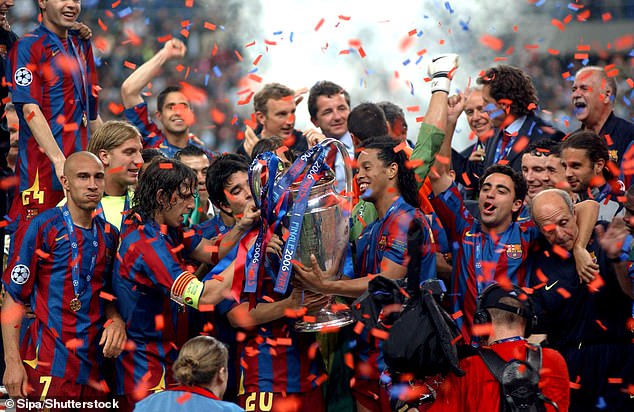
Arsene Wenger’s side had reached the showpiece for the first ever time, producing a remarkable defensive record along the way, but were ultimately felled by Barcelona in Paris. Despite opening the scoring through Sol Campbell, Samuel Eto’o and Juliano Belletti’s second-half goals ensured the final score was 2-1
The team contained a blend of experienced internationals with young, emerging talent, many of whom went on to enjoy long and varied careers across Europe and beyond.
Two decades on, the starting XI – and those who featured off the bench – have taken very different paths since leaving north London.
From coaching and punditry to business ventures and personal struggles, here Daily Mail Sport takes a look at where Arsenal’s 2006 Champions League finalists are now…

Arsene Wenger ’s side had reached the showpiece for the first ever time, producing a remarkable defensive record along the way, but were ultimately felled by Barcelona in Paris

Despite opening the scoring through Sol Campbell, Samuel Eto’o and Juliano Belletti’s second-half goals ensured the final score was 2-1

Robert Pires (far right) told Arsene Wenger he was leaving after the Champions League final in 2006, believing he was no longer in the boss’ plans after being sacrificed in the 18th minute
ARSENAL’S STARTING XI (4-4-2). May 17, 2006.
GK Jens Lehmann (Germany)
The German was in his third season at the club when Arsenal’s Invincibles reached the Champions League final for the first time, and he was a key figure in that run, breaking the record for the most consecutive clean sheets in the competition that season (10).
After moving to Stuttgart a couple of years later, he announced he would retire at the German side in June 2010. Amid a goalkeeping injury crisis at Arsenal the following season, Lehmann returned and played one more game in the top flight, against Blackpool, before finally hanging up his boots at the end of the campaign.
In 2020, he joined Hertha Berlin as a representative on its supervisory board, but was sacked a year later after sending Sky pundit Dennis Aogo a racially charged message. He has also worked as a manager in the six-a-side Baller League, while currently working as an analyst on German TV.
RB Emmanuel Eboue (Ivory Coast)
Eboue departed Arsenal for Galatasaray in 2011, where he spent three trophy-laden seasons with the perennial Turkish champions. He returned to England in 2016 when he signed a short-term contract with Sunderland, but was released just a month later without making an appearance after FIFA handed him a one-year ban over a dispute with a former agent.
Issues in his personal life followed, including a divorce from his wife Aurelie, and he later described how he ‘lost everything in my life in England’, including his houses, cars and money. This had a profound impact on his mental health, something he has since spoken openly about to promote openness in the game, as well as encouraging young players to seek financial advice.
His son Mathis, from whom he is estranged, joined Chelsea’s academy in January last year. Earlier this month, he appeared in a senior matchday squad for the first time when the Blues faced Liverpool at Anfield.
CB Kolo Toure (Ivory Coast)
Toure left Arsenal for Manchester City in 2009 after 326 appearances for the club. He was joined a year later by his younger brother Yaya, with the pair helping City win their first league title in 44 years in 2012. After spells at Liverpool and Celtic, Toure retired in 2017 before moving into coaching almost immediately, joining Brendan Rodgers’ staff and later following him to Leicester in 2019 as assistant manager.
His first senior managerial role at Wigan did not go particularly well, lasting just nine matches before his dismissal. In 2024, he returned to Manchester City’s academy set-up as an under-18 assistant coach before being promoted to Pep Guardiola’s first-team staff a year later. City announced earlier this week that he would be leaving the club following Guardiola’s departure.

Man City announced earlier this week that Kolo Toure would be leaving the club following Guardiola’s departure
CB Sol Campbell (England)
Despite scoring in the final, Campbell endured a difficult final season at Arsenal amid injury issues and a loss of form, and left for Portsmouth in July 2006. After three years at Pompey and a brief spell at Notts County in 2009, he returned for a second stint at Arsenal, making 11 appearances. He finished his career at Newcastle in 2011, officially retiring a year later.
He attempted to move into politics but failed to be shortlisted as the Conservative candidate for Mayor of London in 2016. He worked briefly with QPR, became assistant manager of Trinidad and Tobago in 2017, and later held managerial roles at Macclesfield and Southend.
He has since said he stepped away from pursuing management roles due to a lack of fair opportunities. Campbell studied at Harvard Business School, gaining a qualification in sport, media and business, and has recently spoken about developing a ‘virtual coach’ and using AI-led scouting and coaching platforms globally.
LB Ashley Cole (England)
Cole controversially left Arsenal for Chelsea in 2006, souring his relationship with fans. However, he went on to enjoy major success at Stamford Bridge, winning another Premier League title, four FA Cups and the Champions League in 2012.
Since retiring in 2019 after spells with Roma, LA Galaxy and Derby County, Cole has built a coaching career with Chelsea’s academy, Everton, Birmingham and England. Earlier this year, he landed his first senior managerial role with Italian side Cesena in Serie B. Despite narrowly missing out on the play-offs, he has been praised for improving the team.

Earlier this year, Cole landed his first senior managerial role with Italian side Cesena in Serie B
RM Robert Pires (France)
Pires told Arsene Wenger he was leaving after the Champions League final in 2006, believing he was no longer in the manager’s plans after being sacrificed in the 18th minute for tactical reasons following Lehmann’s red card.
Pires went on to play for Villarreal and later Aston Villa, before finishing his career with Indian Super League side Goa in 2015. He returned to Arsenal in 2016 as a coach under Wenger, but departed the following year.
He has since been involved in Baller League projects, as well as regularly undertaking punditry duties discussing Arsenal and the Premier League.
CM Gilberto Silva (Brazil)
After leaving Arsenal in 2008, Silva played for Panathinaikos in Greece, winning the league and cup, before returning to Brazil to finish his career. He retired in 2015 after a short spell with Atletico Mineiro. Since then, he has worked as a pundit, FIFA ambassador and Arsenal ambassador.
CM Cesc Fabregas (Spain)
One of the most important players of Arsenal’s post-final era, Fabregas developed into the club’s captain before joining Barcelona in 2011. He later returned to England with Chelsea, enjoying a highly decorated spell that included two Premier League titles, an FA Cup and a Europa League trophy.
He later played for Monaco before finishing his career at Como in Italy. After retiring in 2023, he became head coach later that year. He guided them to promotion and, earlier this week, to Champions League qualification for the first time.

After retiring in 2023, Cesc Fabregas became head coach later that year, guiding them to promotion and, earlier this week, to Champions League qualification for the first ever time
LM Alexander Hleb (Belarus)
Hleb enjoyed a nomadic career after leaving Arsenal in 2008, making 14 subsequent moves from north London, including spells at Barcelona, Birmingham City and Wolfsburg. After retiring in 2019, he joined the Belarusian Football Federation as an executive committee member.
CF Freddie Ljungberg (Sweden)
After leaving Arsenal in 2007, Ljungberg had spells with West Ham, Seattle Sounders, Chicago Fire, Celtic and Shimizu S-Pulse before retiring in 2014.
He returned to Arsenal in 2016 in a coaching role, later becoming assistant to Unai Emery and then Mikel Arteta. Since leaving in 2020, he has stepped away from full-time coaching, focusing on smaller football projects and occasional media work.
CF Thierry Henry (c) (France)
Perhaps Arsenal’s most recognisable player of the modern era, Henry went on to play for Barcelona and New York Red Bulls, including a brief loan return to Arsenal, before retiring in 2014.
He moved into coaching, working with Arsenal’s youth teams and Belgium’s national side before managerial stints at Monaco and CF Montreal. More recently, he has worked with France’s youth teams, leading them to a silver medal at the 2024 Olympics in Paris.
Henry now works primarily as a pundit for CBS Sports and has recently joined FOX Sports as a lead analyst for the upcoming World Cup.
Despite missing out on the Champions League with the Gunners, he did manage to lift the famous ‘Big Ears’ with Barca in 2009, beating Man United 2-0 in Rome.

Despite missing out on the Champions League with the Gunners, he did manage to lift the famous ‘Big Ears’ three years later with Barca, beating Man United 2-0 in Rome.
Substitutes:
GK Manuel Almunia (Spain) retired from football in 2014 after a heart condition and has mostly stayed out of the public football spotlight.
DF Philippe Senderos (Switzerland) works under Arsene Wenger at FIFA as a youth talent scout.
DF Gael Clichy (France) is currently the head coach of French third-tier side SM Caen.
MF Mathieu Flamini (France) became a hugely successful entrepreneur and co-founded a biochemical company focused on sustainable energy. According to Forbes, Flamini’s net worth has soared to £10billion.
FW Jose Antonio Reyes (Spain) tragically died in a car accident in 2019 at the age of 35.
FW Robin van Persie (Netherlands) became a coach after retiring and is currently manager of Eredivisie club Feyenoord.