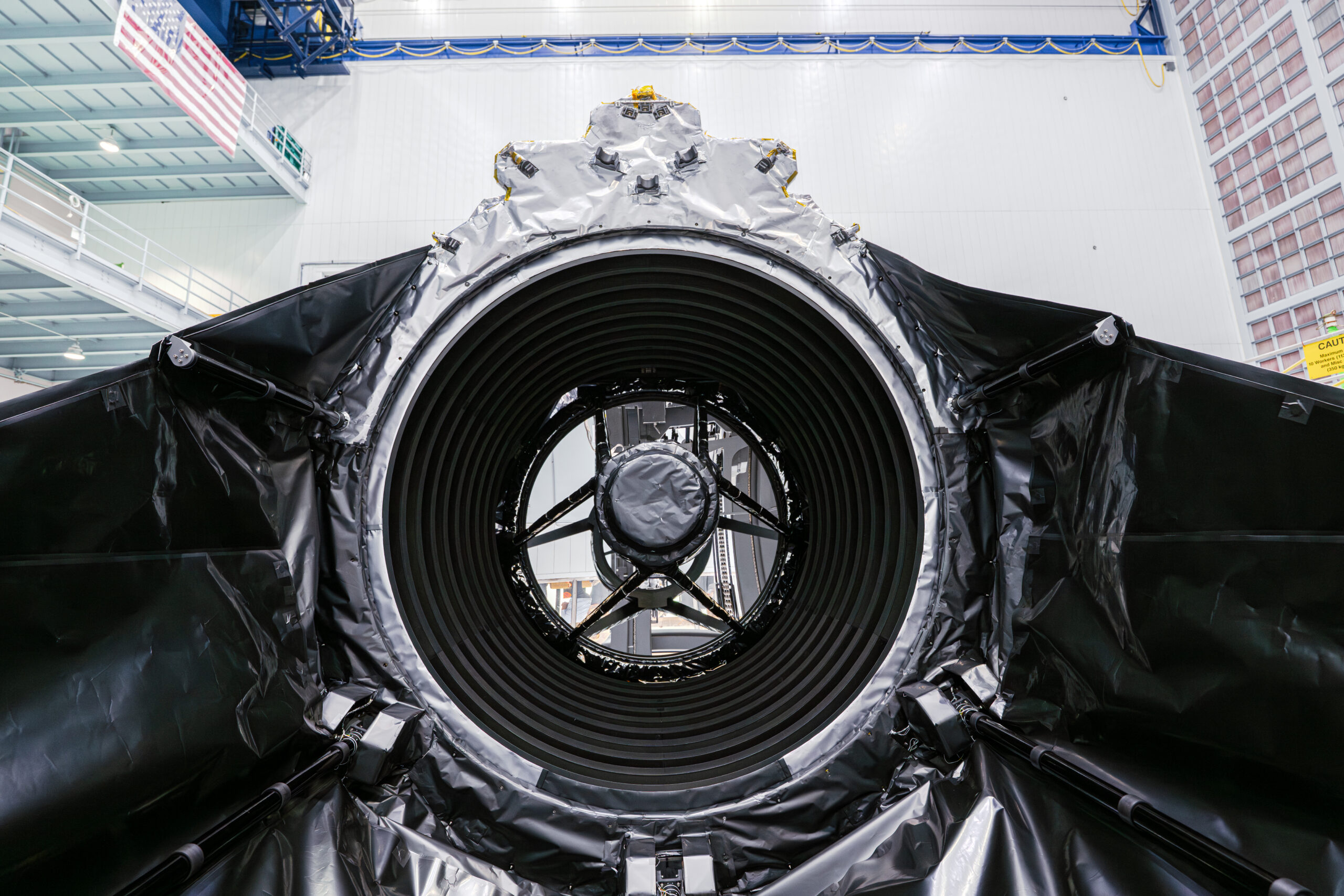
Engineers at NASA’s Goddard Space Flight Center in Greenbelt, Maryland, have completed their final inspection of a key element for the agency’s Nancy Grace Roman Space Telescope: the primary mirror. This 7.9-foot (2.4-meter) mirror will collect and focus light from cosmic objects near and far, helping Roman capture stunning panoramas of space.
NASA’s Goddard Space Flight Center
“The Roman engineering team laid eyes on the telescope for the final time before it, in turn, becomes the eyes of humanity, revealing the wonders of the cosmos,” said J. Scott Smith, the Roman telescope manager at NASA Goddard. “It is a profoundly humbling moment to witness the culmination of hard work from so many dedicated individuals, teams, and partner organizations, including L3Harris.”
On May 20, engineers turned the Roman observatory onto its side and deployed the “hood” that will be stowed for launch to protect the mirror. Then the team conducted a meticulous visual inspection to ensure no specks fell onto the mirrors during testing and confirm there are no defects in the coating or alignment.
“We developed a method of using a high-resolution camera equipped with a very powerful zoom lens to do a multi-purpose inspection,” said Bente Eegholm, optics lead for Roman’s Optical Telescope Assembly at NASA Goddard. “The mirror passed with flying colors, keeping the mission on track for an early September launch.”
The team carefully observed the optics along the path light will follow to the Wide Field Instrument detector array and confirmed it remains in proper alignment following the observatory shake test.
“In order to gather very sensitive measurements of objects strewn throughout space, all of Roman’s components have to be ultraprecise,” Eegholm said. “The primary mirror certainly delivers on that precision.”
Roman’s primary mirror sports a layer of silver less than 400 nanometers thick — about 200 times thinner than a human hair. The silver coating was specifically chosen for Roman because of how well it reflects near-infrared light. By contrast, the Hubble Space Telescope’s mirror is coated with layers of aluminum and magnesium fluoride to optimize visible and ultraviolet light reflectivity. Likewise, the James Webb Space Telescope’s mirrors have a gold coating to suit its longer wavelength infrared observations.
The Roman mirror is so finely polished that the average bump on its surface is only 1.2 nanometers tall — more than twice as smooth as the mission requires. If the mirror were scaled up to Earth’s size, these bumps would be just a quarter of an inch high.
Since it’s made of a specialty ultralow-expansion glass, the mirror will resist flexing, which can happen to materials during temperature changes (like going from balmy Earth conditions to the deep freeze of space). This preserves Roman’s image quality, because if the primary mirror changed shape, it would distort the images from the telescope.
“We’re really proud of the amazing optical system we’ve delivered for the Roman mission alongside our partners at L3Harris,” said Josh Abel, lead Optical Telescope Assembly systems engineer at NASA Goddard. “Now that it’s assembled, aligned, and all shined up, we’re ready to go.”
Now, the Roman team is preparing to ship the observatory to the launch site at NASA’s Kennedy Space Center in Florida in the coming weeks. NASA expects the mission to begin returning incredible cosmic vistas within several months after launch.
To learn more about NASA’s Roman mission, visit:
https://nasa.gov/roman
The Nancy Grace Roman Space Telescope is managed at NASA’s Goddard Space Flight Center in Greenbelt, Maryland, with participation by NASA’s Jet Propulsion Laboratory and Caltech/IPAC in Southern California, the Space Telescope Science Institute (STScI) in Baltimore, and scientists from various research institutions.
Media contact:
Claire Andreoli
NASA’s Goddard Space Flight Center, Greenbelt, Md.
301-286-1940