Every now and then, a pair of shoes lands on my table that is not simply about the shoe itself, but also the story behind it. This Temiz Atelier Review is one of those moments.
Temiz Atelier, based in Turkey and founded by Veysel Temiz, is still very much at the beginning of its journey. But that is precisely what makes this pair interesting. These are not shoes from a long-established factory with generations of refinement behind them. They are the work of a young maker, self-taught in many ways, clearly passionate about design, and clearly unafraid to make something with personality. Reminds me a lot about me 😉
And I like that. I will always have time for people who put their heart into something and chase the dream of creating products/ideas that they are passionate about.
👉Watch the full review video here:


From Art Student to Shoemaker
One of the more inspiring parts of this story is that Veysel comes from an art background (the painting department) that turned into a passion for classic shoemaking. And you can see that almost immediately in the shoes. There is a design eye here. The patterns are bold, the color combinations are adventurous, and the shoe is not trying to be another safe black cap-toe Oxford. I always respect this route as it is the harder one to climb, but also the one that stands out.
Temiz Atelier represents one of the positive sides of social media and the modern shoemaking world. Years ago, shoemaking knowledge was heavily guarded. You could only learn by becoming an apprentice and shoemakers rarely took them on. And when they did, it was almost always one at a time. Many makers did not want to share their techniques for fear of creating competition.
Today, with Instagram, YouTube, and more open access to information, young makers can learn, experiment, and build something from places where traditional apprenticeship routes may not have been readily available. And that’s precisely how Veysel learned: by watching YouTube! I always find it so fascinating when a shoemaker learns by watching a video. As someone who learned in person and even struggled there, I can only imagine the difficulty of learning without being able to ask a question. The screen won’t reply.
This is one of the beautiful aspects of modern technology.

First Impressions & Packaging
The box itself is simple but attractive. No model name, size sticker, or production details yet, but those are the little things a young brand learns to add over time. I remember the early days of my own brand and all of the details you do not even realize you are missing until someone points them out.
The box colors stood out to me: a sort of Tiffany green paired with a darker forest green, finished with a unique emblem. It immediately felt different from what we usually see.
Inside, the shoes were wrapped in paper rather than accompanied by shoe bags. Again, that is not a criticism so much as a reality of starting out. Shoe bags, boxes, labels, branded packaging, minimum order quantities — all of that costs money, and the world has become much harder for small makers since the pandemic. Suppliers want higher minimums, prices have gone up, and new makers often have to build these details slowly.
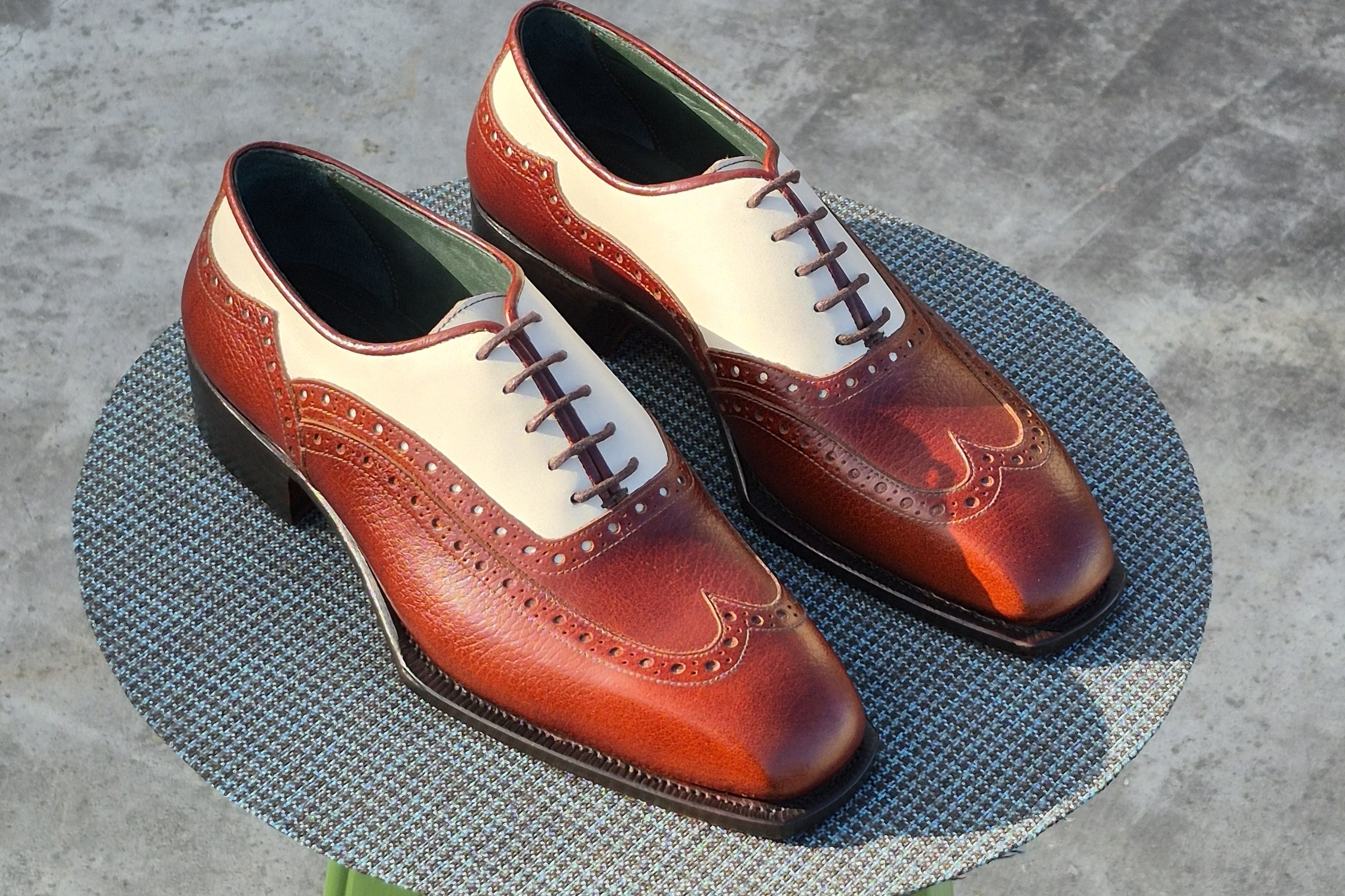
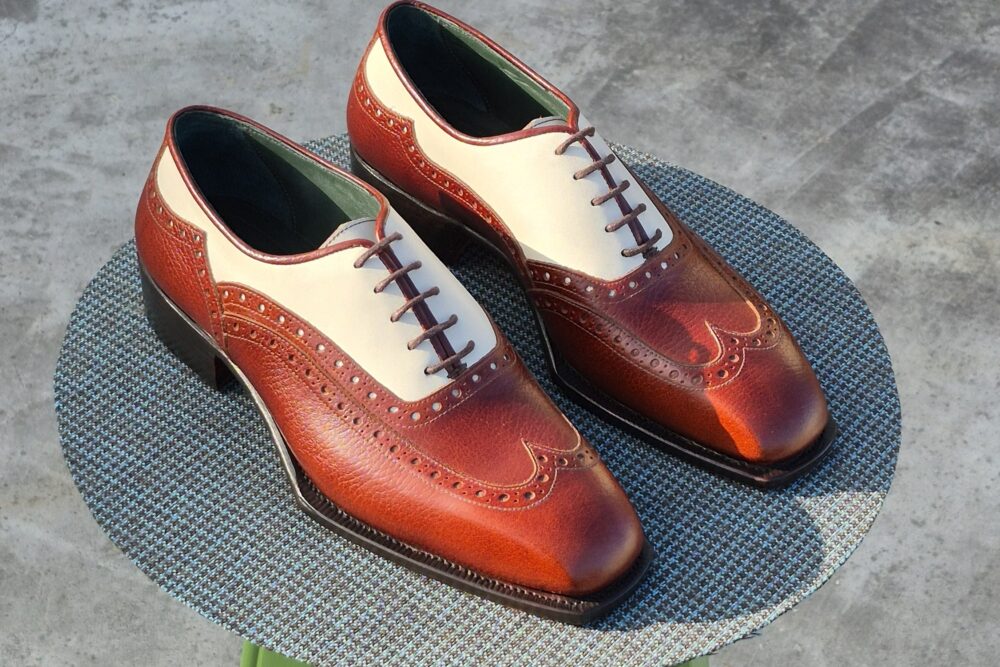
The note from Veysel was a nice touch. He explained that these were only his third completed handwelted pair and that, as a fellow spectator fan, he designed them as asymmetrical wingtip Oxfords. That context matters. When you know you are looking at one of someone’s earliest handmade shoes, you judge it through the right lens. I know, as I remember the first pairs I made for myself. And I was my own hardest critic.


Model Overview: A Bold Spectator Wingtip Oxford
The shoes themselves are bold. Very bold. My kind of bold!
They are a spectator wingtip Oxford — or a correspondent, for those in the UK — with a rich soft grain brown leather paired against a light cream contrast panel. There is a lot going on: brogueing, asymmetric pattern work, a spade sole, notched toe detailing, a chisel last, and a lot of hand-finished character.
This is not a conservative business shoe. A spectator never is. It is the sort of shoe that catches the eye from across the room, and whether someone loves it or not will depend entirely on how they feel about bold design. But even though someone might never wear this, they will almost always certainly appreciate it on someone else.
Personally, this is the kind of design style I enjoy. I like makers who take a classic idea and give it their own twist. Temiz Atelier appears to be doing exactly that with its brand.


Design Details
There are several interesting details throughout the shoe.
The pattern lines are probably the strongest part of the design. The sideline is elegant, flowing, and well judged. That is what originally caught my attention with Veysel’s work on Instagram. There is a confidence to the design that many young makers do not yet have.
The shoes also have different inscriptions or markings on the sole area, rather than simply repeating the same logo on both shoes. I will not pretend to know exactly what the Turkish phrasing means, but as a design detail, it is different. It feels like the kind of touch you might expect from someone with an art school background — a bit more personal, a bit more expressive, and not simply copied from the usual playbook.
The seamless heel is also a nice detail, and the waist work is quite good. For such an early handwelted pair, the waist shape and heel balance are genuinely promising.
Fit & Comfort
I gave Veysel my usual size: EU 40.5, UK 6.5, US 7.5. From what I can tell, these were made on a generic last rather than a full bespoke last, and the fit was surprisingly good.
The instep hugged nicely, and the heel cup gripped well, which are two of the more important parts of fit. If the instep is too loose or the heel is too wide, your foot starts moving around, and the shoe quickly becomes unpleasant to wear.
The forefoot had a bit more room than I personally need, but that is common for me as I have a slender foot. The main thing is that the shoe held me well through the heel and instep, and that is where a lot of the real fit success comes from.


Last Shape & Toe Spring
The last is a rounded chisel shape. It has a defined chisel line, though the toe is a touch wider and blunter than I personally prefer. Chisel lasts are tricky for me. Too sharp and they look aggressive; too blunt and they start losing elegance. This one sits slightly on the blunt side for my own taste, but not to the point of being unattractive.
One thing I would encourage Veysel to think about is toe spring. The line of the shoe is visually beautiful, but there is very little toe spring. Technically, a shoe should have enough toe spring to allow the foot to roll forward naturally when walking. The rule I was taught was that you should be able to slide a standard Bic-size pen under the tip of the toe.
This is not me trying to be overly critical. It is simply one of those small technical details that becomes more important as a maker refines his craft, as fit/comfort are crucial to customer retention.


Quality & Construction Details
For only his third handwelted pair, there is a lot to admire here.
A few points stood out:
- The shoes are fully handmade
- The upper stitching is almost certainly machine-stitched, as expected.
- The heel stack appears to be built piece by piece, which is a good sign.
- The waist work is nicely shaped and one of the stronger areas of the shoe.
- The heel has a good height and ratio to the rest of the last.
- The seamless heel is a lovely touch.
- The overall design has real personality, and his pattern to last shape ratio is perfect.
There are also areas where refinement is needed, particularly in the sole finishing. The channel work shows some roughness and breakage in places, which is one of the hardest parts of shoemaking to master. I know that struggle personally. When I was learning bespoke shoemaking, closing the sole channel cleanly was one of the most nerve-racking parts of the entire process. And I ruined most of them. I do not recall ever making a perfect one in my 7 pairs.
You can make an entire shoe beautifully, then at the very end, one bad cut can ruin the look of the sole. It takes practice. Lots of it. But these things must be kept in perspective. Most of that sole finishing wears away after a couple of wears anyway. It is not something that affects the fit, comfort, or longevity of the shoe in any meaningful way.


Leather & Finishing
The leather is not perfect. There are some small natural marks, and I noticed little blemishes in places. There is also a small cut near the heel area from the making process.
Would that bother some customers? Possibly. I understand that when someone spends hard-earned money on a pair of shoes, the small things can feel bigger. But I also think people often become too emotionally attached to tiny imperfections that do not actually affect what matters most.
What matters most in a shoe is fit, comfort, and longevity. At the very high end, once you start paying serious money, what you are often paying for is not necessarily more durability, but refinement. You are paying for fewer visible imperfections, cleaner finishing, and a higher level of perfection.
For a young maker on his third handwelted pair, I would not obsess over small leather marks or a bit of rough sole finishing. The important foundation is there.


What I Loved
The design is easily the highlight for me. I love the boldness of it. I love that Veysel is not simply trying to recreate what everyone else already makes. There is a clear sense of personality, albeit some inspired design, for sure, but with his own touch to it.
The pattern work is strong, the waist is elegant, the heel stack is promising, and the shoe has a real artistic spirit to it. That matters, at least to me 😉
Refinement can be improved. Finishing can be improved. Leather selection can be improved. But an eye for design is harder to create from scratch.


What I Would Change
Personally, I would not choose the spade sole. I appreciate it as a design and shoemaking feature, but it is not something I would order for myself. That is simply personal taste.
I would also slim down or sharpen the toe shape slightly and add a touch more toe spring. Those changes would improve the balance for my eye and likely make the shoe more functional from a walking standpoint. But these are all just personal preferences. Not hard-line necessities for improvement.
The sole finishing will improve with repetition, as will the channel work and the tiny details that separate a promising shoe from a truly refined one.
Final Thoughts
This Temiz Atelier review is less about judging a finished brand against the most polished makers in the world and more about recognizing promise.
For only his third handwelted pair, Veysel Temiz is doing very well. There are areas that need refinement, but that is expected. What impressed me most was not perfection, but personality. The shoes have heart. They have a point of view. And they show the beginning of what could become something very interesting.
Temiz Atelier may not yet be for the conservative buyer looking for a flawless black Oxford. But for those who enjoy bold design, young makers, and the early stages of creative shoemaking, this is one to watch.
I hope that you have enjoyed the Temiz Atelier review and that you go check out their work. I also Veysel continues to excel, because the foundation is there. And if his third handwelted pair looks like this, I will be very curious to see what his thirtieth looks like!
Find out more: https://www.instagram.com/temizatelier/
—Justin FitzPatrick, The Shoe Snob
Shop · Marketplace · J.FitzPatrick · Patreon
Disclosure: The brand sent these shoes for review. I was not paid for this video nor this post; there were no talking points, and what you hear is my own honest take, as always.