Here’s one of the more unsettling schemes to recently emerge from Silicon Valley: human clones grown without a conscious brain. At least one biotech start-up reportedly has quixotic ambitions of breeding spare, unfeeling meat sacks as a way to clear the ethical path for procedures called “body transplants”—and, hypothetically, immortality. The idea seems to be that if these surrogate bodies are wholly unconscious, without even the faintest awareness of the world or themselves, then there’s no harm done.
It isn’t clear how much—or how little—of a brain these clones would have, but they’d certainly lack a cerebral cortex, the wrinkly outer layer that’s responsible for sophisticated cognitive functions such as language, self-reflection and abstract thought. Most theorists have long assumed that the cortex is where consciousness, or our subjective experience of the world, arises. If they’re right, an organism without one would have no thoughts, sensations or emotions—no inner life at all.
But what if they’re wrong? A growing number of consciousness researchers are seriously considering the possibility that consciousness could originate deep within the brain’s most evolutionarily ancient realm: the subcortex. They argue that, just as astronomy once labored under a false geocentric model, consciousness research is in thrall to the mistaken notion that cortical processing lies at the center of all experience—the corticocentric model. The idea is “as old as any attempt to relate brain to mind” in neuroscience, says Mark Solms, a neuropsychologist at the University of Cape Town in South Africa. “It’s a foundational theory about where the mind is.”
On supporting science journalism
If you’re enjoying this article, consider supporting our award-winning journalism by subscribing. By purchasing a subscription you are helping to ensure the future of impactful stories about the discoveries and ideas shaping our world today.
Yet over the past several decades, Solms and others have marshalled counterevidence in hopes of forcing a Copernican upheaval in their field. The subcortical revolution, should it come to pass, would have massive implications for how we define and measure consciousness—and for which creatures we deem worthy of moral consideration.
The Brain in Two Parts
The cortex is neuroanatomy’s latest innovation, and it has done well for itself. Its size varies across species, but in humans and many other mammals, the cortex now swells to epic proportions—around 75 percent of brain mass, in our case—and envelops the older structures beneath it. The inmost region, the subcortex, holds more foundational responsibilities than the upstart upstairs: maintaining arousal, processing emotions, regulating the body and relaying sensory information.
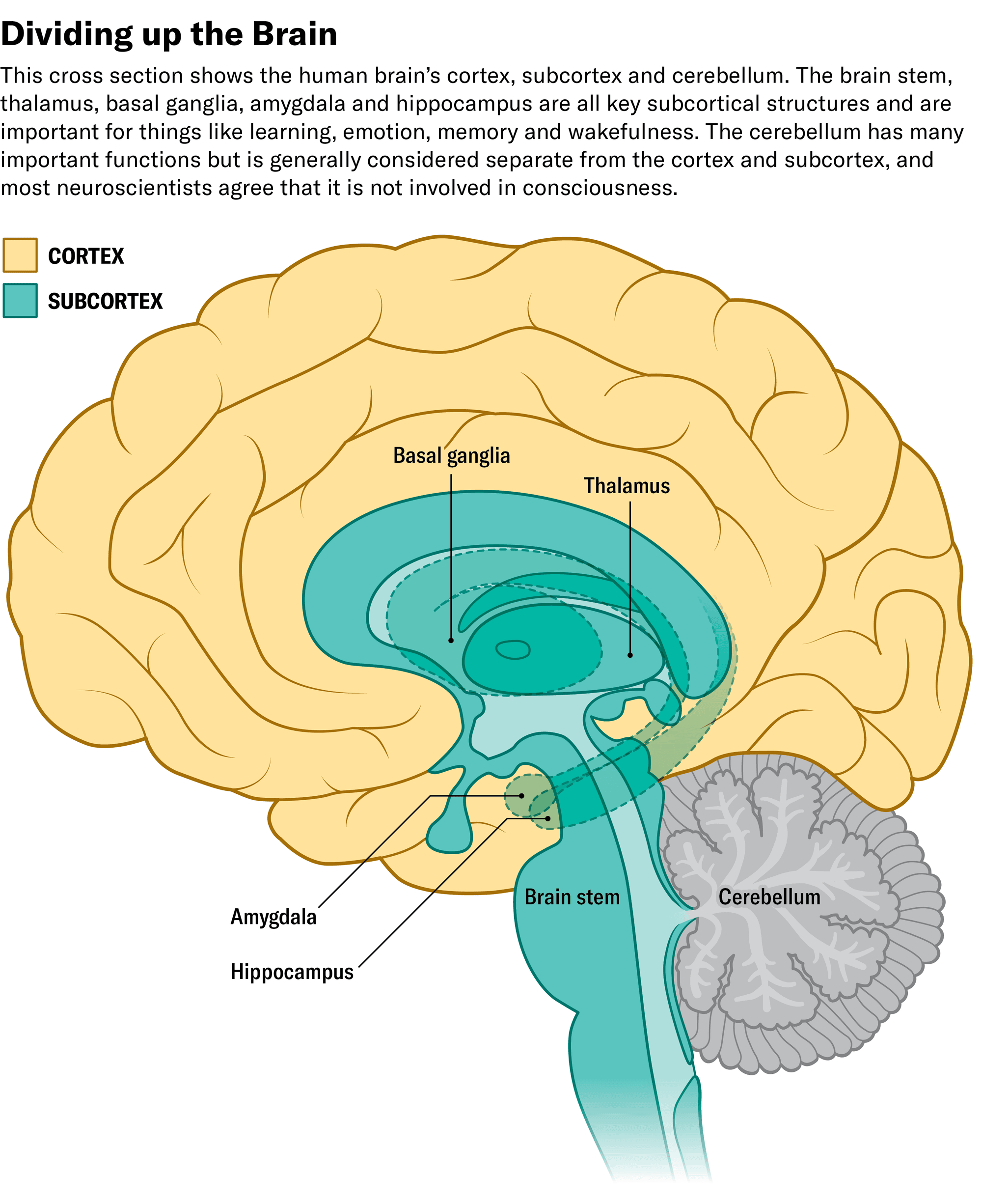
The cortex and the subcortex are tightly interconnected. When most sensory information enters the brain, it flows through deep-brain relay points in the subcortex on its way up to the cortex, which then responds with feedback signals in an ongoing communication loop. Virtually all neuroscientists agree that, in healthy human brains, consciousness depends on this continuous dialogue between cortex and subcortex; it’s been clear for nearly a century that if certain parts of the subcortical brain stem get damaged, “the lights go out,” as Solms puts it. The question is whether the subcortex is merely a power supply keeping the cortex’s consciousness online, as corticalists hold, or whether it can sustain basic consciousness by itself.
Unconscious Zombies
The most intuitive evidence that the subcortex is more powerful than we thought is that many organisms without a cortex nevertheless seem conscious. We need not wait for Silicon Valley’s clones: children with a rare developmental disorder called hydranencephaly are already born sans cortex and, on that basis, are often classified as being in an unconscious vegetative state.
But in 2004, at what turned out to be a pivotal moment for how researchers think about the subcortex, Swedish neuroscientist Bjorn Merker joined five families that included children with hydranencephaly at Disney World.
He spent a week observing the children’s behavior. They giggled, played with toys and generally showed “responsiveness to their surroundings in the form of emotional or orienting reactions to environmental events,” as he later wrote. They struck Merker as utterly normal, if developmentally delayed. Though they couldn’t speak and thus couldn’t report on their internal state, he simply could not believe he was in the presence of philosophical zombies—hypothetical beings that act like normal humans but have no felt experience.
Solms, following Merker’s example, also spent time around children with hydranencephaly. “The evidence that they are not ‘zombies’ is exactly the same evidence that your dog and your cat are not zombies,” he says. “They’re reporting by their behavior that they’re feeling things.”
Of course, the appearance of consciousness and consciousness itself are not the same thing. Strictly speaking, we can’t determine whether an organism is conscious unless it can somehow narrate its experience, leaving us to speculate about babies, brain organoids and nonhuman animals. (What this means for large language models, which can narrate their “experience,” is another question.) So we seem to be at an impasse: How can nonverbal life-forms possibly prove they aren’t mindless automatons?
When language isn’t an option, most researchers will use other information to infer consciousness. Matthias Michel, a philosopher at the Massachusetts Institute of Technology, is prepared to attribute consciousness to other mammals, which have a cortex, and to birds, which have a functional equivalent in the pallium—but not to fish or insects, which do not.
This conviction is based partly on studies showing how visual information enters conscious awareness—investigations that form the bulk of consciousness research. Visual information travels from the eye to subcortical structures and then on to the primary visual cortex at the back of the brain. From there, neural activity ripples rapidly across higher cortical areas. This initial pass appears to unfold unconsciously, beneath the threshold of awareness; only later, when feedback loops start to reverberate within the cortex, do people report conscious awareness of what they’re seeing.
Michel argues that animals with a similar brain organization to humans probably enjoy a similar kind of awareness—and that animals without this likely don’t. After all, we don’t need to be conscious of information for it to affect what our body does in response to it. “Consciousness is just the tip of the iceberg,” Michel says. “The large part of your behavior is driven by unconscious processes.” In the phenomenon known as blindsight, for example, people whose visual cortex has been damaged appear to respond to visual stimuli, despite insisting that they see nothing. (There are also auditory and olfactory versions, known respectively as deaf hearing and blindsmell).
The upshot is that one need not be conscious of something to respond to it. Perhaps that’s what happens in children with hydranencephaly and certain nonhuman animals—subcortical activity brings about reactive behavior but not the subjective experience associated with it.
Feelings (and Who Feels Them and Why)
Most consciousness research has focused on vision, but clearly visual perception can proceed unconsciously. What about other modes of experience? Solms argues that researchers ought to be investigating feelings, which he takes to be intrinsically conscious. “If [we] had started with feeling rather than vision,” he says, “there would have been no mystery to begin with.”
There’s a case to be made that feelings are the most fundamental form of consciousness. Evolutionarily speaking, Solms contends, they show up once organisms become complex enough to have many competing needs: eating, sleeping, finding mates, evading predators, and so on. Such organisms must constantly reprioritize those ever shifting needs; feelings give direction to their actions. “We feel,” Solms says, “so that we can transcend instinct.”
This balancing of needs is widespread throughout the animal kingdom, unlike the elaborate brain processing most neuroscientists consider essential for experience. To subcorticalists, that ubiquity suggests that a capacity to feel—even if only inchoately—may be just as widespread. “Consciousness is not, as many assume, a cognitively sophisticated function but something far more elementary,” Merker says.
Even some experts without strong subcortical leanings find this an attractive evolutionary explanation. “You’ve got to integrate all of that stuff, and you’ve got to act in real time,” says Tim Bayne, a philosopher at Monash University in Australia. “Maybe that’s what consciousness is all about, and pretty simple animals have that.” This just-so story suggests consciousness may be distributed widely across the tree of life.
Unlike the mammalian cortex, which began to coalesce some 300 million years ago, the subcortical architecture to which Solms and others ascribe experience evolved during the Cambrian explosion—the dawn of vertebrate life—more than 500 million years ago. Drawing the line here would admit reptiles, amphibians and fish to the consciousness club; some researchers believe that analogous brain structures may also support consciousness in insects and cephalopods, including octopuses.
In humans and other mammals, complex cortical processing no doubt augments experience. Even staunch subcorticalists concede that much. As Merker puts it, “Everything that makes our world rich is a gift of the cortex. And by the same token, without the cortex, there is no such richness.” It’s just that he’s convinced cortical processing leads to consciousness not in situ but deep inside the brain.
This is the most parsimonious way to account for the unified nature of consciousness, according to subcorticalists. The human brain receives a torrent of information about the world, but we don’t perceive the entire scene in detail. “Our experience is so simple by comparison,” says Daniel Freeman, a neurophysiologist at M.I.T. Somehow, the thinking goes, cortical information must be distilled into a single stream of awareness. Subcorticalists argue that this happens as the cortex funnels its diffuse electrical signals downward, toward a neural bottleneck in the brain’s nether regions. There, subcorticalists argue, the chaos is transformed into a finished product fit for consciousness.
In children with hydranencephaly and primitive animals, Solms says, the subcortex alone might give rise to “only the most rudimentary form of consciousness.” In that vein, research has shown that deep-brain stimulation can summon basic (but powerful) emotions such as severe depression and fear. But corticalists deny even this possibility, arguing that such feelings could result from downstream activity higher in the brain. “Even experiencing a dim light, the most boring experience,” Michel insists, “would require something like the cortex.”
Stimulating the Deep Brain
So does consciousness originate in the cortex or the subcortex? “I don’t think we’ve got enough evidence to support either of those versions fully,” says Anil Seth, a neuroscientist at the University of Sussex in England. He agrees with Michel that “there’s a wealth of evidence” tying cortical processing to consciousness, yet the precise brain activity that corresponds with experience—the so-called neural correlates of consciousness—has remained elusive. Of the myriad theories of consciousness, none inspires anything like consensus. That may be because we understand so little of what goes on in the subcortex during experience.
But a new technique, called transcranial focused ultrasound (tFUS), may let researchers directly probe subcortical structures—the terra incognita lurking beneath a relatively well-mapped cortex. Though Freeman and Michel hold opposite views on where consciousness lies, they recently co-authored a paper suggesting that tFUS offers “an exciting opportunity for breakthroughs in consciousness research.” Certain results could persuade Michel to rethink his cortical commitments. If, for instance, a person who had lost the sensation of pain because of damage in the cortex regained it during subcortical stimulation, he says, “I would be blown away.”
Corticalism dominates the field for now, but a reappraisal of the subcortex seems to be underway. When Bayne and Seth wrote an influential review of consciousness theories in 2022, they relegated subcortical considerations to one sentence in a sidebar, reflecting the absence of these ideas in the broader discourse. Today, Bayne says, “I think the debate has opened up a little bit.” One sign of that shift is the New York Declaration on Animal Consciousness, which was released in 2024 and signed by nearly 600 scientists. After noting that other mammals and birds are almost certainly conscious, it states that “the empirical evidence indicates at least a realistic possibility of conscious experience in all vertebrates … and many invertebrates” and that we must therefore consider their welfare.
Alongside the signatures of Solms and other confirmed subcorticalists, Seth set his own. Though he still leans cortical, he, too, has opened his mind. “I wouldn’t be terribly surprised if we look at the book of truth,” he says, “and the answer is that some basic forms of consciousness are completely supported by the subcortex.”