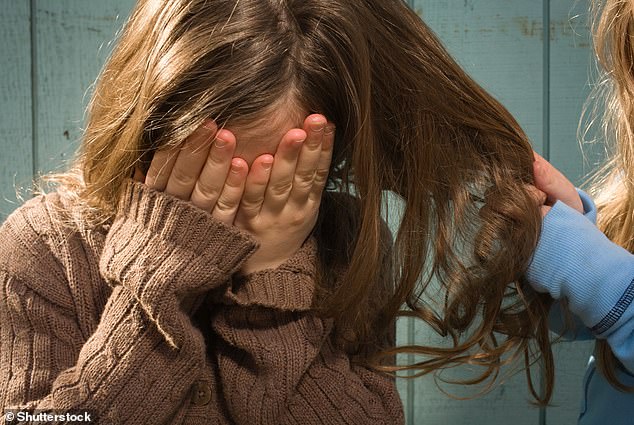
A violent bang to the head woke me up with a start in the dead of night. Then came the kicks to my ribs. As the searing pain hit me, I realised I’d been struck with an ornament and shouted in panic for my mum.
She came rushing in and tried to coax my attacker into another room to calm down.
This was no violent intruder though; she was known to both me and my mother. And the assault was hardly a one-off.
Then 12, I had been attacked in my sleep multiple times. And, as always, my sister Louisa, who was three years younger than me, was my assailant.
Perhaps, subconsciously, I’ve blocked out many of the memories of her violence towards me. But I do know that I never fought back. Rather, I’d try to defend myself by raising my arms or a pillow, for example, and attempt to push her away. She always left me with multiple cuts and bruises.
Mine would have been an idyllic childhood growing up in Shropshire with my mum and our two younger siblings, Charlie, now 20, and Evie, 18 – my dad left when I was young – but for my severely autistic sister.
It’s an admission that leaves me conflicted as I care deeply about Louisa. Now 23, she can be lovely between the explosive outbursts that have been her trademark since she was about four years old.
My mum bore the brunt of her eruptions. As she said to me recently, had it been a man attacking us the way Louisa has, he’d have been arrested and we’d have been put into a safe house.

Chloe’s violent little sister Louisa, who is severely autistic, often left her with multiple cuts and bruises, but she says that she never fought back
Instead, Mum was left to deal with Louisa largely alone. Now 26 and a trained teacher, I am still traumatised by my sister’s behaviour. No child should have to witness their beloved mum being regularly beaten by her own daughter.
We saw Mum black and blue, with cuts, bruises, scratches, black eyes and snapped fingernails. I felt so helpless and guilty that there wasn’t more I could do to stop my sister.
The most distressing attack came when Mum was eight months pregnant with our sister, Evie. Louisa kicked and pushed her, smashed a TV, mirrors, laptops, ripped doors from their hinges and kicked holes in internal walls, causing £8,000 of damage. Thankfully, unborn Evie wasn’t injured, but it was a huge worry.
Mum’s determination to get the best help she could for Louisa never wavered; she was constantly pushing social services and CAMHS (Child and Adolescent Mental Health Services) for a diagnosis and support.
Medication was never suggested at that point though. Although in the UK, certain medications can be prescribed from five years old, the National Institute for Health and Care Excellence (NICE) generally considers it a ‘last resort’ or supplementary option after environmental adjustments and behavioural therapies have been tried first.
I think my career in teaching has helped me understand my sister’s behaviour at a deeper level and acknowledge that she doesn’t have control over these outbursts due to her own additional needs.
My training was like therapy, helping me to make peace with our childhood now I know that so many other children demonstrate similar behaviours. Indeed, statistics show as many as 20 per cent of those with autism exhibit violent behaviour.
Though my parents separated when I was eight, Mum met my lovely stepdad when I was 15.
A director in manufacturing, he’s always been torn between his instinct to intervene and the knowledge that doing so would only make Louisa’s behaviour worse. Instead, he’ll help me to get her out of the house as she tends to calm down when removed from the situation to the garden.
Even as a baby, Louisa used to growl menacingly at people. I’d been so excited about having a little sister, but she wasn’t the sweet, cuddly bundle I’d imagined.
By the time she started in reception aged four, she had become angry and physically violent, and it was in her early years in primary school – though I don’t remember exactly when – that she began to attack me too.

The situation grew so extreme that Chloe was reluctant to have friends over, as she didn’t want them to feel that they were in danger or witness Louisa hurting her
Over the next few years at school, there were various incidents when she threw tables and chairs at staff and pupils, inflicting injuries on some of them.
But despite Mum’s concerns, teachers and social services said that Louisa was just a ‘naughty child’ and would grow out of it.
She is incredibly strong and, aged nine, was expelled after throwing a filing cabinet across a classroom.
Even after this, Mum’s constant pleas to social services and CAMHS were met with the same response: ‘You’re already doing all the right things, there’s not much more we can do to support you.’
It was years before we got a diagnosis of autism and dyslexia.
It was left to Mum to find another provisional education setting for children with additional needs where they recognised Louisa’s problems and provided much of her education outside the classroom on a neighbouring farm and woodland.
But at home, the abuse was unrelenting. She and I shared a bedroom until I was about 12, when the attacks on me in my sleep became so frequent that it became too dangerous to continue.
In the end, Mum, who owned her own business, bought a five-bedroom house so I could have my own room. Even then, Louisa would come in and smash it up when I wasn’t there. And there were still plenty of outbursts during the night; I’d go to school with cuts, bumps and bruises, and minus my homework, which she’d destroy.
Between rages, however, Louisa and I were actually quite close. That said, I was all too aware that the slightest thing could trigger a violent reaction from her. Mum was always her primary target and me second. If she did lash out at Charlie and Evie, I’d step in and take the blows myself to protect them and never fought back.
On one occasion when I was in my teens, Louisa knocked me unconscious after grabbing me by my ponytail and smashing my head into a wall in the hallway. All because I’d slipped on her shoes when taking rubbish out to the bin for Mum. After days of excruciating headaches, I finally did what Mum asked and went to A&E where I was diagnosed with concussion.
I was reluctant to have friends over, mostly because I didn’t want them to feel that they were in danger, or to witness me being hurt by my younger sister.
I was also deeply embarrassed by the state of the house. At one point, we had no internal doors because she’d damaged them so badly that they couldn’t be rehung. There was no point fixing things because Louisa would only smash them up again.

Louisa spent two years in care, during which we had contact sessions with her for a couple of hours at weekends. It was a relief to have some respite from her, says Chloe
Family days out and holidays were challenging and we were never able to go abroad because of the high risk that she’d have a violent meltdown in an airport, on a plane or in a hotel, for example.
I spent my life feeling on edge, wary of what Louisa might do next. At the same time, I felt horribly conflicted for being so nervous around her; it didn’t feel right.
Mum pushed for therapy sessions for Louisa through CAMHS and her various schools, where she also insisted on them providing safe spaces for her to go and calm down. Simultaneously, she fought the system for eight years to get a diagnosis of autism for Louisa when she was around 12. This meant she could be medicated with anti-psychotic drugs and sleeping pills, but they made her withdrawn and there were no positive benefits to her behaviour so she was taken off them.
Luckily, Louisa made it to the end of primary school. But within a couple of hours of starting secondary school, she had an enormous meltdown, throwing furniture around because she’d been told she was wearing the incorrect uniform – a black jumper instead of a navy one.
Expelled again, Mum got her into another secondary school. And another when the behaviour continued. In the end, nowhere would accept Louisa, so Mum managed to get her into what’s called an alternative provision, where she attended learning sessions with other children who had similar difficulties.
Sessions were short and focused on life skills rather than education, with one of her ‘classrooms’ being a local wildlife centre.
But this still didn’t make her calmer at home.
She was 12 when Mum had to call the police because she was destroying the house. When four male officers couldn’t restrain her, they had to request special permission to taser her, which was necessary but incredibly distressing for us all. Soon after, Louisa attacked a social worker who’d come to the house and Mum made the agonising decision to put her into temporary care.
Louisa spent the next two years in care, during which we had contact sessions with her for a couple of hours at weekends. It was a relief to have some respite from her behaviour and I think she found it helpful to have her own space. All the work she was doing with social workers meant that, in time, we saw a nicer side to her again. Eventually, she was able to stay with us for a night or two every week, almost like a custody arrangement.
She had to earn these stays by attending anger management classes to try and get her emotional reflex under control.
When she was deemed safe enough to move home aged 15, the attacks were less frequent.
I left home to go to Sheffield University just as she returned. Family is everything to me, but I could finally breathe.
Last year, I bought a home of my own, close to Mum. Louisa still lives with her, has a little job in a pub and is calmer with fewer meltdowns as a result of her new medication and all the work she’s done over the years with social workers. Charlie and Evie are now away at university.
I do worry about Mum and the life of care that she’ll have to give to my sister. But life is much better and Mum’s doing OK, finding ways to support Louisa in her job.
The last time she lashed out at me was three months ago when she threw a plate at my head after I’d asked her to put it in the dishwasher. I’m cautious around her, always fearful that if I say the wrong thing or she’s not in a good mood, it could quickly escalate into violence. It means I tend to be quite passive in her presence.
Otherwise, I’ve been fortunate. I have good friends, partly as a legacy of moving away to go to university and also from the time Louisa spent in care, when our home was a freer place to bring people.
If I ever found myself in Mum’s shoes with an autistic child of my own, the biggest thing I’d do differently is push hard from an early age for a diagnosis, therapy and support with care of that child, even when the professionals say no.
My greatest fear is that I don’t ever want Louisa’s behaviour to impact my career as a teacher. One of the reasons I’ve never fought back in recent years is the fear that if I inflicted any physical harm on her, even in self-defence, it could somehow have a detrimental effect on the career I adore.
Though I love Louisa dearly and feel protective of her, I can’t help but resent her for the terrible impact she has had on our family. She took away my childhood but I refuse to allow her to do the same to my adult life.
Chloe White is a pseudonym. Names and identifying details have been changed.
As told to Sadie Nicholas.