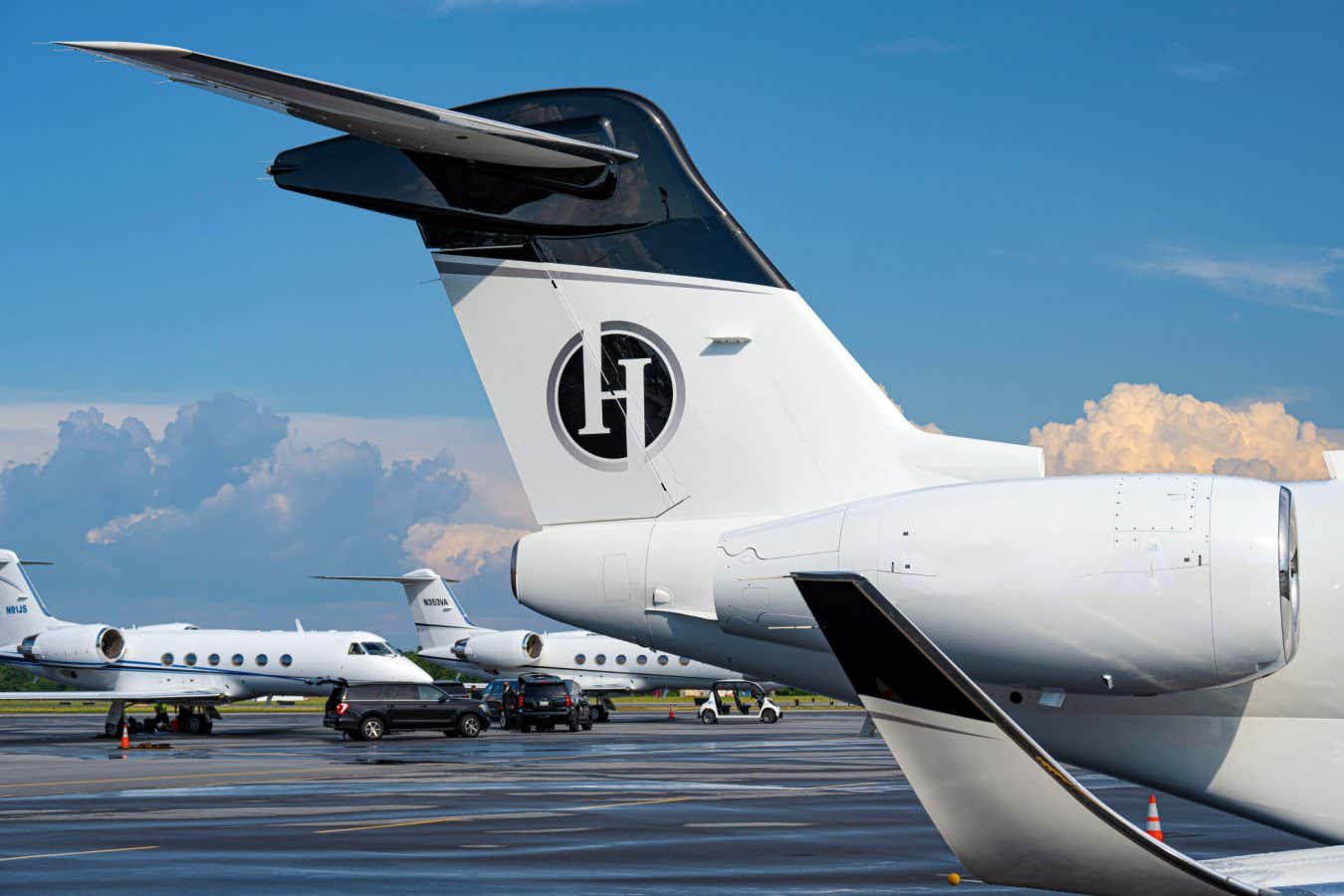

Private jets are the most carbon-intensive way to travel
Steve Allen / Alamy
People who care the most about the environment also do the most environmental damage with their jet-setting lifestyle, at least among those with the highest income and education.
But rather than being a critique of environmentalism, this finding shows that changing policy is more important than changing values when it comes to halting the climate and biodiversity crises, scientists say.
“We do not want to suggest that individuals are solely responsible for their carbon footprints”, since low-carbon alternatives to activities like flying are often still hard to find, says Malte Dewies at the University of Cambridge, one of the researchers behind the new work.
In fact, the term “carbon footprint” was popularised by BP to shift responsibility to consumers.
It’s long been known that a person’s footprint tends to increase with their income. This study, however, brought personal beliefs into the equation. Researchers first asked 5000 people across Canada, France, Germany, Italy, the UK and the US about their income, wealth, education and job prestige to establish their socioeconomic status.
Then they asked them about their views on nature, climate and wastefulness. Finally, they asked about factors like meat and dairy consumption, house size, trash generation, vehicle use and hours spent flying to estimate a broad “ecological footprint”.
For most respondents, the more importance they placed on preserving nature, the lower their ecological footprint. But among the top 30 per cent by socioeconomic status, the people who cared the most about the environment had an even larger footprint than their peers.
The main reason was that high-income nature lovers fly frequently, one of the most emissions-intensive individual activities. They may be justifying this by dedicating themselves to activities like recycling that barely reduce their footprint, says Dewies.
Environmentalism is “a universalistic value, and that means these are also the people who are open-minded, who want to interact with people from different cultures, who typically have friends in different countries and who fly more”, says Felix Creutzig at the University of Sussex, UK, who wasn’t involved in the research.
Earlier research hypothesised that environmental impacts first increase but later curve downward as a country gets richer and has more money to invest in sustainable alternatives, a trend dubbed the “environmental Kuznets curve”. Some have suggested this could apply to people as well, but Dewies and his colleagues say the results contradict this idea.
“Targeting the environmental attitudes of individuals with campaigns will not do the job” of reducing emissions, says team member Micha Kaiser at the University of Cambridge. “We need at some point to come up with stronger measures.”
Countries like the UK and Germany have raised taxes on aviation, and airfares have increased 24 per cent due to the Iran war energy crisis. The researchers said the price hikes probably aren’t enough to put off high-income air passengers, however.
In 2023, France banned short-haul flights, but loopholes meant no routes were actually cancelled.
Carlo Aall at the Western Norway Research Institute says policy interventions won’t avert climate catastrophe and that the research is instead an argument for degrowth, the idea that countries should reduce energy and resource consumption even at the cost of shrinking their economies. “Even the environmentalists cannot escape from the hamster wheel” of consumerism, he says.
The researchers admit their results could bolster perceptions that environmentalists are hypocrites, discouraging climate action. Climate philanthropists like Bill Gates have been bashed for flying on private jets, a rapidly growing aviation sector, including to the landmark 2015 Paris climate summit.
But Creutzig points out that the Fridays For Future protests started by Greta Thunberg pushed the German government to adopt climate legislation, even though not every demonstrator swore off flying like Thunberg did. “Being a citizen with an active voice matters more than [consumer] behaviour,” he says.
Topics: