May 27, 2026
4 min read

Tiny quantum computers could lead to supersized telescopes
Advances in quantum technology might allow astronomers to circumvent age-old issues that limit the size of optical observatories
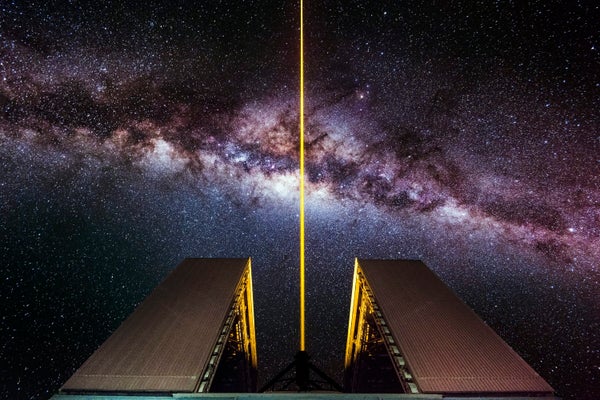
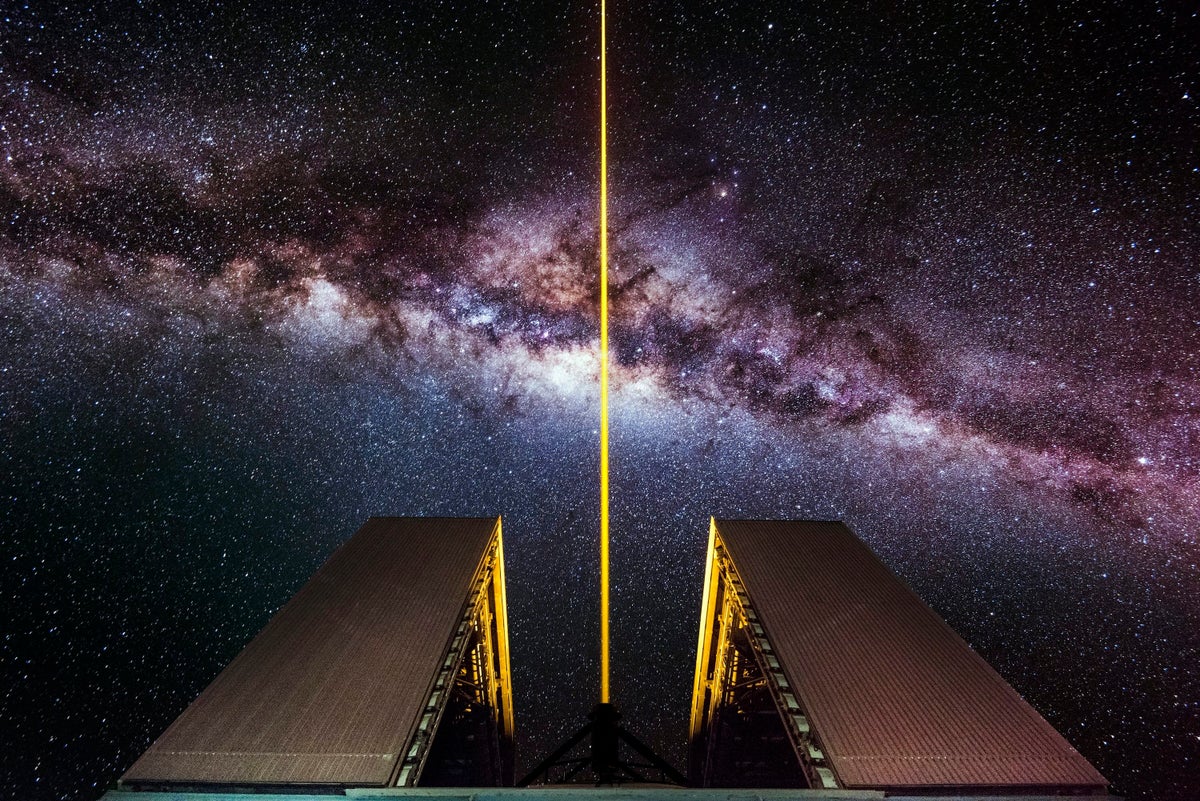
A laser shoots into the night sky from an 8.2-meter optical telescope at the European Southern Observatory’s Paranal Observatory in Chile. In the future, quantum technology could allow arrays of optical telescopes to work in unison, effectively acting as a single giant observatory.
Alberto Ghizzi Panizza/Science Photo Library/Getty Images
For the light from faraway stars and galaxies to reach and be detected by our telescopes, it first has to beat the odds. Of the photons of light that avoid clouds of dust and other deep-space obstructions to reach our planet, most don’t make it through Earth’s thick atmosphere, let alone through a telescope’s loss-prone optics. Astronomers boost these odds by building telescopes with bigger light-gathering mirrors or detectors, which in turn collect more photons and deliver crisper, clearer images. But constructing ever-bulkier hardware rapidly runs into physical and economic obstacles that limit the size of any single telescope and the sharpness of our cosmic views.
Radio astronomy has long relied upon an esoteric workaround: using a technique called interferometry to make arrays of smaller telescopes collectively act as one giant observatory. Through exquisite timing to track the arrival of photons from each telescope, essentially all the light soaked up by the entire array can be combined to make interference patterns from which images can be extracted. And the greater the “baseline” separation between an array’s individual telescopes, the higher the spatial resolution of the array’s resulting images will be; this has allowed radio astronomers to, for instance, construct arrays with a baseline as large as Earth itself, gaining sufficient resolution and sensitivity to map the shadowy boundaries of the supermassive black hole at the Milky Way’s distant heart.
Optical interferometers were invented more than a century ago, but orchestrating and combining signals from multiple telescopes across long baselines has proved much harder to accomplish with visible light compared to the relative ease of working in radio waves. One key impediment to making bigger optical interferometers has been the loss of precious photons along the path between them. Now, however, quantum-driven advances are revealing a possible way to solve this problem and create giant optical interferometers by using tiny quantum storage systems—quantum memories—to hold onto incoming photons.
On supporting science journalism
If you’re enjoying this article, consider supporting our award-winning journalism by subscribing. By purchasing a subscription you are helping to ensure the future of impactful stories about the discoveries and ideas shaping our world today.
“I think this could really become a very exciting area where one could do things which classical systems just cannot do,” says Mikhail Lukin, a physicist at Harvard University overseeing the new research.
The general idea of using a quantum network to improve optical interferometry has been around for decades, but the challenge has been making one robust enough to receive and process these incoming photons. Lukin’s research group began its quest to create the foundations for such a network two years ago; earlier this year team member Maxim Sirotin, a doctoral student at the Massachusetts Institute of Technology, presented the group’s first “proof-of-concept” experiment at the American Physical Society’s Global Physics Summit. A paper describing the result appeared in Nature in February.
“As soon as we realized that we had sufficiently good quantum memories, we wanted to apply it to a real problem,” Sirotin says.
The team’s experiment involves two quantum receivers—used to emulate telescopes—separated by a mere six meters yet connected by a 1.5-kilometer-long spooled optical fiber, through which a weak laser is beamed. At each receiver, a quantum memory chip built from an atomic-scale defect in a tiny diamond—a so-called silicon vacancy—can store photons’ information as variations in the spins of an electron and a silicon atom. (In this setup, the electron and nucleus inside the atom are each considered qubits, the quantum equivalent of classical computing bits.)
Entangling the two quantum memory chips via light signals before measuring the weak laser beam allows the researchers to retrieve an interference pattern from both “telescopes”—a feat that, in theory, could also be achieved with piped-in starlight instead.
If used in field, the result would be that two small telescopes separated by 1.5 kilometers could work together to create images that are as high resolution as those from a single telescope with a huge 1.5-kilometer-wide mirror. The resolution could be further improved by increasing the baseline between the two small telescopes to emulate an even larger light-gathering surface. This technique could help astronomers hoping to catch glimpses of exoplanets or get a more precise understanding of the motions and sizes of distant stars. But the Harvard research team notes that using its system “on the sky” to create optical interferometric images of actual celestial targets remains a far-off goal.
Even so, other experts are impressed. “I would say it’s a breakthrough,” says John Monnier, an astronomer studying interferometric techniques at the University of Michigan, who was not involved in the new study. “This is really a completely new way to make interferometers work.”
Many hurdles must still be overcome, Monnier cautions, before quantum-enhanced optical interferometers become at all practical for astronomical applications. Building the infrastructure for a sufficiently large optical interferometer might take decades, he says, adding that this is still the “fun early days” of trying and testing multiple different technological approaches.
“People are now really starting to think what quantum machines can do,” Lukin says. “What we’ve done is a proof of concept. It’s not practical so far, but it really shows a path to a new class of applications.”
It’s Time to Stand Up for Science
If you enjoyed this article, I’d like to ask for your support. Scientific American has served as an advocate for science and industry for 180 years, and right now may be the most critical moment in that two-century history.
I’ve been a Scientific American subscriber since I was 12 years old, and it helped shape the way I look at the world. SciAm always educates and delights me, and inspires a sense of awe for our vast, beautiful universe. I hope it does that for you, too.
If you subscribe to Scientific American, you help ensure that our coverage is centered on meaningful research and discovery; that we have the resources to report on the decisions that threaten labs across the U.S.; and that we support both budding and working scientists at a time when the value of science itself too often goes unrecognized.
In return, you get essential news, captivating podcasts, brilliant infographics, can’t-miss newsletters, must-watch videos, challenging games, and the science world’s best writing and reporting. You can even gift someone a subscription.
There has never been a more important time for us to stand up and show why science matters. I hope you’ll support us in that mission.