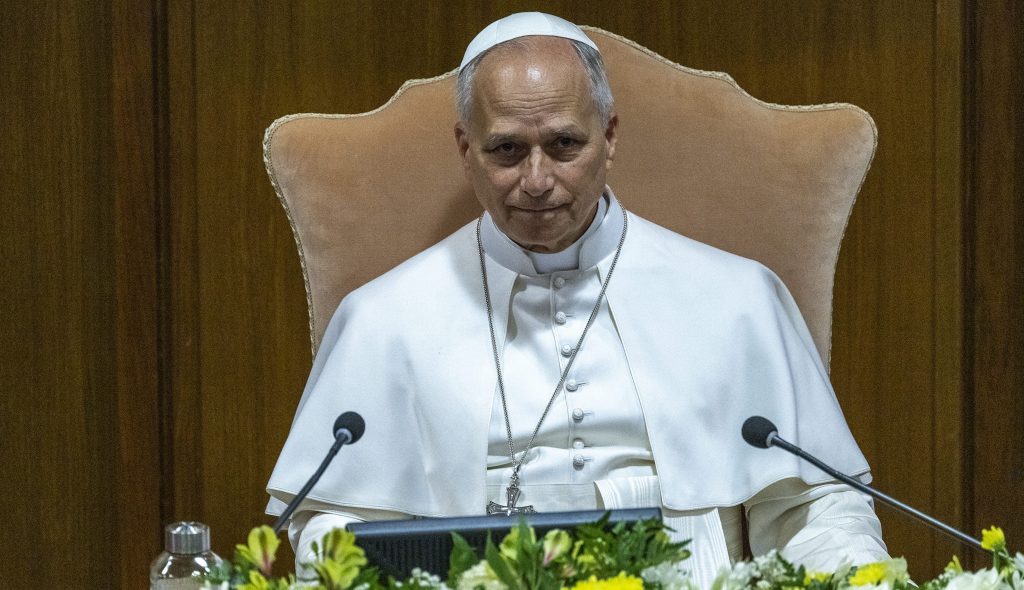
In his encyclical “Magnifica Humanitas” (Magnificent Humanity) released today, Pope Leo XIV warns that artificial intelligence “threatens to normalize an anti-human vision” and strongly cautions against the concentration of the new technology in the hands of the few.
In the first sentence of the encyclical, the Pope writes, “Humanity, created by God in all its grandeur, is today facing a pivotal choice: either to construct a new Tower of Babel or to build the city in which God and humanity dwell together.”
“A more moral AI is not enough if that morality is determined by a few,” the Pope writes as the pontiff calls for “an ethical code subject to shared standards of social justice.”
The Pope writes, “It is not enough to invoke ethics in the abstract; robust legal frameworks, independent oversight, informed users and a political system that does not abdicate its responsibility are required. A more moral AI is not enough if that morality is determined by a few.”
Pope Leo was joined at the Vatican today by Christopher Olah, a co-founder of the AI firm Anthropic, who said, “We need more of the world — religious communities, civil society, scholars, governments — to do what His Holiness has done here: to take this seriously, to look closely, and to push events in a better direction. We need moral voices that the incentives cannot bend.”
Read the full encyclical below.
Specifically, the Pope calls for clarity with regard to the responsibilities and accountability “at every stage of the development process” of AI policies and legal frameworks, independent oversight and user education.
“What is needed is a more active political involvement that is capable of slowing things down when everything is accelerating,” Leo writes in the text, adding that the environmental impact of new technologies must not be overlooked “since they require large quantities of energy and water, affecting Creation.”
Already the encyclical letter is being interpreted by many as a clear and concise retort to Silicon Valley about the future of civilization. AI, Pope Leo notes, must be “disarmed” in order to free it from the mentality of military, economic, and cognitive competition.
“To disarm means discrediting the assumption that technical power automatically confers the right to govern,” he writes. “To disarm does not mean rejecting technology, but preventing it from dominating humanity.”
“Humanity – in all its grandeur and woundedness – must never be replaced or surpassed,” he writes, while acknowledging that technology can alleviate humanity’s sufferings and open new possibilities but must not deny the essence of humanity, which is our “capacity for relationship and love.”
“The true alternative is not between enthusiasm and fear,” the Pope says of AI, “but between two paths of development: a progress that serves individuals and peoples, or a progress that subjects them to the mentality of power.”
Read the “Magnifica Humanitas” here.