



May 21, 2026
2 min read

Hidden structural features inside Egypt’s Great Pyramid may have helped it withstand earthquakes, new study finds
Constructed by ancient Egyptians, the Great Pyramid has survived multiple earthquakes through the ages—now researchers think they know why
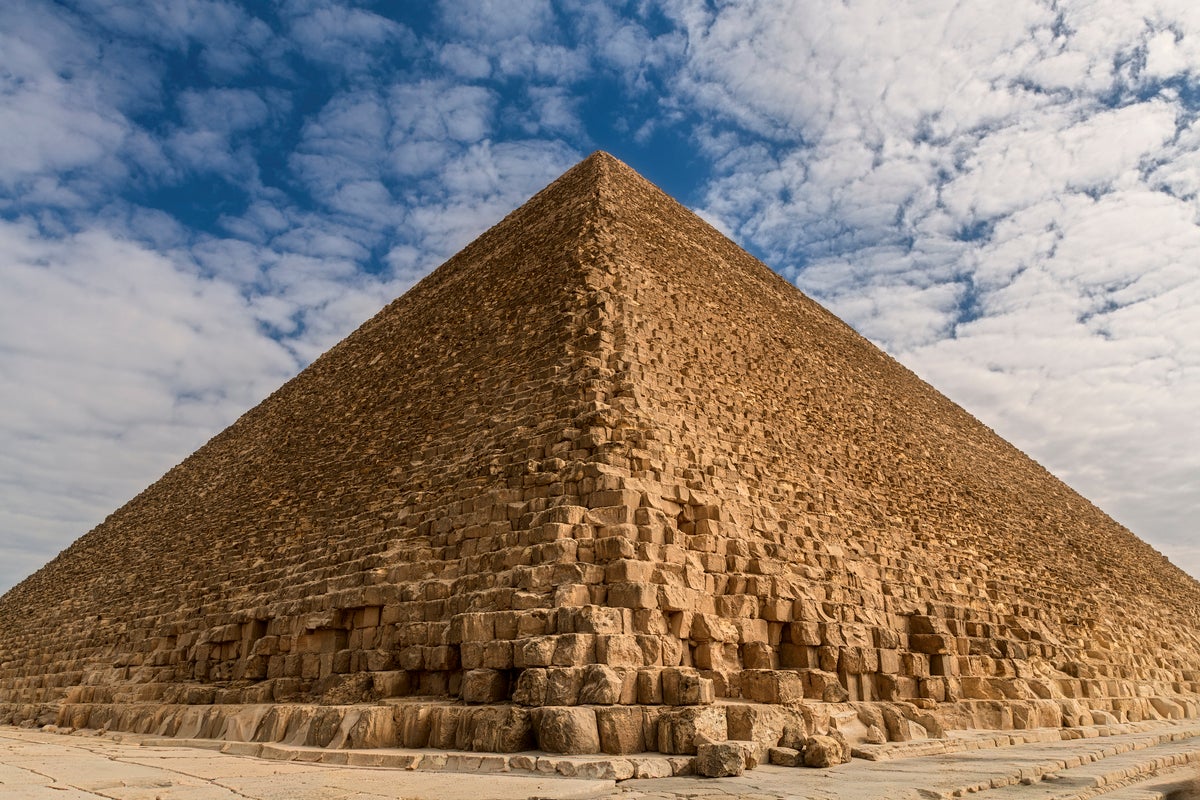
The Great Pyramid of Giza.
Nicola Micheletti/Getty Images
The Great Pyramid of Giza, also known as the Khufu pyramid, is among the most famous wonders of the ancient world. It is also a wonder that the structure is still standing—given that it was erected some 4,600 years ago and has had to withstand significant weathering and seismic activity over that time, including earthquakes in 1847 and 1992. Why the pyramid could withstand such trauma hasn’t been fully understood, but now scientists are beginning to unearth some answers.
In a new study published on Thursday in Scientific Reports, researchers took dozens of measurements from inside the Khufu pyramid to characterize its “fundamental frequency,” a measure that can inform how a building might respond during an earthquake.
You can think of a building’s fundamental, or natural, frequency like the sway of a swing, says Mohamed ElGabry, the study’s lead author and a professor at Egypt’s National Research Institute of Astronomy and Geophysics. It might take a lot of force to move the swing from a still position. But at a certain point, even just a small push to a moving swing can send it flying. A similar effect happens in structures: a building’s natural sway affects how it responds during “pushes”—or earthquakes. If a structure has the same frequency as the ground below it, that can amplify the effects of an earthquake, he says.
On supporting science journalism
If you’re enjoying this article, consider supporting our award-winning journalism by subscribing. By purchasing a subscription you are helping to ensure the future of impactful stories about the discoveries and ideas shaping our world today.
That’s not the case for the Khufu pyramid, ElGabry and his colleagues found. They discovered that most of the structure has around the same frequency, an average of about 2.3 hertz (Hz). That’s much higher than the ground’s frequency of about 0.6 Hz.

Field measurements are taken in the Relieving Chambers of the Great Pyramid. The inscription visible on the lefthand side commemorates the discovery of the top four chambers by Western archaeologists in 1837.
Today engineers often make similar measurements to assess the earthquake safety of buildings. But the new findings are “very important,” ElGabry says, because nobody had made such measurements for the Great Pyramid before.
In this case, the Khufu pyramid’s natural frequency, aided by “pressure-relieving chambers” within the pyramid, appear to have protected it from earthquakes for thousands of years. It was also built on a limestone plateau, “a very strong and massive stone,” which helps the pyramid resist damage from earthquakes, ElGabry says.
“I was not surprised, but I was impressed,” he adds.

A diagram of the inside structure of the Great Pyramid.
There is no indication, however, that the ancient Egyptians who built the pyramid were aware of these dynamics. “It doesn’t mean they knew, at that time, all the physics we know today. For sure they didn’t,” ElGabry says.
But if you look at the design of the pyramids of Giza, as well as other ancient structures such as the Bent Pyramid—which, as its name suggests, has a “bend” in its shape—in the Egyptian site of Dahshur and the stacked rectangular prism construction of the Step Pyramid of Djoser, it’s clear that ancient pyramid builders were “learning by doing,” ElGabry says, adapting to their surrounding environment and using the resources they had on hand to build structures that would be as strong as possible.
“They used it very wisely to build in a very efficient way that survived,” he says.
It’s Time to Stand Up for Science
If you enjoyed this article, I’d like to ask for your support. Scientific American has served as an advocate for science and industry for 180 years, and right now may be the most critical moment in that two-century history.
I’ve been a Scientific American subscriber since I was 12 years old, and it helped shape the way I look at the world. SciAm always educates and delights me, and inspires a sense of awe for our vast, beautiful universe. I hope it does that for you, too.
If you subscribe to Scientific American, you help ensure that our coverage is centered on meaningful research and discovery; that we have the resources to report on the decisions that threaten labs across the U.S.; and that we support both budding and working scientists at a time when the value of science itself too often goes unrecognized.
In return, you get essential news, captivating podcasts, brilliant infographics, can’t-miss newsletters, must-watch videos, challenging games, and the science world’s best writing and reporting. You can even gift someone a subscription.
There has never been a more important time for us to stand up and show why science matters. I hope you’ll support us in that mission.