


Something I’ve repeatedly complained about with smart TVs is how outdated their ports are, even if you’ve paid thousands of dollars for an RGB or OLED set. You’ll often find HDMI 2.0 and 2.1 ports sitting next to each other, despite 2.1 being virtually mandatory for modern laptops and consoles. Ethernet ports, meanwhile, may be stuck at 100Mbps, even though gigabit technology has been available since 1999. That’s right — there are adults with kids and careers who’ve lived their entire lives in a world where gigabit is the norm.
After the persistence of HDMI 2.0, the worst debacle has to be the state of USB ports. You might not have thought much about it, but your TV isn’t nearly as well-equipped as it should be, and it’s holding both you and the industry back. If you’re not already onboard, you’ll see what I mean in a minute.
What’s wrong with USB on your TV?
State of the art for 20 years ago

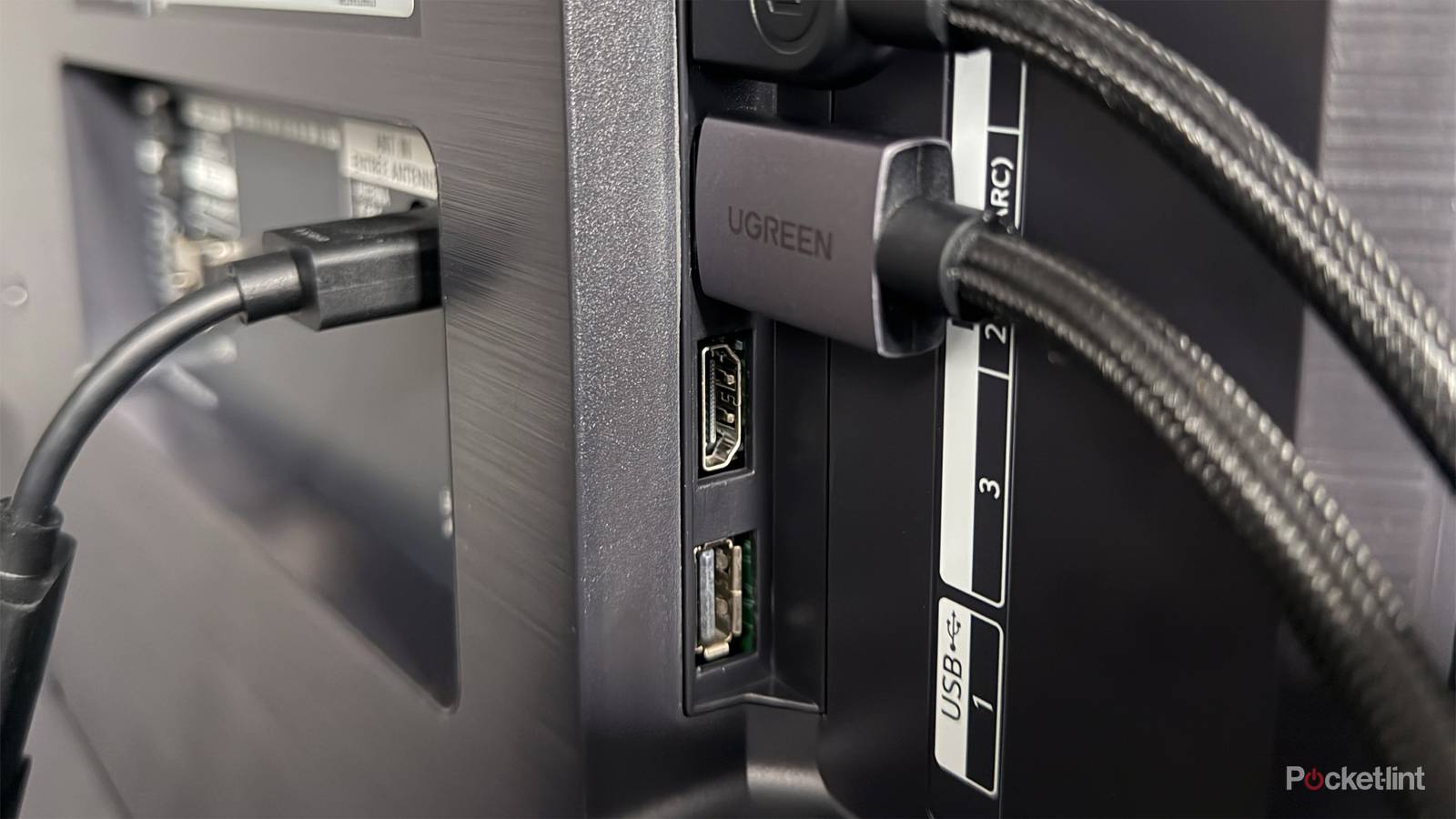
Some of you might be thinking that the quantity of USB ports on TVs is one of my complaints, but not really. Simply including a couple of them makes a TV more flexible, and a few TVs have more than that, as you can tell from the picture above. In fact, I can’t really think of a circumstance in which I needed more than one USB port at a time. Chances are, if I’m powering a streaming dongle, I don’t need a movie drive plugged in simultaneously.
Really, the focus of my rage is performance, leading with data speeds. Most TVs don’t manage anything faster than USB 3.0, which tops out at 5Gbps (gigabits per second). That’s fine if you’re trying to play 4K movies from an attached SSD, but not much else. On many TVs, you’re still going to encounter USB 2.0, which dates back to the year 2000 and is capped at 480Mbps (megabits per second). Imagine if you bought a new speaker system and discovered that it was limited to Dolby Pro Logic II, another standard that’s just as old. You’d be upset at missing Dolby Atmos, and rightly so.
TV makers simply haven’t kept pace with available tech on most of their models. USB 3.1 emerged in 2013, and USB 4 in 2019. The latter supports speeds of at least 40Gbps, and up to 120Gbps if you’re lucky to have USB 4 v2. You can actually run an external graphics card over a v2 connection.
All this should make you mad as well, because having that amount of bandwidth standard across TVs would radically change things. Mainly I’m thinking of DisplayPort Alt Mode, which lets you pump video directly over USB. Imagine being able to (reliably) connect a phone, tablet, or laptop to your TV using the same cable you use for charging — not only skipping an HDMI adapter, but probably getting better visuals in the process. This would be extremely convenient for handhelds like the Steam Deck or Switch 2, which normally depend on docks to bridge with TVs.
You’d think it would be trivial to apply USB-C across the board on TVs, given that there’s no requirement that the connector type be matched by fast speeds.
Really, it’s the possibilities that haven’t been explored yet that excite me. Imagine, for instance, an add-on that could radically upgrade your TV’s capabilities, for instance letting you play advanced 3D games without having to buy a complete console. Heck, I’d be happy if I could treat every TV as a Thunderbolt dock when I can’t (or don’t) want to work at a desk. Somehow, there are still barriers that prevent most people from treating a 4K TV as a monitor replacement.
Another thing hampering your TV’s potential is power output. USB 3.0 can’t deliver any more than 7.5W at best, which is barely enough for a media streamer. Conversely, USB-C ports that support the USB PD 3.1 spec can potentially supply as much as 240W. There’s no reason your TV couldn’t be transformed into a charging station for all your phones, tablets, and laptops. Combined with USB 4’s bandwidth, it might be possible to run a laptop workstation on your TV through a single cable — but at the moment, you’re out of luck.
The icing on the cake is that most TVs still rely on USB-A connectors, not USB-C. That may once again force you to buy adapter cables, since as you know, USB-C is increasingly de facto on every other tech product. Even Apple is finally using USB-C on all its iPhones, having stubbornly clung to Lightning between 2012 and 2023. You’d think it would be trivial to apply USB-C across the board on TVs, given that there’s no requirement that the connector type be matched by fast speeds.
Why are we stuck with this situation, and when will things change?
Don’t get your hopes up, brother

The main reason we’re in this mess is profit margins. Over the decades, TVs have become increasingly commodified, meaning that they’re frequently interchangeable in the eyes of customers. That pushes prices down, so to keep up their profits, manufacturers cut corners wherever they feel they can get away with it. The cost of a 5Gbps USB-C port might not be much on its own, but scaled to millions of units, it’s enough of a hit that dumping 480Mbps USB-A on customers has obvious appeal.
We’ve also been conditioned to expect relatively little from our TVs. That might sound crazy to those of you who remember the pre-HD era, but our imaginary link to that era is part of the problem. You probably still think of your TV as a dumb window into your media, whereas it’s actually a full-fledged computer, with a processor handling functions like an OS, apps, image processing, and decoding audio. Because the “dumb window” framework is acceptable in our minds, we don’t demand anything better, and TV makers are happy to oblige.
By 2030, any TV that’s still equipped with USB-A is either going to be a budget model or feel like a slap in the face.
Is there any chance of a dramatic course correction? Not anytime soon, but USB-C is slowly beginning to filter onto TVs, and I would expect the pace of adoption to accelerate in the next few years. USB-A is so conspicuously outdated that its inclusion already feels like an insult. By 2030, any TV that’s still equipped with it is either going to be a budget model or feel like a slap in the face.
That shift might be the dambreaker. Once a company’s made the leap to USB-C, it’s not such a big reach to offer 5Gbps data, or increased power delivery either. Once customers have a taste of that — and economies of scale help — it’s not too hard to imagine premium TVs gaining USB 4, and the tech slowly filtering down from there. It’s just frustrating that I might have to wait until 2036 to get it on my TV, whereas just about any PC I buy today will have at least one USB 4 connection. By 2036, I’ll probably be using USB 5 somewhere.

- Display Size
-
42, 48, 55, 65, 77, or 83 inches
- Operating System
-
webOS
- Display Type
-
OLED
- Display Resolution
-
4K (2160p)