



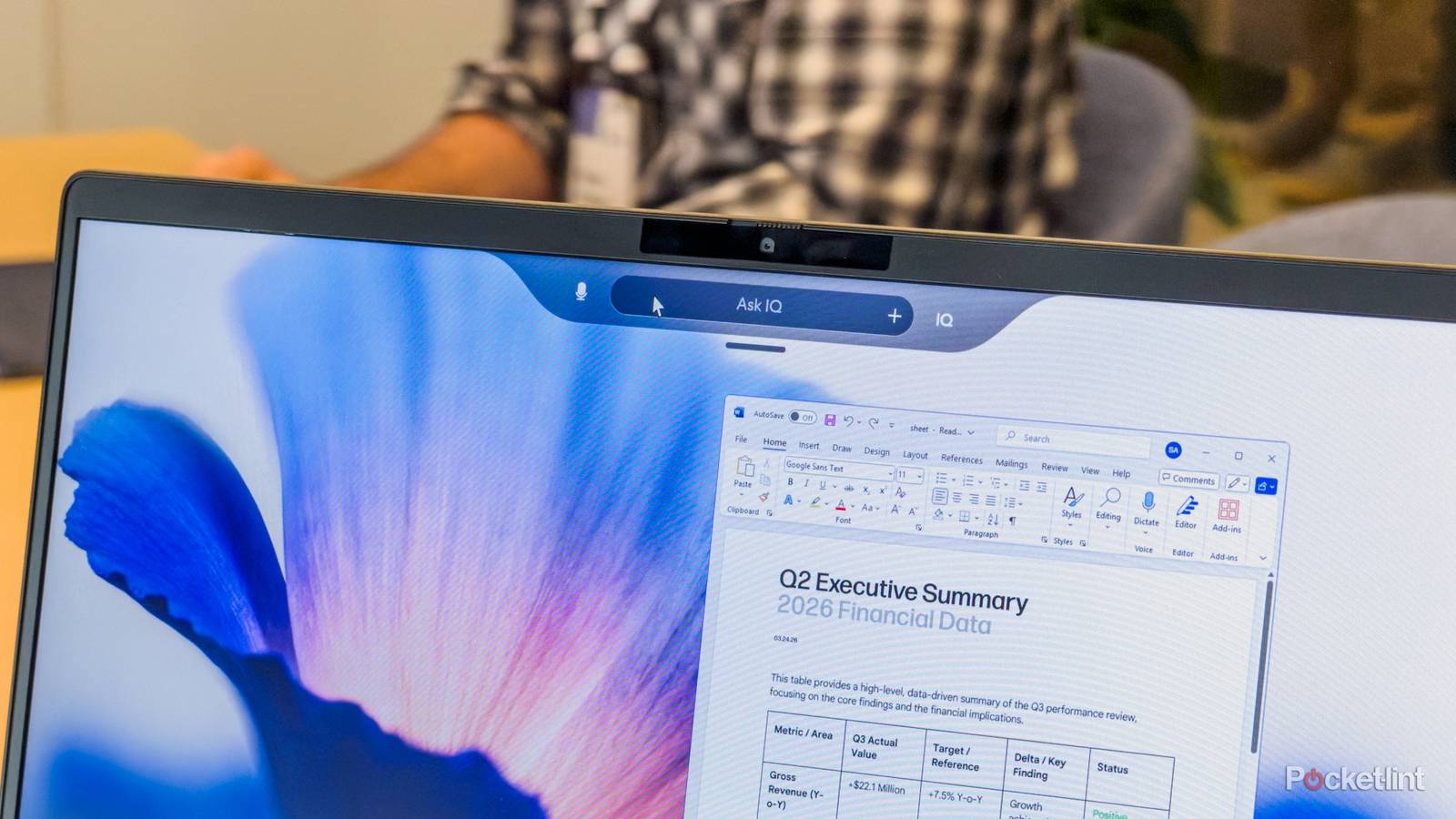
HP IQ is probably not what most people expected the first proper post-Humane product from HP to look like. After HP acquired key parts of Humane, including its Cosmos platform, IP, and parts of its team, it would have been easy to assume the company was going to try and salvage some version of the AI Pin’s original vision. Instead, HP IQ is something much more grounded.
What is HP IQ?

This isn’t a new AI wearable, nor is it trying to replace your phone; this is HP’s attempt to build an on-device AI layer for work, and while that makes it less ambitious than what Humane originally intended to do, it also makes it much easier to understand.
Having followed Humane since 2018, I’ve always believed that, as flawed as Humane’s execution was with the AI Pin, the company was looking to solve a real problem. The way we currently interact with computers, and most recently, AI systems, still feels awkward, and is largely confined to a chat interface. Humane tried to solve that by creating an entirely new kind of device, but it appears HP is taking a very different route by putting the AI on devices they already make.
At its core, HP IQ is a workplace intelligence layer that runs across select HP AI PCs and other workplace devices. The foundation is a local 20-billion-parameter model built on OpenAI’s GPT-OSS, with specialized tools and an orchestrator that decides how tasks should be handled. Some tasks can still be routed to the cloud, but HP is positioning the experience as local-first, which matters for enterprise use for both security and speed.
What does it do?

The current set of features are useful, but they aren’t necessarily groundbreaking. Ask IQ lets you use text or voice to ask contextual questions, while Analyze can look through personal files like PDFs, Word documents, PowerPoints, and text to summarize information or pull out insights.
Notes & Knowledge keeps a record of your interactions so you can search through them and pick up where you left off, and Meeting Agent can help capture ideas and notes during meetings without forcing you to constantly switch between apps.
These are all features I can see being helpful in a workday, especially because they are integrated into the PC rather than living as another tab in a browser or another standalone app, but the issue is that they are still fairly basic in what they currently enable. Document analysis, meeting notes, and contextual prompts are useful, but they are also the kinds of features that have quickly become the bare minimum for any AI productivity suite.
HP IQ feels like it’s playing things safe in this first version, which is understandable for an enterprise product, but also means it does not yet carry the ambition that made Humane’s original pitch so compelling.
The main interface for the whole feature suite is called the Visor, and this is where HP IQ starts to feel closer to the original Humane lineage, even if the product itself is completely different. The Visor is meant to surface relevant controls and actions when you need them, rather than making you go find a separate AI tool.

The intuition for the Visor feels quite obvious, but I think this is the actual interface problem most AI products still have; we have models that are getting better, but the experience around using them is still fragmented, and this is the first type of interface that attempts to solve it. That isn’t to say HP IQ is solving that problem in some radical new way yet, but it is at least approaching it from the right direction.
HP NearSense is the other major part of the experience. It is HP’s proximity-based connectivity system, designed to make nearby devices work together more easily, adjacent to something like Apple’s Continuity features, but for the workplace. On supported HP AI PCs, that includes dragging and dropping files to nearby colleagues, joining conference room meetings with a single click, and eventually connecting more naturally to Android devices, Poly video bars, printers, displays, peripherals, and other HP hardware.

My early verdict

A lot of what HP IQ brings together has already existed in some form. Nearby file sharing immediately brings to mind AirDrop and Quick Share, while meeting transcription and document summarization are already common across tools like Microsoft Teams, Zoom, and countless AI productivity apps.
Even the broader idea of a contextual assistant on a PC is something Microsoft, Google, and others are all actively moving toward. HP IQ doesn’t really break new ground through any single feature. What makes it more interesting is how HP is trying to pull these familiar pieces into a local, device-aware system that sits closer to the hardware. That is both the strength and limitation of HP IQ right now.
Compared to Humane’s original vision, this is far less radical. It doesn’t carry the same sense that HP is trying to define a new consumer computing paradigm or interface, nor does it have the same sci-fi possibility that made the AI Pin compelling before the product was undelivered.
Like most AI-driven software we’ve seen over the past couple of years, HP IQ still needs to prove that it can become something people rely on consistently rather than a collection of features they try once and forget about. The individual tools are useful, but usefulness alone is not enough to make an AI layer feel essential.
What HP IQ could enable, though, is the normalization of edge-driven AI in the workplace; a version of AI that is not entirely dependent on sending everything to the cloud, and one that can operate within the security, privacy, and manageability expectations of enterprise environments. That may not be as exciting as Humane’s original vision, but it is probably a more realistic place to start. As a first entry, HP IQ is not especially groundbreaking, but I still think it is directionally interesting. The real question is whether HP can build on this foundation with features that feel less like familiar AI utilities and more like a genuinely new way to work across devices.