



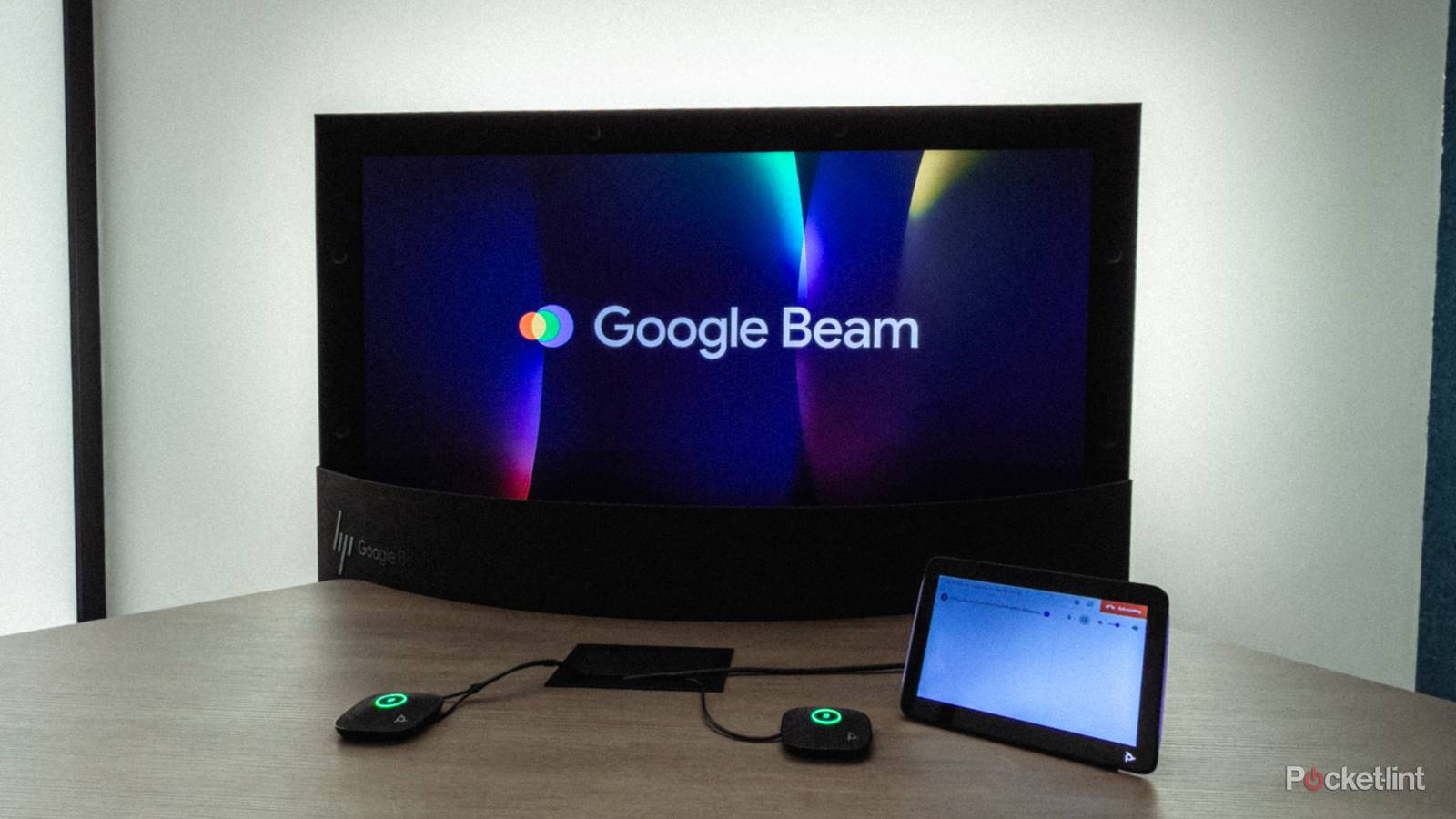
I have gotten to experience a lot of interesting tech over the past couple years, but HP’s Dimension with Google Beam is one of the only demos I have seen that made me feel like we are living in the future.
What is HP Dimension?
HP Dimension with Google Beam, formerly known as Google’s Project Starline, which is a 3D video communication system built for enterprise collaboration. The system uses a 3D light field display, six-camera capture, spatial audio, adaptive lighting, and AI to create a more lifelike version of the person on the other side of the call, without requiring a headset, glasses, or any wearable.
After trying it with an HP representative, I think HP and Google are much closer to giving us something straight out of the movies.
What is a call like?
When you first join a call, the person on the other side does not just appear as a flat video feed; it more so resembles a 3D video capture of them sitting across from you, adjacent to something like Apple’s spatial videos or 3D movies in theaters, but without the glasses.
There is a sense of depth, scale, and presence that makes it feel like they are sitting a couple feet away from you at the table. Eye contact also feels more natural than it does on a regular video call, where instead of you having to choose between looking at the camera or looking at the screen, there’s a feeling that you’re genuinely making eye contact with the person across from you.
The best comparison I can make is FaceTime on Apple Vision Pro, but without having the headset on. Apple’s spatial Persona calls already give you a version of this idea, where the person you are speaking with feels like they exist in your space rather than inside a window.

Google Beam induces a similar feeling, except the hardware disappears more naturally because you are just sitting at a table. There is no headset, or any additional hardware than the screen itself along with the microphone and speakers, and no sense that you are entering a separate virtual environment. You simply sit down and talk.
The experience becomes even stranger when objects are introduced into the scene. Seeing a person is impressive, but seeing them hold up an object with depth makes the system feel far more convincing. It creates this odd instinct where your brain briefly believes you could reach forward and grab it. The illusion is not perfect, but it says a lot about how different this feels from a traditional video call.
Convincing but not perfect
That said, video quality itself still has room to improve. There were moments where the image did not look as sharp or clean as I would want from something this expensive, and because the whole experience depends on realism, any visual softness becomes easier to notice.

This is clearly not a product for most people. HP says it will be available to select customers for $24,999, with the Google Beam license sold separately, which places it firmly for enterprise customers and not regular consumers. However, for companies with distributed teams, high-value client conversations, executive meetings, or remote design reviews,
I don’t think HP Dimension with Google Beam replaces in-person meetings, and it probably should not be framed that way, but what it does is make the gap between virtual and physical interaction feel smaller than anything else I have tried. The technology still needs to improve, especially around image quality and broader accessibility, but the core experience is already compelling.