

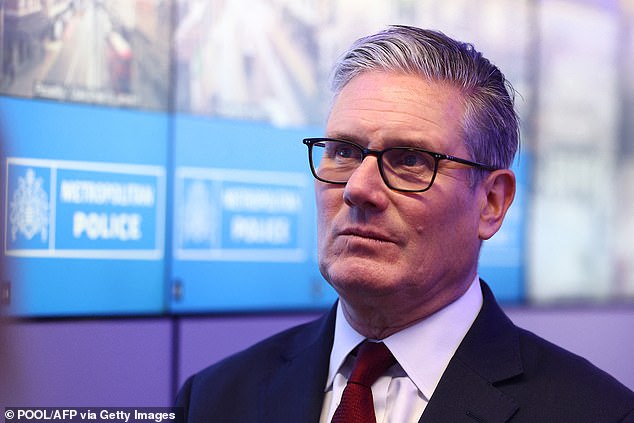
Sir Keir Starmer’s Government was today accused of covering up failures in the Peter Mandelson scandal and putting the UK’s national security at risk by Parliament’s own intelligence watchdog.
The beleaguered Prime Minister, already reeling from a week that has seen his premiership put on life support, received a stinging rebuke from Parliament’s powerful Intelligence and Security Committee (ISC).
The committee, which has statutory responsibility for oversight of the UK Intelligence Community, blasted the Government for withholding key files – including Mandelson’s controversial vetting papers – and redacting important details ahead of the expected release next week of another cache of documents on the shamed peer’s appointment as US ambassador.
Today, the watchdog published a letter condemning a series of ‘appalling’ security blunders by the Government, highlighting how ministers regularly formulate government policy over WhatsApp, use insufficiently secure IT systems and fail to keep audit trails.
As the Prime Minister continues to fight for his survival in the face of growing revolts on all sides, including over his handling of the scandal, the ISC said it was ‘gravely concerned’, adding: ‘This failure to adhere to professional practices is appalling and puts the UK’s national security at risk.’
In an intriguing twist, within minutes of the press release being issued by the committee, the document was suddenly taken down from the website in a move widely interpreted as an attempt at damage limitation. After the Government had ‘sought clarity’, it was republished hours later.

The beleaguered Prime Minister, already reeling from a week that has seen his premiership put on life support, received a stinging rebuke from the Intelligence and Security Committee

The committee blasted the Government for withholding key files – including Peter Mandelson’s controversial vetting papers
In February, the Tories and other opposition MPs won the release of a huge tranche of documents connected with Mandelson’s appointment, including private messages between the peer and senior ministers and their advisers.
The ISC was tasked with reviewing the Government’s redactions to those documents on national security grounds ahead of the release next week.
But the influential cross-party committee chaired by Lord Beamish, a Labour peer and former shadow defence minister, has criticised the Government for hiding key information.
In its scrutiny of 337 documents handed over so far, the ISC concluded redactions on non-security grounds were ‘being applied far too broadly’ and accused ministers of withholding documents despite not having ‘the authority to do so’.
Astonishingly, the missing documents include the critical vetting file on the Labour grandee which was compiled by the UK Security Vetting (UKSV) – part of the Cabinet Office responsible for conducting in-depth vetting.
It emerged last month that the UKSV advised against granting Mandelson the Developed Vetting necessary for his appointment, but the Foreign Office went against the advice and cleared him for the role.
The watchdog also highlighted a ‘lack of proper records on discussions and decisions’ by Sir Keir’s administration, saying: ‘The lack of an audit trail – in terms of agendas, minutes and records of conversations, in the FCDO in particular – do not appear to be kept as a matter of practice. This is unacceptable in Government.’
Alex Burghart MP, Shadow Chancellor of the Duchy of Lancaster, said: ‘It is outrageous that Labour are trying to withhold documents about the Mandelson-Epstein affair from Parliament.
‘Throughout this process Starmer and his ministers have sought to pull the wool over the public and Parliament’s eyes. They only started releasing information because the Conservatives forced them to, and even now they are continuing the cover up.
‘Labour have also breached the measured and sensible guidance issued by the last Conservative government on the use of WhatsApp by ministers, putting national security at risk in the process.
‘Starmer promised transparency in Government. He must come clean with the full facts about Mandelson’s vetting. Nothing short of that will suffice.’
In the letter, the ISC took aim at the lax attitude to national security in Number 10.
It said: ‘The Committee found it extraordinary to see how much Government business appears to be being conducted over unofficial systems. Lengthy WhatsApp conversations between senior officials and ministers appear now to be the format by which Government policy is formulated.
‘Government systems exist for a reason and should be the proper forum for the conduct of Government business. The Committee has raised this issue before – with the last Government – and it is disappointing to see not only that it continues, but the extent to which it has spread.’
In other instances, policy discussions have taken place on insufficiently secure networks, the ISC said: ‘Many exchanges have clearly been conducted on lower-level Government IT systems when they should more properly have been held on the more secure IT systems that exist.’

As well as criticising the Government’s lax attitude to security, the ISC letter also hit out at their choice to ignore MI5’s advice about Mandelson’s appointment (Pictured with Jeffrey Epstein)
Committee members were also scornful of the decision to ignore advice by MI5 and the UKSV about Mandelson’s appointment.
The watchdog said: ‘Where advice is sought and obtained by those organisations whose job it is to ensure security, for that advice to be overruled to suit some other objective is not acceptable.
‘Proper security concerns cannot be dismissed simply because they are inconvenient.’
Now the body is calling on the Government to release more information including individuals’ personal data, email addresses and the identities of junior civil servants.
Liberal Democrat Leader Sir Ed Davey said: ‘This thing reeks. Why is the Government trying to cover up, again, the scale of the Mandelson mess? What could be worse than what we’ve already seen?
‘The Prime Minister must make use of what could be his last days in office to personally intervene and make sure we get the truth.’
A Cabinet Office spokesperson said: ‘The Government takes its obligations to Parliament and the protection of our national security extremely seriously.
‘We have been clear that the public deserve transparency and we are committed to complying with the Humble Address in full.
‘Redactions will only be made where necessary and in a way which is transparent to the House. We are working to publish as much material as we can, as soon as possible.’