


Researchers have identified a gigantic new species of long necked dinosaur in Thailand that is now considered the largest dinosaur ever discovered in Southeast Asia. The finding comes from a collaboration led by scientists from University College London (UCL), Mahasarakham University, Suranaree University of Technology, and Thailand’s Sirindhorn Museum.
The dinosaur was described in the journal Scientific Reports after researchers examined fossils first uncovered near the edge of a pond in northeastern Thailand about a decade ago.
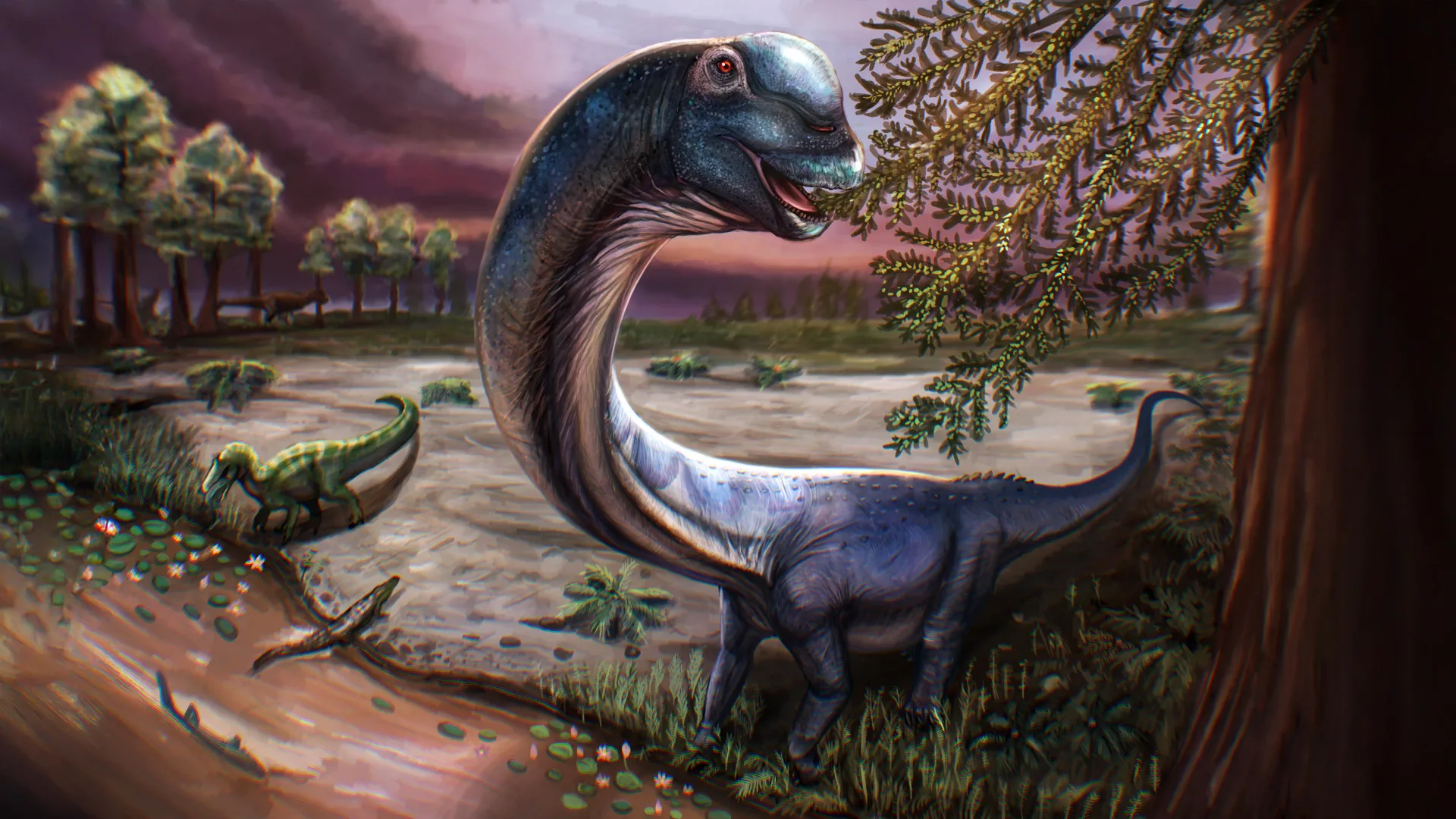
By studying vertebrae, ribs, pelvis bones, and leg bones, the team determined the enormous animal likely stretched around 27 meters (89 feet) long and weighed roughly 27 tonnes, which is comparable to nine adult Asian elephants. One front leg bone alone measured 1.78 meters long (as long as a human).
The newly identified species was named Nagatitan chaiyaphumensis. The name combines “Naga,” a legendary serpent from Thai and Southeast Asian mythology, with “Titan,” referencing the giants of Greek mythology. The species name honors Chaiyaphum province, where the fossils were found. It is the 14th dinosaur species officially named in Thailand.
A Giant Sauropod From the Early Cretaceous
Nagatitan belonged to the sauropods, the group of giant plant eating dinosaurs known for their long necks and tails. Famous sauropods include Diplodocus and Brontosaurus. This newly discovered dinosaur lived during the Early Cretaceous period between 100 and 120 million years ago.
Lead author Thitiwoot (Perth) Sethapanichsakul, a Thai PhD student at UCL Earth Sciences, said: “Our dinosaur is big by most people’s standards — it likely weighed at least 10 tonnes more than Dippy the Diplodocus (Diplodocus carnegii). However, it is still dwarfed by sauropods like Patagotitan (60 tonnes) or Ruyangosaurus (50 tonnes).
“We refer to Nagatitan as ‘the last titan’ of Thailand. That is because it was discovered in Thailand’s youngest dinosaur-bearing rock formation. Younger rocks laid down towards the end of the time of the dinosaurs are unlikely to contain dinosaur remains because the region by then had become a shallow sea. So this may be the last or most recent large sauropod we will find in Southeast Asia.”
Scientists believe the region during the Early Cretaceous was dry to semi dry, conditions that sauropods appear to have favored. Researchers think the animals may have used their long necks and tails to help release heat and regulate body temperature.
The fossil site also points to an ancient river environment filled with fish, freshwater sharks, and crocodiles.
Ancient Thailand Was Home to Predators and Flying Reptiles
The massive dinosaur likely shared its habitat with a variety of other prehistoric animals. Smaller plant eaters such as iguanodontians and early ceratopsians (relatives of Triceratops) lived in the area alongside giant predators including carcharodontosaurians and spinosaurids. Flying reptiles known as pterosaurs also hunted fish along the river system.
Researchers classified Nagatitan as a somphospondylan sauropod, a branch of sauropods that spread widely around 120 million years ago. More specifically, it belonged to a subgroup called Euhelopodidae, which is known only from Asia.
The dinosaur stands apart from related species because of several unique features found in its spine, pelvis, and leg bones. A life size reconstruction of Nagatitan is currently on display at the Thainosaur Museum at Asiatique in Bangkok.
Thailand’s Growing Dinosaur Research Scene
Sethapanichsakul said: “My dream is to continue pushing to get Southeast Asian dinosaurs recognized internationally. More international collaborations between Thailand and other institutions like UCL can further our understanding of the region’s paleobiology and apply it to a global context. This all starts with identifying and describing the specimens we have found first. We have a large collection of sauropod fossils that have not yet been formally described — these may include a number of new species.
“I’ve always been a dinosaur kid. This study doesn’t just establish a new species but also fulfills a childhood promise of naming a dinosaur.”
Co-author Professor Paul Upchurch of UCL Earth Sciences said: “This discovery comes out of a new collaboration between UCL and colleagues in Thailand. The material was studied both in Thailand and at UCL — 3D scanning and printing has meant that we can study the specimen and collect data without having to travel (good for reducing carbon footprint).
“We have had a long-standing interest in the evolution of these gigantic plant eaters and have good collaborative links with researchers around the world. It is great to work with Thai colleagues and start to get insights into what was happening in Southeast Asia during the Jurassic and Cretaceous.”
UCL’s dinosaur evolution team includes five academics along with research fellows, postdoctoral researchers, and more than 10 PhD students. Several are focused specifically on dinosaur evolution, while others study vertebrates such as crocodiles and birds.
Project leader and National Geographic Explorer Dr. Sita Manitkoon, a researcher at the Palaeontological Research and Education Centre at Mahasarakham University, said: “Although Thailand is a small country within Asia, we have a very high diversity in dinosaur fossils, possibly the third most abundant in Asia in terms of dinosaur remains. We’ve only really been studying dinosaurs in Thailand about 40 years (since the first dinosaur was named in 1986), and already we have a surge of younger generation paleontologists, who are actively undertaking research and promoting paleontology and its importance within the country.”
The research was funded by the National Geographic Society.