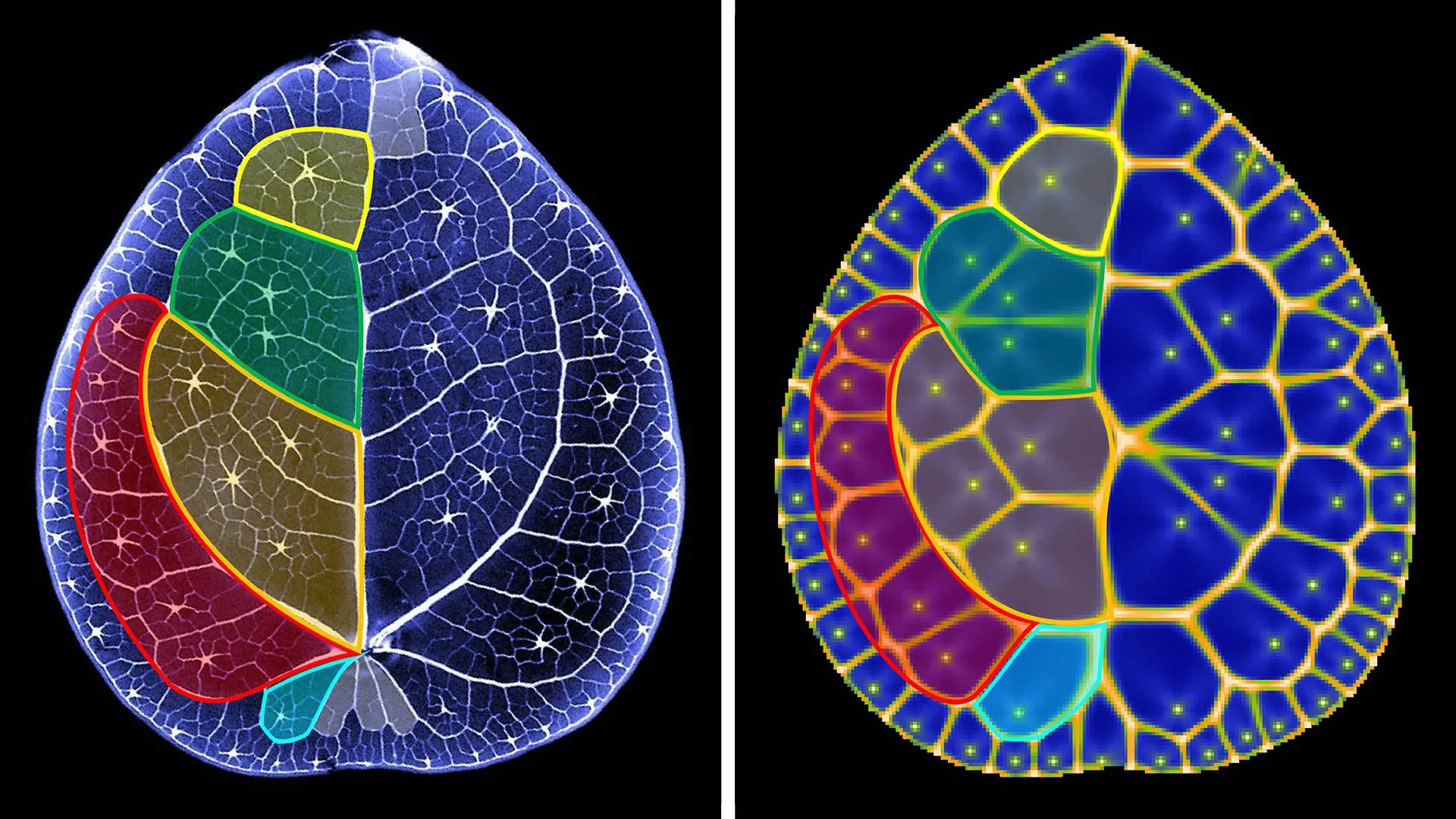
People often spot familiar shapes in random places. Maybe you have looked at the clouds and imagined a sailboat, a seahorse, or even your great-aunt Rosemary staring back at you. Scientists call this tendency to find meaningful patterns in randomness “apophenia.” But in some cases, those patterns are very real. Cold Spring Harbor Laboratory Associate Professor Saket Navlakha studies the hidden structures that appear throughout nature.
One of the best known examples of organized patterning is the Voronoi diagram, a geometric system that divides space into separate regions around central points. A simple example would be school districts. Each district (region) is arranged so students are always closest to the school (central point) assigned to them.
“Voronoi diagrams have been used for centuries in a variety of applications ranging from city planning to network design,” Navlakha says.
Patterns resembling Voronoi diagrams can often be seen in nature, including the markings on giraffes. However, these natural versions usually do not contain the obvious central points found in textbook examples. Navlakha and former graduate student Cici Zheng recently identified a rare exception in Pilea peperomioides, better known as the Chinese money plant.
Chinese Money Plant Reveals Hidden Mathematical Pattern
The Chinese money plant is a perennial species native to China’s Yunnan and Sichuan provinces. It is also a popular houseplant often given as a gift. Its circular leaves contain noticeable pores called hydathodes, which are surrounded by looping vein networks that move water and nutrients through the leaf.
After carefully mapping the pores and veins, Navlakha and Zheng found that the leaf structure naturally forms a Voronoi pattern.
To better understand how the pattern develops, the researchers partnered with Przemysław Prusinkiewicz, a scientist internationally recognized for his work on plant vein formation. Together, they identified the “natural algorithm” responsible for creating the looping veins around the pores in the leaves.
“Just as humans have to solve problems to survive, the same goes for other organisms,” says Zheng, now a postdoc at the Allen Institute. “But unlike humans, plants cannot explicitly measure distances! Instead, they rely on local biological interactions to achieve the same Voronoi solution.”
Hidden Algorithms in Nature
The discovery highlights how living organisms can create highly organized systems without conscious planning or measurement.
“We think of these algorithms in nature as an explanation for how organisms will behave and as a way to try to make sense of the world,” Navlakha says. “This example is a nice merger of classical geometry, modern plant biology, and computer science.”
Prusinkiewicz says the findings may finally answer a long-standing scientific mystery involving leaf vein formation.
“It’s remarkable how mathematical yet another aspect of plant form and patterning turns out to be,” Prusinkiewicz adds. “For decades, the question of how reticulate veins form has remained open, and finally we have a plausible answer” in Chinese money plants’ Voronoi patterns.
Navlakha and Zheng hope future studies of these patterns will reveal more about how plants solve complicated biological challenges. They believe the work could eventually help scientists better understand the mathematical principles that shape evolution, development, and life itself.