- A new poll was conducted after the Federal Budget
- One Nation was ahead of Labor in primary support
One Nation has topped Labor on its primary vote in the first public opinion poll released since the Federal Budget.
The Roy Morgan Snap SMS poll – conducted this week after the Albanese government confirmed major property tax changes – found Pauline Hanson’s party ahead of Labor on first preferences, 32 per cent to 28.5 per cent.
The Coalition was at 16.5 per cent, the Greens 11.5 per cent and independents and other parties 11.5 per cent.
It was too close to call on a two-party preferred basis – with Labor ahead 51 per cent to One Nation’s 49 per cent.
The poll was conducted via SMS on Wednesday and Thursday with an Australia-wide cross-section of 2,348 voters.
The snap poll also found 59 per cent of Australian voters disapproved of Albanese’s work as Prime Minister.
That majority was across both genders, every age group, and voters in all five mainland states.
The only exception was in Tasmania where 51 per cent approved of his work.

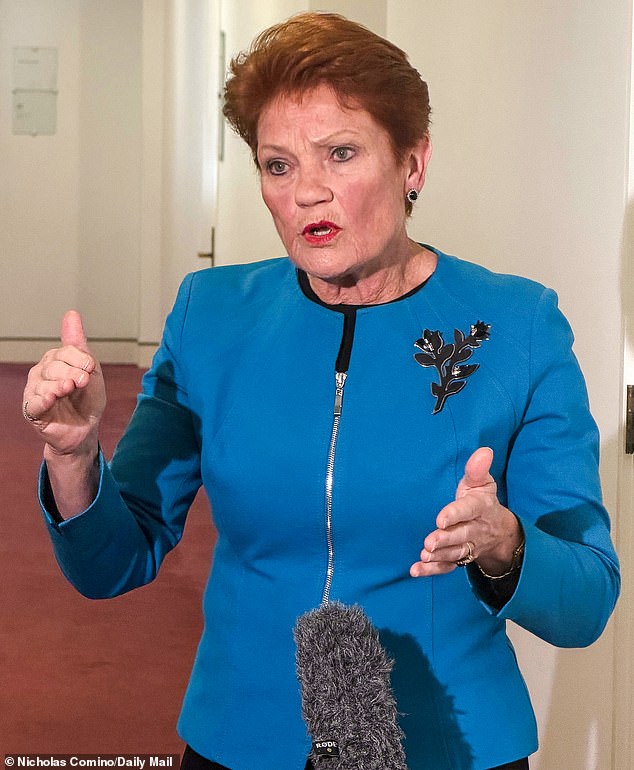
Pauline Hanson’s (above) One Nation beat Labor’s primary vote in the first public opinion poll since the Federal Budget
Aussies also had it out for Treasurer Jim Chalmers with a 57 per cent disapproval rate.
Negative gearing was scrapped on residential property in Chalmers’ Budget, except for new builds. The capital gains tax offset was also tweaked.
The poll results come as Senator Hanson outlined her economic agenda on Thursday, naming income-splitting between couples with children to reduce tax as her top priority.
It would allow single-income or uneven-income families to slash their overall tax bill at a time when most Australian parents must work.
‘Income splitting means those people who stay home with their children aren’t penalised,’ Hanson said.
‘Why should we force parents into a system where both have to work just to make ends meet?’
One Nation estimates a household with a single $120,000 income could be about $9,500 a year better off if taxed as two $60,000 earners.
Couples with more balanced incomes, like $120,000 and $30,000, would get a smaller benefit, around $2,000 annually.

The poll also recorded a 59 per cent disapproval rate of Anthony Albanese (above) as Prime Minister
Hanson said the measure would also cut reliance on government-funded childcare, encouraging more parental care at home.
‘Families, mums and dads want that time with their young children,’ she said.
‘Why shouldn’t we encourage that?’
Hanson did not comment on the potential cost of such an income-splitting policy to the Budget.