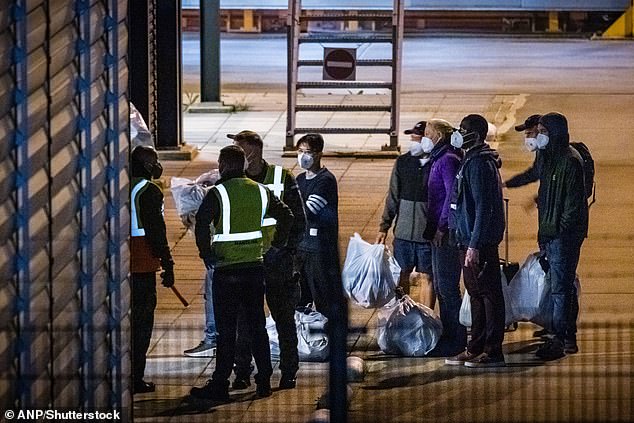
Australians potentially exposed to the deadly hantavirus will wear full PPE on a flight to Perth, where they will remain in a quarantine facility for at least three weeks.
There are 11 cases of hantavirus among the passengers and crew members who were on board the doomed Dutch cruise liner MV Hondius.
Three passengers – a Dutch couple and a German woman – have died from the virus.
Health Minister Mark Butler said six people, who will travel in full PPE, are in good health and have so far tested negative for the virus.
‘This is one of the strongest quarantine arrangements in response to this hantavirus outbreak (that) you will find anywhere in the world,’ he told reporters on Thursday.
‘Our agencies are, and certainly I am, monitoring this outbreak very closely.
‘The Department of Foreign Affairs and Trade (DFAT) has secured a suitable aircraft and crew to transport the four Australian citizens, the permanent resident and one New Zealand resident from the Netherlands to Australia.’
The plane is scheduled to leave the Netherlands about 5.30pm AEST on Thursday and land at RAAF Base Pearce, northeast of Perth, on Friday.

Six cruise passengers infected with hantavirus will be brought back to Australia on a flight to Perth while dressed in full PPE

Health Minister Mark Butler said the government has made necessary arrangements

There are 11 cases of hantavirus among the passengers and crew members who were on the Oceanwide Expeditions cruise
Butler outlined the ‘very strict conditions’ about the flight, which have been cleared and approved by the Centre for Disease Control (CDC) during a press conference.
‘Australians can have very high confidence that we are doing everything to ensure that this repatriation of those six passengers is undertaken completely safely,’ he said.
‘All passengers and all crew members will travel this flight for its duration in full Personal Protective Equipment (PPE).
‘Those passengers will be the subject of a quarantine order to remain at the Bullsbrook quarantine facility, one of the national resilience centres set up towards the end of the Covid pandemic.
‘The quarantine order remains in place for threw weeks but will be reviewed during those three weeks to determine what should take place for the remainder of the 42 day period of potential incubation that the World Health Organisation has advised.’
The six passengers will be spending their time in the 500-bed Centre for National Resilience in Bullsbrook, approximately 40km north-east of Perth.
Butler said specialist staff have been deployed from the Darwin-based National Critical Care and Trauma Response Centre to receive the group.
‘These are expert staff, well-experienced in infectious disease emergencies alongside a range of other emergencies that they serve the country for,’ he said.

Pictured, MV Hondius cruise passengers on a third evacuation flight from Tenerife arrive at an air base in The Netherlands on May 12

Six passengers repatriated to Australia will spend at least three weeks at an official isolation centre in Bullsbrook, northeast of Perth (Pictured, The Centre for National Resilience)
The health minister highlighted that Australia’s quarantine order is significantly harsher than measures taken by other countries following the repatriation flights.
‘Many countries that are repatriating passengers from this cruise ship – the United States, the UK, and others – are only subjecting their repatriated passengers to a managed quarantine arrangement at a hospital or at a centre like Bullsbrook usually for two or three days,’ he said.
The passengers are then expected to move into a home-based quarantine arrangement.
‘We have decided on a precautionary basis to take a stronger approach to that because our overriding priority is to keep the Australian community safe,’ Butler said.
Hantavirus, which can cause deadly lung damage and organ failure, is usually spread by rodents’ urine, droppings or saliva.
When the virus makes the jump from rodents to humans, which is rare, it is usually because viral spores have been inhaled.
It is believed that the first victim of the virus may have been infected at a landfill site on the outskirts of Ushuaia, Argentina, a birdwatching spot popular with tourists – and overrun with scavenging rodents.