

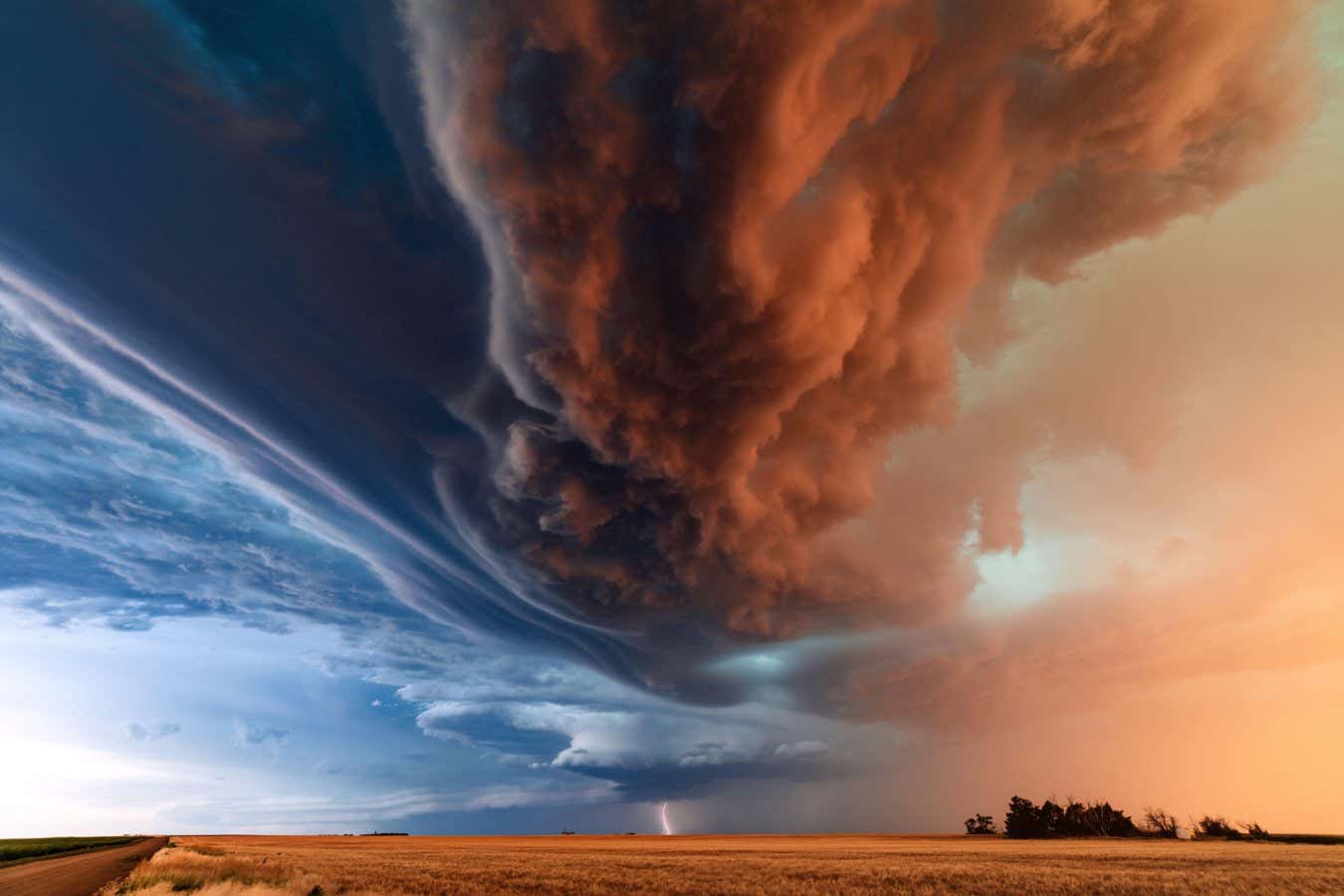

On a cold, windy night in November 2025, a quadcopter drone took off from a farm field at the foot of the Bannock mountain range north of Salt Lake City, rising 4000 metres into thick clouds. A fan with anti-icing propellers kicked into action, blowing yellow dust out of a cannister attached to the back of the drone. Cloud-seeding company Rainmaker was trying to fight dust with dust, spreading silver iodide powder to encourage precipitation and end the deadly dust storms plaguing Utah’s capital.
The Great Salt Lake, which is fed by snowmelt from the Bannock mountains and nearby ranges, has roughly halved in area since 2012. Wind blows toxic dust from the dried lakebed towards Salt Lake City, exposing millions of people to “forever chemicals” and heavy metals like arsenic. But cloud seeding “can refill the lake”, Rainmaker, which is contracted by the state, has promised on billboards.
Drought in the south-west US is symptomatic of an era of global water bankruptcy, with over 50 countries now collectively investing hundreds of millions of dollars in cloud-seeding technology. Yet the jury is still out on whether rainfall can be engineered in any meaningful way. “What we don’t know about cloud seeding is how effective it is,” says Kaveh Madani at the UN University Institute for Water, Environment and Health. “But when you’re desperate, it sounds very good.”
These realities may matter less than perceptions. The notion that humanity can control the weather is fuelling cross-border claims of water theft and spurring conspiracy theories about deadly flash floods. So, will cloud seeding replenish freshwater reserves, or merely distract from taking climate action?
Controlling clouds
We have dreamed of mastering the weather since ancient times, when, according to Greek mythology, Phaethon, the mortal son of the sun god Helios, took the reins of the sun chariot from his father. During the 1930s Dust Bowl, when severe dust storms raged across the American Great Plains, so-called pluviculturists – also known as rain wizards – promised to break droughts with vats of vaporous chemicals. But even when rain did come, a question always lingered: was it due to the rainmaking, or just a change in the weather?
An accidental discovery in 1946 revealed a potential scientific basis for rainmaking. Vincent Schaefer, a researcher at General Electric’s House of Magic laboratory in upstate New York, tried to cool down a freezer on a hot July day by dropping dry ice into it. To his surprise, the freezer filled with floating ice crystals as the blast of intense cold froze tiny water droplets suspended in the air. These supercooled droplets can remain liquid at temperatures as low as -35°C (-31°F).
Since many clouds contain supercooled droplets, the General Electric research team began dumping dry ice from aeroplanes. As water would condense onto the newly frozen droplets, they would gain mass and begin to descend, colliding with still more droplets. Eventually, they would get heavy enough to fall out of the cloud and reach the ground as snow, or melt into rain on the way down.

Vincent Schaefer (right) creates artificial clouds using dry ice at General Electric’s laboratory in upstate New York
Schenectady Museum/Hall of Electrical History Foundation/Corbis via Getty Images
That same year, Schaefer’s colleague Bernard Vonnegut discovered that silver iodide particles, which have a hexagonal structure that is similar to ice, could serve as seed crystals to “fool” droplets into “explosive ice growth” at warmer temperatures than dry ice, he wrote in his lab notes. The finding partly inspired Vonnegut’s brother Kurt to write his 1963 science-fiction novel Cat’s Cradle, in which the world is threatened by a substance called “ice-nine” that can freeze water on contact.
Seeing the battlefield potential of what the General Electric team described as “the control of weather”, the US military took over their research. The following year, the scientists attempted to redirect a hurricane by bombing it with dry ice. Unfortunately, the storm, which had passed over Florida and was heading out to sea, turned around and slammed into the coast a second time – although it’s unclear whether they bore any responsibility.
“
If China is redistributing water to the extent that it claims to be, it could spark conflict
“
Other countries, including China and the Soviet Union, started their own cloud-seeding programmes, with little accountability. “He who controls the weather will control the world,” soon-to-be US President Lyndon Johnson said in 1962.
But the exposure of the secret US cloud-seeding operation to bog down North Vietnamese military supplies on the Ho Chi Minh Trail caused public outrage and soured opinions in Congress. In 1977, the US and the USSR spearheaded an international ban on environmental modification for military purposes, and research funding began to decline. Ultimately, the US government abandoned cloud seeding because there was no convincing scientific proof that it actually worked.
Water bankruptcy
In more recent years, growing drought and shrinking rivers and aquifers have sparked a cloud-seeding renaissance. Due to global warming, urbanisation and agriculture, most regions are overdrawing their annual income of rainwater and snowmelt and beginning to run down their long-term savings of groundwater. Four billion people – almost half the people on Earth – face water shortages at least one month a year.
“We are seeing desertification, sand and dust storms. We are seeing declining groundwater tables. We are seeing sinkholes. We are seeing land subsidence. We are seeing shrinking lakes, rivers,” says Madani.

Utah’s Great Salt Lake drastically shrunk in area between 1985 and 2022
USGS/contains modified Copernicus Sentinel data (2022), processed by ESA
Consequently, weather-modification programmes have popped up on every continent except Antarctica. In Iran, where dried-up reservoirs and sputtering taps helped fuel protests last year, both the civilian authorities and the Islamic Revolutionary Guard have begun aircraft cloud-seeding campaigns in an attempt to break the five-year drought. Countries including India, Thailand and Saudi Arabia now conduct large-scale cloud seeding.
In these hot, dry regions, water droplets in clouds are often too warm to freeze on contact with silver iodide, so scientists disperse salt particles, which absorb moisture from the air, essentially building raindrops around themselves. As the downward pull of gravity overcomes the uplift of air currents, they begin to descend, bumping into and accumulating smaller droplets until they fall out as rain.
Small aircraft in the United Arab Emirates, which faces extreme water stress, fly hundreds of missions with salt flares under their wings each year. The country has also spent tens of millions of dollars on research. “Operational [cloud seeding] may not always work or work very well, but water is an emotional type of thing if you don’t have a lot of it,” says radar expert Roelof Bruintjes, who consulted the UAE programme.

An aeroplane releases salt flares during a cloud seeding mission over the United Arab Emirates
New York Times/Redux/eyevine
China, where water insecurity threatens more than 50 million people, has the world’s largest programme. It resembles not so much an experiment with cloud formations as a full-scale attack on them. Besides rockets and planes, it has deployed thousands of anti-aircraft guns and cannons to fire salt and silver iodide into the sky to try to boost irrigation and hydropower, rinse pollution from the air, prevent hailstorms and regrow melting glaciers. China claims its cloud-seeding operations extend over 5 million square kilometres, covering more than half of the country.
Since 2016, China has even been trying to divert water from the Indian monsoon to the cities and farms of the Yellow River basin, thousands of kilometres to the east. For this so-called Sky River project, it has installed hundreds of “burning chambers”, essentially remote-controlled chimneys that combust silver iodide, to intercept atmospheric rivers and precipitate their moisture into the headwaters of the basin.
To what extent do these ambitious cloud-seeding projects actually pay off? “What most people want to know when they ask that question is: can you produce enough precipitation… to have some impact towards the mitigation of drought?” says Jeffrey French at the University of Wyoming. “That’s a much more difficult question to answer.”
A variety of trials have claimed to increase precipitation by as much as 20 per cent. But because no two clouds are the same, there’s no control to determine whether precipitation is due to cloud seeding or natural variability. To get around that, researchers in Wyoming burned tanks of silver iodide on the ground underneath clouds passing over one mountain range, while leaving a nearby range untouched for comparison. They randomly selected which of the two ranges to seed and operated from 2007 to 2014 to try to account for annual fluctuations in snow. Underwhelmingly, precipitation increased by 1.5 per cent, which is statistically insignificant.
It was only in 2017 that French and his colleagues became the first to show without a doubt that cloud seeding can produce precipitation. The SNOWIE experiment dropped silver iodide flares from an aircraft on clouds over the Sawtooth mountains in Idaho. The aircraft deliberately flew north and south, perpendicular to the wind, so that the slowly falling flares formed a zigzag pattern as they were carried eastward by gusts.
About 30 minutes later, among the snow banks and pine trees, truck-mounted radar systems observed ice crystals forming in a similar pattern. “It pops up very much in this sort of zigzag fashion. And that’s just not something that naturally would ever happen,” says French. “Is it possible to alter the natural evolution of a cloud? I would say, definitively yes. We showed that.”
Although cloud seeding can generate precipitation, the amount varies hugely depending on the location, the season and atmospheric conditions, says Katja Friedrich at the University of Colorado Boulder, who led the SNOWIE study. Some clouds simply don’t contain enough moisture to produce rain.

China routinely fires rockets to try to engineer rainfall across large swathes of the country
Xinhua News Agency/eyevine
Yet cloud-seeding claims have led many to suspect that governments are playing God with water flows on a massive scale. If China is redistributing water to the extent that it claims to be – or if other countries suspect that it is – it could spark conflict, suggests James Fleming at Colby College in Maine, author of Fixing the Sky. Such far-reaching plans verge on the kind of global interventions against climate change known as geoengineering, like spraying tiny seawater droplets into clouds so they will reflect more sunlight away from the ocean. In India, officials have publicly claimed that China’s weather modification caused floods in states downriver of Tibet. In a similar vein, Iran has accused Israel and Turkey of “cloud stealing” precipitation that was on the way to Iran.
It might seem intuitive that if more rain falls on one place, less will fall on other places downwind. Rainfall isn’t a zero-sum game, however. Clouds often precipitate only a small percentage of their moisture, or they rain over the ocean. If anything, cloud seeding speeds up the natural water cycle, says Friedrich.
Conspiracy theories
Nonetheless, a 1996 US Air Force report on “owning the weather”, with techniques including cloud seeding, birthed the idea that aeroplane contrails are government “chemtrails” for weather or population control. This conspiracy theory, which isn’t backed by scientific evidence, is now supported by a third of the US population. In 2024, the UAE’s cloud-seeding programme was blamed by many for floods in Dubai, and rumours emerged that US President Joe Biden’s administration had caused hurricanes Helen and Milton to hit Donald Trump-supporting southern states through cloud seeding or other nefarious technologies.
Similar suspicions arose after social media users noticed that Rainmaker, contracted by the state, had been operating in a different part of Texas two days before extreme rainfall caused deadly flooding in Kerr county in 2025. Marjorie Taylor Greene, then a member of the US House of Representatives, held a congressional hearing and proposed a law against weather modification. Three states have banned “weather modification”, even though there is still no evidence cloud seeding can have large-scale impacts. “We can generate precipitation, but not to the degree of a flooding event,” says Friedrich.
Still, Rainmaker, whose founder Augustus Doricko was inspired by the SNOWIE experiment, claims it can make water-bankrupt regions solvent again. Doricko, who is also the company’s CEO, says that within six years, the company will have stopped the drying of the Great Salt Lake and potentially the Colorado river, too, a crucial source of water for Utah and six other states.
Already, Rainmaker has raised more than $31 million and has contracts with five states for cloud seeding. The idea is to use radar, satellites, weather balloons and artificial intelligence to identify pockets of supercooled water and then sell an exact quantity of precipitation to clients. “This is what is going to move cloud seeding forward and take it out of the land of ‘you’re a snake-oil salesman’ to ‘no, this is exactly what we did’,” says Kaitlyn Suski, Rainmaker’s head of research.

Cloud-seeding company Rainmaker claims its drones can stop Utah’s Great Salt Lake from drying up
Rainmaker
Other projects are also trying to find cheaper, more effective ways to engineer rain. In February, start-up Rain Enhancement Technologies said it boosted snowpack in a Utah mountain range by electrifying natural particles. Idaho Power is misting liquid propane fuel into clouds. Researchers in the UAE are firing lasers into them.
These efforts won’t get close to refilling large bodies of water, according to Friedrich, but it could help lessen the impacts of drought, especially by building snowpack that will melt gradually in spring and summer. “It’s not the Holy Grail that solves all the problems,” she says.
What’s more, cloud seeding might distract from simpler and more effective solutions. Over-consumption is the primary cause of water scarcity, such as the “use it or lose it” policy that encourages farmers to take their full allocation of Colorado river water. Restricting water can hurt agriculture and the economy, while other conservation measures, like repairing leaky infrastructure or switching from canals to drip irrigation, can be expensive. “That’s why they get crazy about cloud seeding,” says Madani. “Other solutions are very hard.”
Boosting water supply through techniques like cloud seeding may even increase consumption, an example of a phenomenon known as the Jevon’s paradox. For instance, when tunnels and canals doubled the flow in the Zayandeh-Rud river in Iran, water-hungry industries expanded, and farmers switched from livestock to peaches and almonds, leading again to scarcity and conflicts between regions. Without measures to limit demand, cloud seeding could become a “fix that backfires”, says Madani.
Fleming thinks we could learn a lesson here from Phaethon. When he attempts to drive his father’s sun chariot, he loses control of the horses and scorches the planet, forming the world’s deserts. The history of cloud seeding – from botched military operations to chemtrail conspiracy theories – echoes this legend about the perils of hubris, says Fleming. “This idea of the big lever, big fix, controlling the world’s weather… it’s fraught with a lot of unanswered questions.”
Topics: