

Defense Secretary Pete Hegseth tried to avoid giving a clear answer about the cost of the Iran war while appearing before lawmakers on Capitol Hill Tuesday morning.
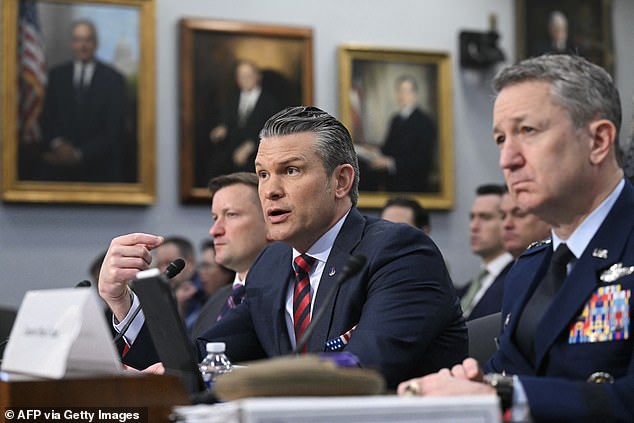
Hegseth appeared before the House Appropriations Committee on Tuesday morning to discuss the Pentagon’s budget, alongside Pentagon comptroller Jay Hurst and the chairman of the Joint Chiefs of Staff Dan ‘Razin’ Caine.
The Defense Secretary was probed by California Democrat Pete Aguilar to share more details about the budget, to which Hegseth said the Pentagon would ‘share what we can … when it’s relevant and required.’
Aguilar then responded that he believes, ‘this would be the format that would be required.’
Hurst told lawmakers that the estimated cost of the war had risen to $29 billion, up from the earlier $25 billion number he had presented to lawmakers while appearing on Capitol Hill at the end of April.
‘That’s because of updated repair and replacement of equipment costs, and also just general operational costs to keep people in theater,’ Hurst noted as justification.
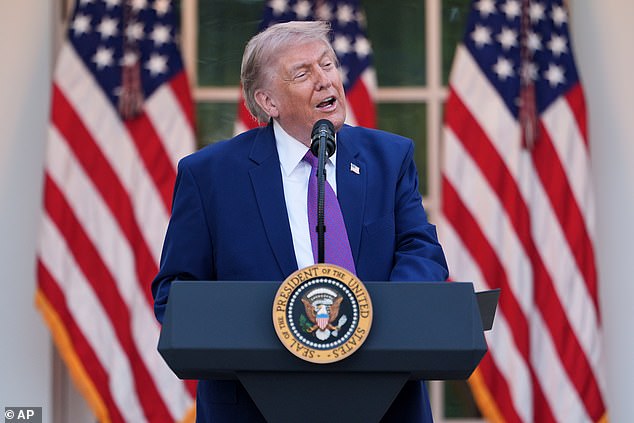
The Trump administration is under increased pressure to end the war in Iran as the midterm elections loom amid mounting frustration with Trump’s Iran war, with gas prices rocketing by more than 50 percent to a nationwide average of $4.52 per gallon.
Trump’s approval stands at 37 percent and 59 percent disapproval, the lowest reading of his presidency, according to a NPR/PBS News/Marist poll last week.

US Secretary of Defense Pete Hegseth (C) US Chairman of the Joint Chiefs of Staff General Dan Caine (R) testify during a House Committee on Appropriations, Subcommittee on Defense hearing to examine the 2027 budget for the Department of Defense on Capitol Hill in Washington, DC, on May 12, 2026

California Democrat Pete Aguilar questions Defense Secretary Pete Hegseth at a House Appropriations subcommittee budget hearing for the Department of Defense, Tuesday, May 12, 2026, in Washington, as Texas Democrat Henry Cuellar listens
During a hearing at the end of last month, Hegseth had a series of tense exchanges with top Democrats on Capitol Hill as he revealed the huge price tag for the Iran war.
He was grilled over the conflict, which has been going on for nearly 10 weeks, up from the previous estimate of 4 to 6 weeks for the conflict.
Hegseth faced questioning over the President’s claim that Iran’s nuclear facilities were totally ‘obliterated’ – despite citing the regime’s nuclear program as a reason to go to war.
Hegseth railed against the severe questioning by Democrats, who he claimed were ‘blinded’ by their ‘hatred toward Trump.’
He told top Democrat Adam Smith of Washington that Iran’s nuclear facilities were taken out by B2 bombers during Operation Midnight Hammer – the June 2025 attack by the US.
Given the administration’s earlier claims, Smith felt the need to question Trump’s reasoning for starting the Iran war seven months later in February.
‘We had to start this war… because the nuclear weapon was an imminent threat,’ said Smith.
‘Now you’re saying that it was completely obliterated?’ he probed.
Hegseth responded by saying that Iran ‘had not given up their nuclear ambitions and still had thousands of missiles.
Smith said the war ‘left us at exactly the same place we were before.’

Secretary of Defense Pete Hegseth testifies before a House Appropriations Subcommittee on Defense hearing on President Donald Trump’s FY2027 budget request for the Department of Defense, next to Chairman of the Joint Chiefs of Staff General Dan Caine and Under Secretary of Defense (Comptroller)/Chief Financial Officer Jules W Hurst

A detail of US Secretary of Defense Pete Hegseth’s socks are seen as he testifies during a House Committee on Appropriations, Subcommittee on Defense hearing to examine the 2027 budget for the Department of Defense on Capitol Hill in Washington, DC, on May 12, 2026
Hegseth has faced lawmakers twice since the Iran war began at the end of February, and is participating in a third hearing on Tuesday morning as well.
The series of hearings were set to discuss the Pentagon’s budget for the coming 2027 fiscal year.
The administration has prepared a 2027 military budget proposal, which would boost defense spending to a historic $1.5 trillion.