


Georgia residents were left outraged when they discovered a massive data center had been guzzling up nearly 30 million gallons of water without paying for it.
The issue began last year when residents in the affluent subdivision of Annelise Park in Fayetteville noticed their water pressure was unusually low, Politico reports.
When the county utility then investigated the problem, officials discovered that developer Quality Technology Services (QTS) had installed two industrial-scale water hookups to the approximately 6.2 million square foot data center campus – located about 20 miles south of downtown Atlanta.
One of the water connections appeared to have been installed without anyone at the water utility knowing, while the other was not linked to the company’s account – and it therefore was not being billed.
By May 15, 2025, the Fayette County Water System sent a letter to QTS, saying it owed nearly $150,000 for using more than 29 million gallons of water – the equivalent of 44 Olympic-size swimming pools, far exceeding the limit agreed to during the planning process.
QTS, which is owned by private equity firm Blackstone, eventually paid off the $147,474 debt and was not charged any extra fines.
But the company’s massive water usage only came to light last week when resident James Clifton obtained the 2025 letter to QTS from a public records request, and posted it to Facebook.
Meanwhile, the entire state of Georgia is experiencing moderate to high levels of drought. Governor Brian Kemp has even declared a state of emergency in response to one of the state’s worst wildfire outbreaks in years.

Developer Quality Technology Services installed two industrial-scale water hookups without officials at the Fayette County water authority’s knowledge

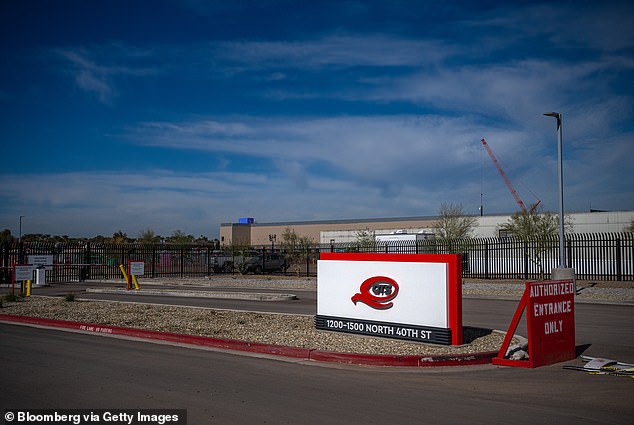
In May 2025, the Fayette County Water System sent a letter to QTS, saying it owed nearly $150,000 for using more than 29 million gallons of water at its data center (pictured) – the equivalent of 44 Olympic-size swimming pools
When residents were then told to scale back their own water usage, their frustrations with the data center reached a boiling point.
‘We get this notification from Fayette County water system saying you need to stop watering your lawns to help conserve water,’ said Clifton, a local attorney who is now running for county office.
‘So the first thing they do is lean on the individuals and the citizens to stop water consumption, when we have QTS that’s just absolutely draining us – most months it’s the number one consumer of water in the county.’
‘It’s just frustrating to see them come into our community and run all over us, like the citizens don’t matter, and then they’re above the law when they do break it,’ Clifton added as he railed against the fact that the water utility did not penalize or fine the data center.
He also shared on Facebook on Sunday that the data center – one of the largest in the country – has been watering its landscape ‘nearly continuously’ for four days.
Gregory Pierce, director of UCLA Water Resources Group, also said it is unusual that the water company did not fine the center for breaking the rules.
‘I don’t know exactly what’s happening here, but they probably don’t want to upset one of their new and largest customers,’ he posited.
Vanessa Tigert, the director of the Fayette County water system, seemed to acknowledge that was a consideration in her own remarks to Politico.
‘They’re our largest customer and we have to be partners,’ she said. ‘It’s called customer service.’

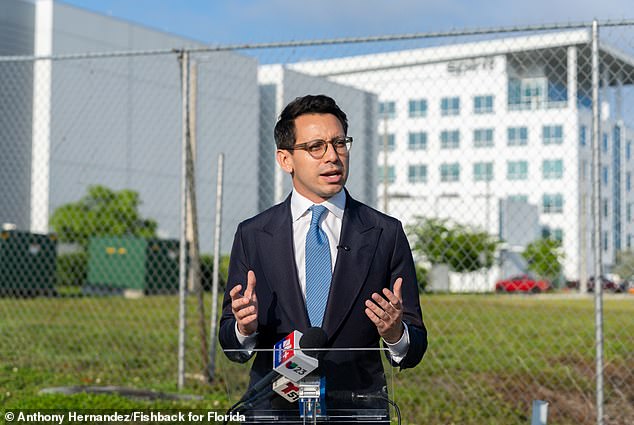
The water usage first came to light last week when James Clifton (pictured) obtained the letter through a public records request, and posted it to Facebook

He has since also accused the data center of continuing to water its landscaping amid a drought
She said the data center likely did not pay the water bills for about four months last year – but blamed the issue on a mix-up at the utility.
Tigert explained that the utility didn’t know about the water hookups because the connection process ‘got mixed up’ as the county transitioned to a cloud-based system, while also trying to accommodate a large industrial customer.
‘Fayette County is a suburb, it’s mostly residential and we don’t have much commercial meters in our system anyway,’ she said. ‘And so we didn’t realize our connection point wasn’t working.’
She also noted that her staff is small and at capacity.
‘Just like any water system, we don’t have enough staff. We can’t keep staff,’ Tigert said. ‘I’ve got one person that’s doing inspections and plan review, so he’s spread pretty thin.’
The water system director also claimed it was possible that her staff knew about the hookups, but she hadn’t been able to locate the inspection report.
‘I may have hit “send” too soon,’ she said of the 2025 letter to QTS about the nearly $150,000 debt.

The entire state of Georgia is experiencing moderate to high levels of drought. An urban park in the heart of Atlanta is pictured during a previous drought
A spokesperson for QTS also noted that the bills went unpaid while the county converted its system to smart meters and said the company has paid all of the retroactive charges.
The spokesperson said the water bill was likely unpaid for nine to 15 months, and claimed its water consumption was so high during that time period due to temporary construction-related activities, like laying concrete, dust control and site preparation as QTS works to add 16 more buildings to the site.
The project is expected to be completed in three to five years.
Once it is fully-operational, the company said the data center will only use water for domestic needs, such as bathrooms and kitchens – the equivalent of what four US households use each month – thanks to its ‘closed loop’ cooling system that does not use water for cooling.
But QTS’s high water usage comes amid nationwide concerns about data centers’ energy usage.
A January 2026 report by Bloom Energy predicts US data centers’ total combined energy demand will nearly double between 2025 and 2028, jumping from 80 to 150 gigawatts. That is the equivalent of adding a country with the energy needs of Spain to the power grid in just three years, according to Consumer Reports.
Already, residential electricity prices have jumped 7.1 percent – more than double the inflation rate, and topping 20 percent in some states.
Areas with high concentrations of data centers even saw electricity prices jump 267 percent over the past five years.
Officials in Georgia – home to more than 200 data center facilities – are now taking action, even as Fayette County officials tout the tens of millions of dollars in annual taxes the data center will generate.
The state’s Public Service Commission froze Georgia Power’s base rates through 2028 in an effort to prevent data centers from shifting electricity costs to residential customers, Tom’s Hardware reports.
Additionally, the Fayetteville City Council voted last month to ban new centers in every zoning district within the city of around 21,000 residents.
The Daily Mail has reached out to QTS for comment.