


The United States will send an emergency aircraft to evacuate the 17 Americans who are still stuck onboard the deadly cruise that has been riddled with the hantavirus.
So far, there have been eight cases of hantavirus linked to the outbreak that began on the luxury cruise ship MV Hondius headed for the Canary Islands in early April.
Five infections have been confirmed, three are suspected, and three people have died already – with many fearing that the disease may become a deadly outbreak.
The US is one of several countries coming to save the nearly 140 passengers and crew members trapped on board the ill-fated vessel.
Evacuations are expected to begin between Sunday and Monday, in conjunction with the Spanish government after MV Hondius docks in Tenerife.
Passengers will be tested for hantavirus and will disembark, country by country, before boarding smaller boats in groups of five to head to shore for the plane ride.
The State Department told CBS News the plane is being chartered by the Centers for Disease Control and Prevention and the Department of Health and Human Services.
The CDC said Friday that they will provide their own ‘exposure risk assessment’ for the American passengers to help assess the level of monitoring needed.

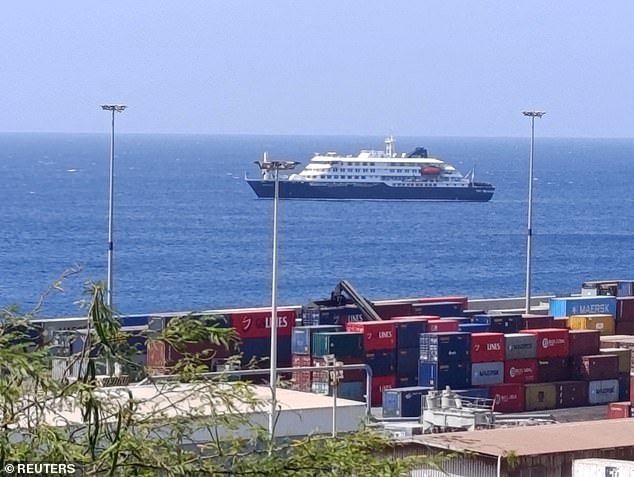
Cruise ship MV Hondius docks off Cape Verde port, as passengers were not allowed off the ship, while health authorities investigated suspected cases of hantavirus aboard the vessel

The United States is set to send an aircraft to evacuate the 19 Americans stuck on the deadly cruise that has been riddled with the hantavirus, prompting fears of a potential outbreak

The plane will take the Americans to Offutt Air Force Base in Omaha before going to the University of Nebraska Medical Center’s new state-of-the-art biocontainment unit
The Americans will land at the Offutt Air Force Base in Omaha, before going to the University of Nebraska Medical Center’s new state-of-the-art biocontainment unit.
The CDC will also be sending a team to the university for support.
All of the travelers will be quarantined on their own for the time being, according to Michael Wadman, medical director of the university’s National Quarantine Unit.
‘Each individual will have their own room,’ Wadman said, while adding that there is no standard quarantine period set for those being brought in.
‘Each of the rooms looks very much like a hotel room with the addition of availability of WiFi, exercise equipment. If the quarantine is prolonged, those would be important in terms of making sure they’re comfortable.’
The unit, which opened in 2019, comes from a $20 million Department of Health and Human Services grant, ABC News reported.
The dedicated biocontainment and quarantine unit in Omaha previously was used to treat Ebola patients and some of the first COVID-19 patients.
Nebraska Medicine is one of a handful of hospitals in the US with specialized treatment units for people with highly dangerous infectious diseases.
‘We are prepared for situations exactly like this,’ Dr. Michael Ash, CEO of Nebraska Medicine, said in a statement.

Health workers in protective gear evacuate patients from the MV Hondius cruise ship into an ambulance at a port in Praia, Cape Verde

The dedicated biocontainment and quarantine unit in Omaha previously was used to treat Ebola patients and some of the first COVID-19 patients
As of Friday, none of the American passengers on the MV Hondius has shown symptoms of hantavirus.
In interviews with The Associated Press, two Spanish passengers — speaking on condition of anonymity because of fears they’ll be ostracized once on land — said that despite the outbreak, their days aboard have passed with relative tranquility.
Some people are bird-watching, and others are gathering in common areas to read or attend talks, while wearing masks and social distancing.
Both passengers told AP they’re worried about how they’ll be treated in Spain and once home.
‘We’re scared by all the news that’s coming out, by how people are going to receive us, by how people see us,’ one said.
‘We’re just normal people. We’ve heard that this is a millionaires’ cruise, and it’s the complete opposite of reality. And we’re scared by this.’
Images of hazmat-suited medical workers airlifting gravely ill passengers from the MV Hondius earlier this week were hauntingly reminiscent of the darkest days of the Covid pandemic.
Meanwhile, nine passengers who previously left the stricken vessel are now under home quarantine and being closely monitored, including Americans in six states – Arizona, California, Georgia, New Jersey, Texas and Virginia.

The cruise ship MV Hondius is battling a hantavirus outbreak. It is pictured above while at St Helena on April 24
In the latest worrying twist, a Spanish woman who was on the same flight as a passenger who later died from the disease has reportedly been hospitalized with a suspected infection.
She was said to have been ‘two rows behind the person who died’ and had ‘only brief contact’. No further details have been released.
Hantavirus is usually spread through breathing in dust contaminated with infected rodent urine, saliva or droppings – often during sweeping or cleaning.
However, the Andes virus (ANDV) strain identified in the MV Hondius outbreak is unusual because limited person-to-person transmission has previously been documented.
Most hantavirus infections do not lead to severe disease. In many cases, people may develop only mild flu-like symptoms – or none at all.
However, some patients go on to develop Hantavirus Pulmonary Syndrome (HPS), a rare but potentially devastating condition in which the lungs begin to fill with fluid, leading to severe breathing difficulties, dangerously low blood pressure and, in the worst cases, respiratory failure and death.
The CDC says about 38 per cent of patients who develop the respiratory phase of HPS die from the illness.
In 2025, hantavirus made headlines after Betsy Arakawa, 65 – the wife of legendary Hollywood actor Gene Hackman – died from the infection at the couple’s home in Santa Fe.

Nebraska Medicine is one of a handful of hospitals in the US with specialized treatment units for people with highly dangerous infectious diseases

Civil Guard officers and local policemen prepare the command post set up at the port of Granadilla de Abona, in Tenerife Island, during preparations for the arrival of the cruise ship MV Hondius, affected by hantavirus outbreak
Hackman, 95, who suffered from Alzheimer’s disease and cardiovascular problems, is believed to have died about a week later from unrelated causes.
Those most at risk of severe illness are believed to include older adults, people with weakened immune systems, and anyone exposed to a high dose of the virus – for example through prolonged exposure to contaminated rodent droppings or dust. In the US, hantavirus remains extremely rare.
The CDC says 890 cases were reported between 1993 and the end of 2023 – an average of about 30 cases a year.
Worldwide, however, the WHO estimates there are between 10,000 and more than 100,000 infections annually, with the largest burden in Asia and Europe.
The Andes strain involved in the MV Hondius outbreak is considered particularly concerning because it is one of the hantaviruses linked to severe pulmonary disease and the only strain known to spread between people in limited circumstances.
However, experts say the strain involved in the cruise ship outbreak is not significant different to other Andes virus outbreaks, and shows no signs of mutation.
The World Health Organization considers the risk to the wider public from the outbreak as low.
On Friday, the WHO said a flight attendant on a plane briefly boarded by an infected cruise passenger has tested negative for hantavirus. Her possible infection had raised concerns about the virus’ potential transmissibility.
However, the outbreak has inevitably raised alarm – not least because hantavirus is little known outside medical circles, has no specific cure, and can in some cases trigger catastrophic lung failure within days.
Symptoms usually begin between one and eight weeks after exposure.
The CDC says Andes virus is the only hantavirus known to spread between people, and even then transmission is generally limited to close contact with someone who is ill.
They advise anyone who develops symptoms after a possible hantavirus exposure to seek medical attention promptly.
Warning signs include fever, muscle aches, breathing difficulties, chest tightness, severe weakness or symptoms developing after known exposure to rodents or an infected person.
In those circumstances, doctors say people should seek urgent medical advice and inform healthcare providers about any possible hantavirus exposure.
President Donald Trump said Thursday that the virus is ‘very much, we hope, under control.’
‘We have a lot of people, a lot of great people, studying it,’ Trump added. ‘It should be fine, we hope.’