



Jan Bartek – AncientPages.com – Why Neanderthals disappeared while Homo sapiens secured a lasting foothold in Europe remains an open and fascinating question. The answer is undeniably complex and shaped by many intertwined factors, which makes the fresh perspective offered by a new, digitally inspired ecological study especially valuable.
Led by Ariane Burke, professor in the Department of Anthropology at Université de Montréal and head of the Quebec-based Hominin Dispersals Research Group, this research thoughtfully builds on the work of her doctoral students, Benjamin Albouy and Simon Paquin. By creatively adapting models traditionally used to study the distribution of animal and plant species and applying them to prehistoric humans, the team has found a meaningful way to integrate both ethnographic and archaeological data.
Their study turns a careful eye to Europe between 60,000 and 35,000 years ago, a period marked by striking climatic shifts between cold stadial phases and warmer interstadial intervals. It is within this dynamic backdrop that the earliest archaeological traces of Homo sapiens appear in Europe and the final Neanderthals vanish from the record.
What emerges from this analysis is a nuanced and thought-provoking conclusion: neither climate stress nor competition alone—common explanations in past research—fully explains Neanderthal extinction. Instead, their disappearance seems to stem from a subtle, regionally varied interplay of climate, geography, demography, and interspecific interactions.
In ecology, species distribution models offer a powerful way to understand where a species could live, based on where it has already been observed. Building on this insightful approach, Burke and her team extended the logic to ancient hominids, thoughtfully using archaeological sites—rather than observations of living animals—as “presence points” for Neanderthals and Homo sapiens. It’s a creative and highly resourceful application of established ecological tools.
Their study unfolded through a careful series of modelling steps. First, Burke developed four habitat suitability models for each species, drawing on sophisticated methods from conservation biology and geomatics. These models skillfully integrated archaeological evidence with a rich set of geographical and climate variability indices, reflecting a deep appreciation for both environmental complexity and the quality of the data.
Burke then brought these results together by comparing the four models and generating new, refined models that highlighted “core” regions—large, productive geographic areas capable of supporting stable populations and, importantly, remaining connected to one another.
“Obviously, we don’t have precise demographic data for populations living 35,000 years ago, so we used ethnographic data from better-documented ancient hunter-gatherer groups to set parameters for the geomatics tools and generate these models,” Burke explained. “For example, these data show that the typical annual territory of a local group of 25 to 50 individuals, moving seasonally and maintaining regional connections with other groups, would be about 2,500 km².”
Resilience through connectivity
It was at this point in the analysis that meaningful differences between Neanderthals and Homo sapiens began to emerge. Notably, the regions that favored Homo sapiens proved to be more highly connected than those associated with Neanderthals. As Burke highlights, this connectivity is especially valuable: interconnected populations create supportive networks that enable individuals to move between allied, related or partner groups when facing climatic, ecological or demographic shocks. This insight offers a perspective on how social and spatial connections may have helped Homo sapiens endure and adapt.
“These networks act as a safety net,” explained Burke. “They allow for the exchange of information on resources and animal migrations, the forming of partnerships, and temporary access to other territories in the event of a crisis.”
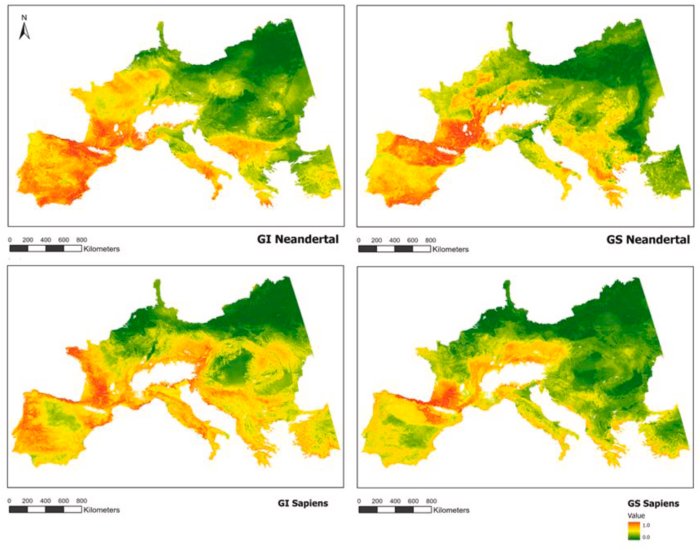
Fig. 1. Habitat suitability models used in this analysis, including: Neanderthal models and Sapiens models under contrasting climate conditions (GS: stadial/GI: interstadial). Credit: Quaternary Science Reviews (2026). DOI: 10.1016/j.quascirev.2026.109850
Burke was quick to clarify that this does not imply Neanderthal groups were incapable of maintaining connections with one another. In fact, archaeological evidence—such as the movement of material objects across distances—clearly shows that they, too, formed interregional networks. However, the models demonstrate that these networks were comparatively fragile. In particular, the regional ties among Neanderthal groups in Central and Eastern Europe appear to have been much weaker, suggesting their social connections were less robust and more vulnerable to disruption than previously assumed.
Mix of factors
The study also showed that climate variability, or how rapidly and unpredictably conditions change, affected populations more than did absolute temperature or precipitation.
“Climate variability appears to have played a major role. So it turns out that humans have been sensitive to environmental variability throughout our history,” said Burke.
However, climate alone cannot explain why the Neanderthals went extinct, since fossil and archaeological evidence shows they survived earlier glacial cycles.
According to Burke, the disappearance of the Neanderthals was not the result of a single cause, but rather a complex combination of interacting forces—climate instability, demographic pressures, and social organization all played a part. Crucially, the evidence suggests that this mix of factors was not uniform everywhere; the specific drivers of extinction likely varied from region to region.
The study illustrates this clearly. In Europe, Neanderthal populations were split into two main groups: one in the west and one in the east. In Eastern Europe, deteriorating climatic conditions combined with limited connectivity between groups may have left populations isolated and vulnerable, reducing their ability to adapt or recover from setbacks. By contrast, on the Iberian Peninsula at the western edge of their range, better-connected core regions appear to have supported stronger population networks, allowing Neanderthals there to endure for a longer period.
All of this points to a compelling conclusion: the fate of the Neanderthals cannot be explained by a simple, one-size-fits-all story. Instead, their extinction makes far more sense when we recognize it as the outcome of multiple, region-specific factors working together over time.
“In western areas, the arrival of Homo sapiens may have added further stress, especially for Neanderthal populations that were already demographically vulnerable,” said Burke. “Because the two species were capable of producing offspring together, their interactions were likely complex, involving competition, occasional interbreeding and other subtle population dynamics.”
Fundamental human need
Burke believes that these ancient dynamics invite reflection on some of humankind’s enduring challenges.
“Human migration has always existed, facilitated by mobility and social networks,” she noted. “Even today, despite the complexities of borders, population densities and social inequalities, humans continue to migrate for the same fundamental reasons: to find more favorable areas, reunite with loved ones and join mutual aid networks.”
See also: More Archaeology News
It’s a powerful reminder that, just as it was 40,000 years ago, our survival today depends on more than technology and intelligence alone. Our true strength lies just as much in our capacity to build, nurture, and sustain meaningful connections with one another.
The study was published in Quaternary Science Reviews
Written by Jan Bartek – AncientPages.com Staff Writer