

May 6, 2026
4 min read

Could this fungus live on Mars? Maybe it already does
An almost unkillable fungal strain isolated from NASA’s ultrasterile clean rooms hints at “critical gaps” in interplanetary quarantine
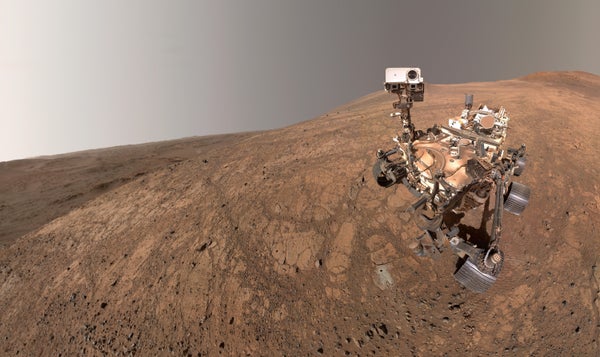
This selfie-style composite image from May 10, 2025 shows NASA’s Perseverance rover on the surface of Mars. Within clean rooms where Perseverance and other spacecraft were tested and assembled, scientists have discovered extremely tough microbes that might survive a voyage to Mars—and even the hostile conditions on the planet’s surface.
The greatest pitfall in the search for extraterrestrial life—according to science fiction, anyway—is foolhardy researchers somehow bringing aliens to Earth to wreak havoc.
But after decades of exploring our seemingly sterile solar system, real-world scientists today are much more concerned with the opposite problem: The possibility that Earth’s life will escape our planet to contaminate other worlds, sabotaging the quest to find any genuine “second genesis” of biology around the sun. Imagine that a multibillion-dollar robotic mission found wriggling microbes on Mars and that follow-up studies then revealing those “aliens” had DNA and other biomolecular machinery that showed they were emigrants from Earth.
Astrobiologically speaking, we would have met the enemy—and it would be us. Taking a cue from sci-fi, you might call such life-forms “Klingons,” for their presumptive hitchhike to the Red Planet as stowaways in spacecraft sent from Earth.
On supporting science journalism
If you’re enjoying this article, consider supporting our award-winning journalism by subscribing. By purchasing a subscription you are helping to ensure the future of impactful stories about the discoveries and ideas shaping our world today.
“Planetary protection” is the term scientists use for efforts to prevent otherworldly invasions of all sorts; to date, most of it has focused on Mars, but the practice applies to all potentially habitable environments within reach of our spacecraft. In the 1970s, for example, NASA did its best to keep its twin Viking landers Klingon-free before launching them to Mars. And if the NASA-led international Mars Sample Return effort ever manages to bring its precious payload back to Earth, the agency will be tasked with quarantining those specimens as if they contain extreme biohazards rather than lifeless bits of rock and soil.
So far, bacteria have been the bogeymen that most planetary protection protocols have been designed to defeat. Now, however, it appears that there’s another type of terrestrial life to be worried about.
A new study has found about two dozen fungal strains isolated from NASA spacecraft assembly clean rooms that are capable of surviving a pretakeoff cleansing of ultraviolet radiation exposure. One in particular—a fungus called Aspergillus calidoustus—proved exceptionally resilient, surviving extended exposures not only to ultraviolet irradiation but also to conditions mimicking the vacuum of space and the surface of Mars. A. calidoustus even withstood the baking at 125 degrees Celsius that NASA now uses to notionally sterilize spacecraft destined for the surface of that world.
The results, published last month in the journal Applied and Environmental Microbiology, suggest that NASA, other space agencies and even private aerospace companies must revise clean room protocols to address nigh-unkillable fungi and bacterial brethren alike. The findings also raise the remote but alarming prospect that previous missions have already exported hardy Earthly microbes to Mars.
An “Entirely Predictable” Critical Gap
The hyper-resilience of A. calidoustus and other fungi represent a “critical gap” in planetary protection strategies, says the study’s lead author Atul Chander, a postdoctoral microbiologist at the University of Mississippi.
The need to close that gap is growing more urgent, thanks to a new generation of ambitious missions that aim to send more landers, rovers and even helicopters to Mars—and beyond. It’s also growing more complicated, thanks to the expanding list of nations—as well as private companies—that are planning interplanetary missions, some of which involve returning extraterrestrial samples to Earth.

This overhead view from November 2019 shows NASA’s Perseverance rover (above center) in the High Bay 1 clean room of the Spacecraft Assembly Facility at NASA’s Jet Propulsion Laboratory.
Planetary protection policies are coordinated at an international level through the Committee on Space Research (COSPAR), which provides guidelines to support compliance with the United Nations’ Outer Space Treaty of 1967.
“These guidelines are not specific to any single country but are intended to be followed by all spacefaring nations,” Chander says. Indeed, major space agencies participate in COSPAR’s Panel on Planetary Protection and contribute to the development and discussion of these standards. Signatory nations are also responsible for ensuring that private space missions that are under their flag abide by COSPAR’s policies.
NASA already has a rich set of COSPAR-compliant procedures, handbooks and training courses to help guide its projects, notes Moogega Cooper, a planetary protection engineer at NASA’s Jet Propulsion Laboratory in California. And the space agency is also seeking to expand that support, she adds, by developing “more tools” for use by the commercial space community.
According to Nick Benardini, NASA’s planetary protection officer at its headquarters in Washington, D.C., some of those emerging tools will be informed by “metagenomics”—the assessment of communities of microbial organisms directly in their natural environments. Such an approach could involve better tracking of microbial ecosystems within clean rooms, supplementing the space agency’s preexisting bacteria-focused “standard assay” appraisals. Metagenomic mapping of microbiomes in crewed spacecraft could also prove crucial in crafting planetary-protection protocols for any eventual human missions to Mars, Benardini says.
Cassie Conley, who was formerly a NASA planetary protection officer from 2006 to 2017, says the results reported by Chander and his colleagues are entirely predictable and quite effectively demonstrate the need for protections in the first place.
“The whole point [is] that we don’t know all the capabilities of life on Earth—and shouldn’t pretend we do,” she says.
The real surprise isn’t how certain fungi can survive harsh extraterrestrial conditions, she adds, but rather how long a simplified bacteria-focused approach has prevailed at NASA and other space agencies. That previous thinking “was only by people who wished that Mars conditions would be sterilizing,” Conley says, “so they wouldn’t have to do planetary protection…. Most extremophile biologists who spend two seconds thinking about it would be pretty sure that Earth organisms able to survive on Mars do exist.”
It’s Time to Stand Up for Science
If you enjoyed this article, I’d like to ask for your support. Scientific American has served as an advocate for science and industry for 180 years, and right now may be the most critical moment in that two-century history.
I’ve been a Scientific American subscriber since I was 12 years old, and it helped shape the way I look at the world. SciAm always educates and delights me, and inspires a sense of awe for our vast, beautiful universe. I hope it does that for you, too.
If you subscribe to Scientific American, you help ensure that our coverage is centered on meaningful research and discovery; that we have the resources to report on the decisions that threaten labs across the U.S.; and that we support both budding and working scientists at a time when the value of science itself too often goes unrecognized.
In return, you get essential news, captivating podcasts, brilliant infographics, can’t-miss newsletters, must-watch videos, challenging games, and the science world’s best writing and reporting. You can even gift someone a subscription.
There has never been a more important time for us to stand up and show why science matters. I hope you’ll support us in that mission.