



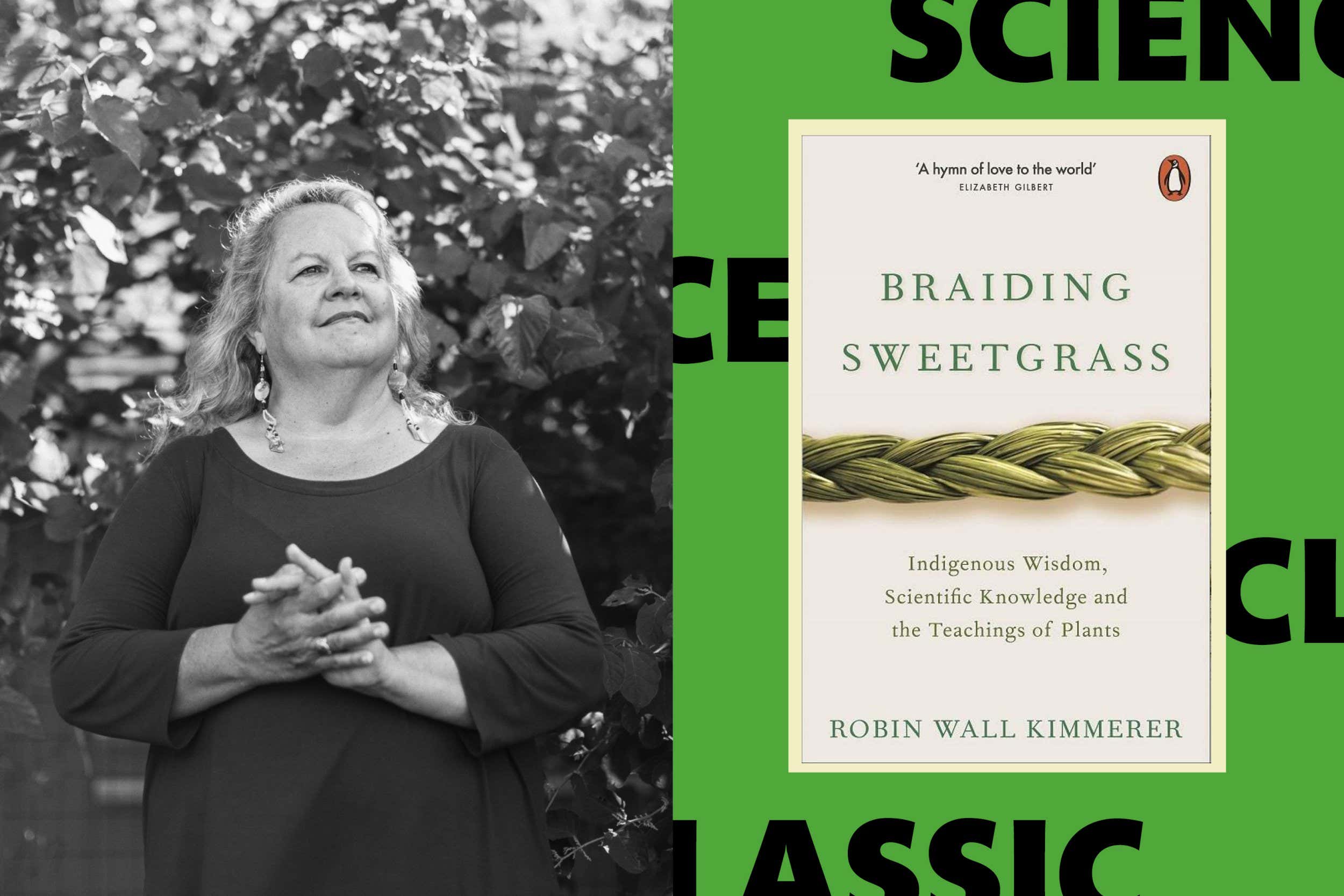

Braiding Sweetgrass by Robin Wall Kimmerer is still a vital science read, 13 years after it was first published
For Indigenous peoples, Western science has rarely been a neutral enterprise. Its history is entangled with colonialism, dispossession and extraction, and with institutions that converted knowledge into power, wealth and policy. Fifteen years after the United Nations formally urged governments to respect Indigenous knowledges and cultures, the language of reconciliation has become familiar. Yet the substance often remains elusive. We are told, repeatedly, to “listen to Indigenous voices”, but far less often shown what it would actually mean for Indigenous knowledge and Western science to work together – let alone whether such a marriage is desirable.
I came to Robin Wall Kimmerer’s Braiding Sweetgrass, first published in 2013, with doubt in my mind, doubt that she skilfully dispels by dissolving the impasse between Indigenous knowledge and science. Kimmerer, a botanist and a member of the Potawatomi Nation, offers not a manifesto but a lived demonstration of what Indigenous science can look like in practice – particularly in the plant sciences. Through a series of intimate, braided essays, she demonstrates how it can shape scientific inquiry itself: what questions are asked, how experiments are designed, and how results are interpreted.
One of the book’s most illuminating chapters centres on an experiment involving sweetgrass, the fragrant plant that gives the book its name and holds deep ceremonial significance across many Indigenous nations. Kimmerer and her colleagues set out to test whether plots of sweetgrass suffer from different methods of human harvesting. They compared sweetgrass plots that had been pulled out by the roots, carefully pinched off at the base or left untouched as controls. The results were unexpected. Sweetgrass thrived when harvested by humans, regardless of method, while the untouched plots fared worst of all.
Kimmerer described facing harsh scepticism from a panel dominated by white, male scientists, who were unsettled by results that challenged a foundational assumption: that humans are necessarily outsiders to nature, and that our presence can only degrade what we touch. Conservation, under their view, meant withdrawal; the best human was an absent one.
Yet Kimmerer’s book shows how Indigenous land management traditions, by contrast, often treat sustained interaction as essential to ecological health. And science today has only vindicated her. Fire ecologists now increasingly recognise that Indigenous burning practices reduce the risk of catastrophic wildfires. And conservationists now look to studying Indigenous tribes for notes on how to harvest natural resources.
In her book, Kimmerer has many examples of how Indigenous knowledge is powerful, not only because it exposes the invisible assumptions embedded in Western science and environmental policy, but because it insists that another relationship with the natural world is possible.
That insistence gives Braiding Sweetgrass its quiet urgency. In an era defined by ecological collapse, this book is not only a critique, but an act of healing. Kimmerer invites readers to relinquish a self-conception that casts ordinary acts – eating, harvesting, breathing – as inherently extractive. She asks us to imagine instead a reciprocal relationship with the Earth, one in which responsibility and gratitude replace guilt and alienation.
There is a tenderness to Kimmerer’s writing, born of a lifelong intimacy with plants, but it is not sentimental. She resists portraying nature as purely maternal or humanity as either villain or saviour. Instead, she embraces our ambivalence: we are estranged children, careless interlopers, devoted stewards, curious witnesses. Most importantly of all, she argues that to meet the challenges of environmental collapse, she argues, we must abandon the fiction that we were ever separate from nature at all.
Near the end of the book, Kimmerer asks the reader to take a flower and look again. Through the lens of Western science, the flower is a triumph of evolution: its pigments tuned to attract pollinators, its form shaped by millions of years of selection. Indigenous knowledge does not replace this view; it settles over it, like weightless gossamer. We can concurrently understand the flower as a gift, a relative, an invitation into relationship.
That is the achievement of Braiding Sweetgrass. It does not ask science to surrender its methods or its standards. It asks it to remember what it forgot: that knowledge is not only about control, but about care; it’s not only about seeing nature, but a guide to belonging in it.
Topics: