


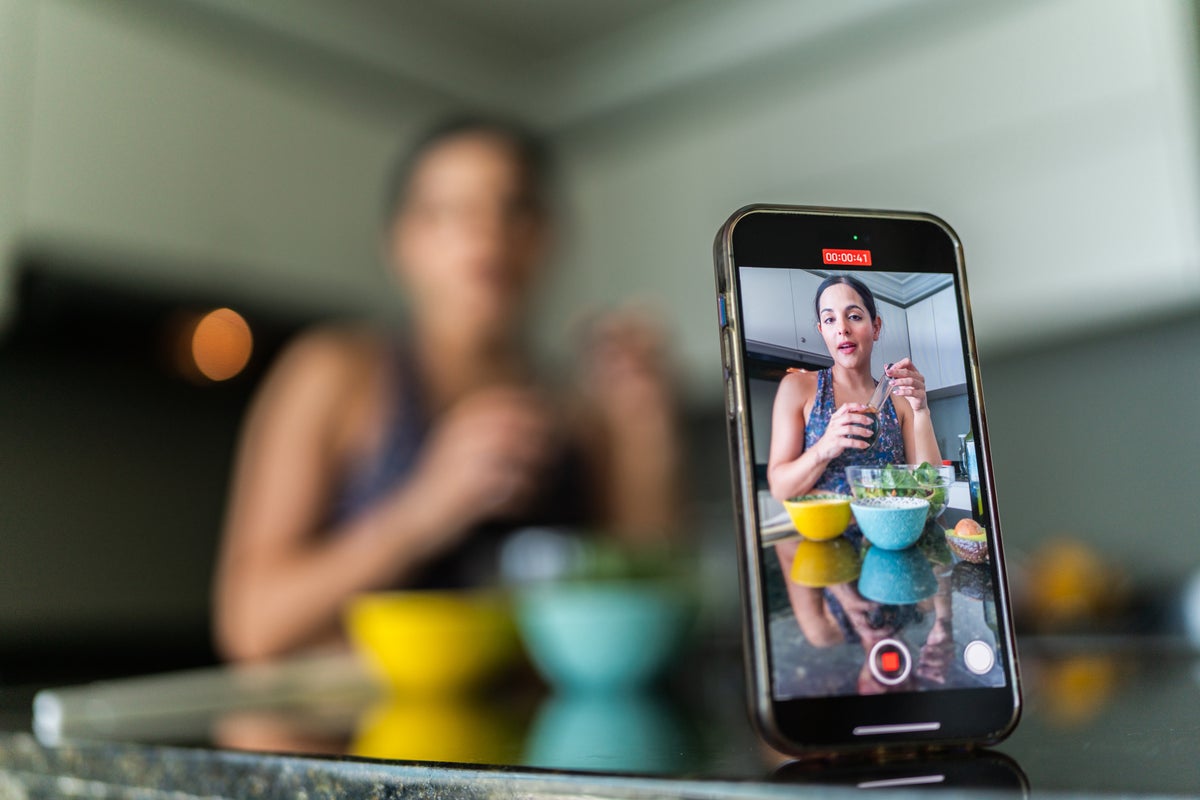
On TikTok and Instagram, fitness content is everywhere. Algorithms serve users glossy videos featuring toned bodies, gym routines and health food endorsements. This isn’t really new: “fitspiration”—an amalgam of “fitness” and “inspiration”—is one of the Internet’s oldest enduring types of content, with roots in the “thinspiration” world of online eating disorder communities.
Fitness content has evolved with new hashtags over the years, but it’s still dominated by the visual language of “fitspo” such as photographs and videos that emphasize strict diet and exercise routines. And researchers have accumulated evidence that this imagery is detrimental to users’ mental health and self-image and may encourage disordered eating.
“It’s incredible how people are responding to this [content],” says Valerie Gruest, who studies the Internet’s effect on body image at Northwestern University. Gruest is a former Olympic swimmer who competed for Guatemala at the 2016 Summer Olympic Games in Rio de Janeiro.
On supporting science journalism
If you’re enjoying this article, consider supporting our award-winning journalism by subscribing. By purchasing a subscription you are helping to ensure the future of impactful stories about the discoveries and ideas shaping our world today.
“This topic [of fitspiration] is so dear to my heart, not only as a researcher but also as an athlete,” Gruest says. She grew up exposed to a lot of fitness content in an athletic environment that already had an “intense eating disorder culture,” she explains. After injuries ended her career, she decided to become a researcher studying how this social media content operates. In a meta-analysis published this week in Health Communication, she examined the mental health effects of a decade’s worth of research on fitspiration content.
Scientific American spoke with Gruest last week, just hours before she defended her Ph.D. dissertation, to ask about how fitness content has evolved, how it affects adults and kids and how we can curate our social media feeds to motivate us in a healthy way.
[An edited transcript of the interview follows.]
Tell me more about fitspiration content and your own exposure to it over the years.
“Fitspiration” content has always emerged very organically on my social media feed and the feeds of people that have been around me throughout my athletic career. This is content that promotes a more active lifestyle but, in the background, motivates people to aspire to a very thin, very fit body ideal—which, in a lot of cases, is very unattainable. I can say for myself, even as an elite athlete, it was very hard to achieve that kind of body. It’s not correlated with athletic performance. There is often an either implicit or explicit invitation for users to engage with disordered eating and exercising practices in order to achieve those standards.
For my Ph.D. dissertation, I had the opportunity to talk with different types of social media users, from elite athletes to people who didn’t consider themselves active. And even in conversations with athletes, there was this feeling of “it’s just impossible for me to either find the time or really have that strict mentality around food and exercise in order to achieve ‘ideal’ body standards.”
How has fitspiration content evolved over time?
This content has origins dating way back to the rise of the web, with roots in pro-eating-disorder websites. People with eating disorders would share their experiences as a way of motivating others to achieve extreme body standards through imagery of emaciated bodies. They transitioned into spaces like Tumblr and Pinterest, and this is where “thinspiration” and “thinspo” originated through hashtags. A lot of these platforms took action, canceling accounts that were related to thinspiration. That’s where fitspiration started to emerge, like the typical picture of a selfie in a Nike sports bra and very small shorts—not as a way to promote fitness but still promoting a very thin body. Then, with the rise of Facebook, Instagram, Twitter and Snapchat, that’s where fitspiration was adopted more widely online. Now we are exposed to this content much of the time. Perhaps we don’t always see the hashtag “fitspiration,” but a lot of those core elements are present. Brands have now adopted the trend in their wellness and fitness-related marketing.
You recently analyzed the results of 26 studies that tested the effects of fitspo content. What did you find?
The scientific literature on fitspiration content has focused primarily on trying to understand the content itself and what the messaging looks like. But there are also some experimental studies on the general impact of fitspiration content. After direct exposure to such content, how are people immediately reacting? This meta-analysis allows us to paint a picture of the best available evidence of the effects of exposure to fitspiration content.
And we see that it’s pretty consistently negative for users to be exposed to such content. It prompted people to compare themselves with the people portrayed, negative self-perceptions increased, and positive feelings decreased. We also saw an increase in diet and exercise motivation. This tells us that this content really has influence over the user outside of the digital world.
That last part seems like it could be a good thing if it’s encouraging people to exercise and eat healthier. Why wouldn’t it be?
What makes fitspiration very unique and concerning is that it’s supposed to motivate healthier lifestyles, but it’s doing that in order to attain a particular body standard. And that’s where the issue comes in. It’s not promoting health. The content encourages you to be extremely conscious of what you eat with very, very specific requirements. I don’t even think elite athletes do it to that level, because performance nutrition nowadays is very much centered on fueling your body, not restricting your body. A lot of the [exercise regimens] that are promoted are extreme measures, featuring a lot of repetition and high intensity that your body has to be prepared for. I know what it takes to reach that elite level of training, and that’s not something that’s healthy for an average person.
People who make this content are not just saying, “Oh, eat healthy and exercise regularly.” It’s very much “restrict food and exercise a lot to compensate for what you ate.” That’s where those disordered patterns start to emerge.
You mentioned that this body standard is often unattainable for most people. Does that factor into why it can have negative mental health impacts?
Yeah, absolutely. When people are engaging with fitspiration content, it becomes this cycle: It’s motivating me to pursue these standards, but then nothing I do gets me that body standard. And it creates a lot of frustration because a lot of people have gone to those extreme measures and they don’t see those effects. What makes this body standard so hard to attain is that you have to be pretty lean, and on top of that, build muscle. And from the elite athlete perspective, it takes a lot to build muscle, right? It takes a lot on the nutrition side. It takes a lot in recovery. A lot of the people I interviewed describe the process as “just never ending.” You think you’ve achieved one part, but then you’re exposed to another post, and then it reminds you that there are other things you need to change about yourself.
Is there a way to present fitness content that doesn’t have these negative effects?
There are some influencers that are not within the fitspiration sphere who promote a more healthy and holistic approach. What is fueling your body? What does your body need in terms of exercise that day? How was your sleep? Are you recovering properly?
But I think there has to be a larger movement in the field [of nutritionists and doctors to communicate about] health, exercise and nutrition across media channels. Younger generations are consuming [content] at rates we have never seen before through social media. This is where they get their information primarily, and they’re resorting to it for health-related advice.
How does this content affect kids?
The average young user identifies fitness content as one of the primary content types they’re exposed to on a daily basis. It is just so pervasive in their feeds. For my dissertation I asked these young users to share their experiences. And they felt like what they were being exposed to was not in their hands. Only people who were in their late 20s had the maturity to say, “I don’t want to be seeing that type of content. It doesn’t make me feel good about myself.” They say that it took them many years to reach that conclusion because media effects are not immediately felt; [such effects] develop over time. The solution they were prescribing for themselves was curating the content to limit it on their feeds.
So how do we approach this with children? Broadly, studies have shown is that younger users are having more and more of a difficult time navigating these image-centric environments. A lot of the research on body image and media psychology has found that exposure time on social media very much correlates with body image issues and disordered eating tendencies. For sure, screen time has a big impact because it’s not just seeing one image. In the studies in this meta-analysis, the experiments showed [something like] 10 to 27 images per experiment. You can consume that amount of images in a minute on social media. The cumulative effects are really important to consider.
For people trying to curate their feeds, what are some red flags for fitness-related content to look out for?
I think it’s about always checking in with yourself. How is this content making me feel? Does it align with my values, my beliefs, my lifestyle, my goals? Is the content promoting anything that can be detrimental to my health, [such as] restriction of food or ultracontrol over food routines and lifestyles? In the interviews that I’ve conducted, people often say they feel that [the dieting and exercise routines] take over their life, in a way. They feel like they’re not going to social events because they’re at the gym trying to burn off what they ate that day or that they just feel like they can’t skip any workouts.
Fitspiration content is innately designed to be visually appealing. It’s very aesthetic, which, on these image-centric platforms, gives it so much traction. I think that a realistic and very honest check-in is always a great way to start. What goal do you aspire to reach? And is that rooted in a pursuit of health—or pursuit of beauty? I think that’s where we can draw the line.
If you or someone you know is struggling with an eating disorder, you can contact the National Association of Anorexia Nervosa and Associated Disorders helpline by calling (888) 375-7767. For crisis situations, you can text “CONNECT” to 741741 to connect to a trained volunteer at Crisis Text Line.