


Australians have blasted a massive new apartment proposal as the ‘densest development’ in the nation, with critics warning surging immigration and runaway population growth are forcing Sydney residents into ‘termite mound’ living.
A proposal to turn Marrickville Timberyards in Sydney’s inner west into a mixed-use precinct was approved in February by the NSW Independent Planning Commission.
The development will range from five to 14 storeys and include 1,231 build-to-rent apartments and studios. It will also feature 726 bike spaces and a car-share scheme.
Build-to-rent is a model where developers and investors construct multi-unit buildings and keep ownership of the apartments, renting them out instead of selling them individually.
Developers say the project will help ease pressure on Sydney’s tight rental market.
The project will also include a communal indoor residents’ space, a creative arts hub, 10,200 square metres of public open space, and 1,425 square metres of retail space on a 2.2-hectare site.
The plan has come under fire from community groups, with Changing Sydney dubbing it ‘the densest development in Australia’.
The development has also been criticised by some locals concerned about how residents will live in and around the precinct, while others backed the project, saying more housing is urgently needed.

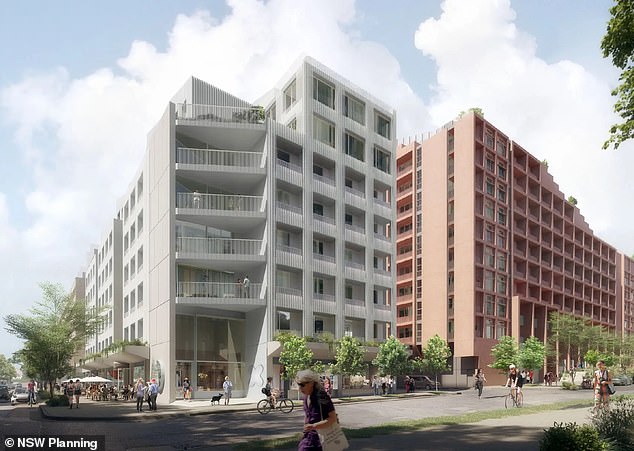
The Marrickville Timberyards proposal was approved earlier this year and would transform the 2.2-hectare site into a massive mixed-use precinct packed with more than 1,200 apartments, retail space and communal areas

Developers promise to alleviate pressure on Sydney’s tight rental market

A map of the new housing development to be built in Marrickville
‘1160 units and 350 car spaces. How the f*** will that work. There are already no available on street car spaces free in the area,’ one said.
Australian entrepreneur Dick Smith also blasted the proposal and fears homes with a backyard in capital cities will no longer exist by 2050 due to high immigration.
He said by then housing will have become even more ‘catastrophically’ unaffordable and Australia’s population will be heading towards 50 million people.
‘We’re moving to a situation that I would say is similar to battery hens,’ he told Daily Mail.
‘We used to have free range chooks in our housing, in other words, parents could buy a place with a backyard for their kids to play in.
‘Now, it’s as if we’re going to the battery chook version of that, where people live in high-rises, crammed in like termites.’
Mr Smith said humans haven’t evolved to live in ultra-dense apartments.
‘When I fly my helicopter over the Sydney suburbs, especially the western suburbs, it’s places just crammed in on each other,’ he said.

Australian entrepreneur Dick Smith has joined the backlash, warning soaring immigration and rapid population growth are changing the Australian dream forever. He fears homes with backyards could disappear from major cities by 2050, replaced by high-rise towers where people are crammed in like termites

Dick Smith said life was better in his youth because ‘families could afford a backyard – we were free-range kids whereas now kids … end up living as battery hens and that’s a real pity’
‘The backyards are only two metres in depth, so there’s no room to do anything in them. Now, those places with backyards are going to be replaced with high-rises.’
If a young Australian was shown a photograph of a typical 1960s house with a backyard versus a picture of a dense unit complex, Mr Smith said there was ‘absolutely no doubt’ they would choose the home.
‘We’re forcing them into these termite mound-type, high-rise developments, which is not going to be good for our young people,’ he added.
A spokesperson for the Independent Planning Commission told the Daily Mail the development was approved after extensive community consultation.
This included a public meeting and written submissions.
‘As a consequence, strict conditions of consent were imposed to mitigate potential impacts identified in the Commission’s assessment of the Application,’ they added.
Jonathan Combley, developments general manager for The Living Company, which runs the project, said they are ‘delivering much-needed housing in a well-connected inner-city location, at a time when Sydney is facing a serious housing shortage’.
‘Some of the language used to describe the project doesn’t reflect the reality of what’s been approved,’ he said.

A timberyard in Marrickville will be turned into one of Australia’s densest housing developments
‘The density is consistent with planning settings for sites close to transport and jobs, and it’s exactly this kind of development that helps make cities more sustainable and liveable over time.
‘On parking and traffic, the project aligns with modern planning approaches that prioritise public and active transport. In locations like Marrickville, residents are far less reliant on cars.
‘Importantly, increasing supply is part of the solution to housing affordability. Build-to-rent delivers secure, long-term rental options and greater choice for renters.’
Mr Smith also said that there is a wider issue for Australians in capital cities that are turning to high-rise living: populations are ‘growing far too quickly’.
‘We need to have a population plan. I think the optimum number is about 30 million total population,’ he said.
Australia’s current population is 27.2 million.
‘I’m pro immigration at about a rate of 70,000 a year, which is our long-term average. That number will round off our population at about 30 million, and that will be good for our children.’
Economist Leith van Onselen has noted Australia’s population will grow by 13.4 million people over 41 years to 2065-66, according to the Centre for Population 2025 statement.

An artist’s impression of the proposed development
He said 81 per cent of that growth is projected to occur in capital cities, which are expected to swell by 10,850,000 over the next 41 years. Australia’s regions are only due to grow by 2.5 million.
Mr Smith said one answer to development driven by an ever-growing population is to remove tax advantages associated with buying houses, especially for people who purchase them as investments.
‘You have some people who own 20 or 30 houses,’ he said.
‘Owning a home used to be because you wanted a home so you could bring up your children in a fantastic way. That’s all changed. Now you buy a home to become a millionaire, and that rules out the next generation because they can’t afford it.
‘We should take away the ridiculous tax advantages in buying homes – the capital gains tax advantage that you get – and also mechanisms that mean you can save tax on your loans, on your earnings, when you buy a property.
‘Both of those should be taken away. And then people, young couples, will be able to afford houses with a backyard again, and that will be good.’
Those incentives are up for review in the next budget, with Treasurer Jim Chalmers admitting Labor’s upcoming tax reforms will focus on housing as the government considers scrapping negative gearing and reducing the capital gains tax discount.
Australia’s capital gains tax discount allows individuals and some trusts to pay tax on only 50 per cent of a capital gain when they sell eligible assets, including shares or investment property, that have been held for more than 12 months.
Negative gearing allows investment property owners to claim losses and running costs, such as loan interest and council rates, against their taxable income, which critics say encourages investors to buy more property.
Chalmers said any tax reforms would be focused on housing and would be announced in the next Budget, which will be handed down on May 12.
‘When we think about the intergenerational unfairness in the budget, in the economy and our society more broadly, a couple of the drivers of that are in housing, are in the tax system,’ he said.
‘We’ve been upfront with people and said that we think that there are issues in the housing market and in the tax system that we are working through.
‘There are some issues of intergenerational fairness that we’re very focused on.
‘One of those issues is around whether or not young people can get a toehold in the housing market.
‘I think a lot of us are very concerned about, over time, the way that there are fewer and fewer younger people who are able to buy their own home, so housing supply is the main game.
‘We want to make sure that people can actually get a toehold in this market as well. And so that’s driving some of these deliberations as we get closer and closer to finishing the Budget.’