

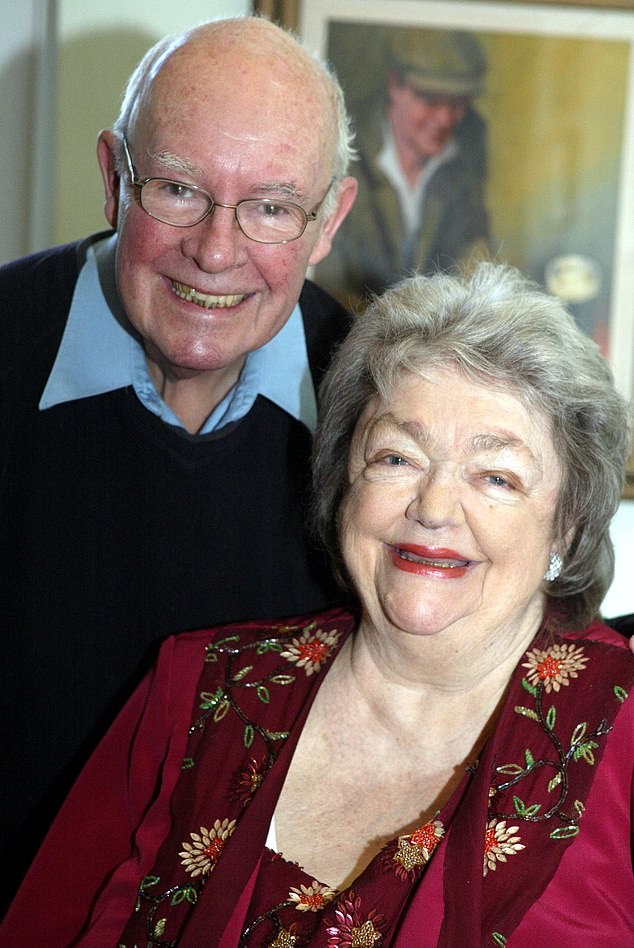
They used to say that behind every great man is a great woman, but the death this week of the author and journalist Gordon Snell highlights that in some cases there is a wonderful man behind a great woman too.
Gordon was that rare thing – a man who was confident enough to allow his wife Maeve Binchy to shine without resentment or any loss of his own sense of self. He delighted in her achievements and took pride in her best-selling status without feeling in any way diminished by it.
‘We rejoiced in each other’s successes,’ he once told The Irish Times. ‘Neither of us felt at all jealous.’
Gordon was a gifted children’s author in his own right, who published titles including The King Of Quizzical Island, Amy’s Wonderful Nest, Tina And The Tooth Fairy and The Supermarket Ghost, as well as writing scripts for RTÉ including the TV show Wanderly Wagon. He also had a gift for very funny, political satirical verses.

Gordon Snell and Maeve Binchy at their home in Dalkey in 2006. Picture: Collins Photos
Born in 1932 in Singapore (then a British colony), Gordon spent the duration of the Second World War in Australia after his mother had enrolled him in school in Geelong and the Japanese invasion of 1942 forced them to remain. His father was a Japanese prisoner of war but never talked about the experience afterwards.
As an only child, the separation must have been traumatic for the young Gordon as he didn’t see his father for years. The family returned to England after the war, where he attended secondary school in Wiltshire, followed by university in Oxford.
He was the quintessential English man in many respects, but Ireland would become his second home thanks to his relationship with Maeve.
Her childhood in contrast had been in a big, shabby but happy house in Dalkey full of books with three siblings (William, Irene and Joan) and parents, William, a barrister, and Maureen, a nurse, who were devoted to each other and their children.
They both died young and never got to see Maeve’s success as an author but had supported her in her early writing and she always attributed her innate sense of confidence to them.
After her mother’s death aged 57 in 1968, Maeve stayed in the family home with her father and thought that was how her life would unfold. She said she expected to lead a life of spinsterhood, as no one seemed to be coming along to be her Mr Right.
After her father’s death in 1971, she was intensely lonely so threw herself into her work as an antidote to her grief. Meeting Gordon would change the course of her life dramatically.

Gordon and Maeve on a clifftop walk. (Photo: Ian Cook/Getty Images)
They first met in the 1970s, when Maeve used to contribute to the BBC’s Women’s Hour when she was in London. Aged 32, she was by then a successful journalist with The Irish Times, editing the Women’s Page with a team that included Mary Maher, Nell McCafferty and Mary Kenny.
Gordon, then 37, was a freelance editor with the BBC World Service, and the introduction was made by a mutual friend who produced Maeve’s radio slots and declared Gordon ‘a terribly nice guy’.
Initially they were just friends: Maeve liked that he had kept all his own friends from school and university, which she thought, ‘a very good sign of a person’. She admitted that she didn’t fancy her future husband at first.
Her teenage crushes had included an intense one on Marlon Brando – whom she was convinced she would marry – and Gordon did not fit that dark, brooding stereotype.
But then romance entered the equation after they took a day trip to Boulogne on the hovercraft and later went on a holiday to Sicily.
‘And then I began to fancy him dreadfully,’ Maeve revealed in the documentary, but she chided herself not to be ‘ridiculous’ as he lived in London and she in Dublin.
Regardless, they launched into a long-distance relationship. On seeing Douglas Gageby putting up a notice looking for a man for the London office of The Irish Times, Maeve expressed an interest and she moved quickly to London to fill the role. Gordon was, according to Maeve, ‘startled but pleased’ with her arrival and they set up home, marrying in 1977, when she was 37 and he 44.

Maeve Binchy playing chess with her husband, writer Gordon Snell, in their living room at home. (Photo by Ian Cook/Getty Images)
The couple weren’t able to have children which was devastating for them, but as with the many challenges they encountered, they got on with things, becoming devoted cat parents to a succession of privileged felines – Tex and Sheila and later Fred and Audrey – and, as they phrased it, ‘borrowing’ their friend’s children and grandchildren when they could.
Maeve was naturally gregarious, sociable and talkative, while Gordon, though affable too, was more reserved. In some way the dynamics of their marriage reflected that of Maeve’s parents: her mother had been vivacious and outgoing while her father was shyer and more cerebral. They had an amazing marriage, and so did Maeve and Gordon.
Perhaps it was a case of opposites attracting but they shared a wicked sense of humour, were unpretentious and delighted in their luck in being able to write for a living.
They never got bored with each other but stayed totally in love as long as they were together. They knew they were lucky and appreciated their good fortune, never taking it, or each other, for granted.
‘I have loved a wonderful man for over 33 years, and I believe he loves me too,’ Maeve said in a 2010 interview when she received the Lifetime Achievement Award from the Romantic Novelists Association. The feeling was mutual. Gordon said of their relationship: ‘We’re personalities that gelled together and it was absolute luck.’
In the early 1980s they moved back to Dalkey and bought Polly Villa, a modest but attractive house in the heart of the village. However, by 1983, that idyll was threatened when they fell behind on the mortgage of £211 per month and faced repossession.
Then an amazing life-changing event unfolded. Maeve had laboured away on a novel, Light A Penny Candle, while working in The Irish Times London office. Each week she had consistently delivered 5,000 words to her agent, Christine Green, by rising at 5am to write before work and at weekends too.
That discipline and effort paid off when the hard copy rights went to Century, a new publishing house, and it then auctioned the paperback rights for £52,000. At the time that was the highest amount ever paid to a first-time author and Maeve was stunned. Later, Viking Press paid $200,000 for the US hardcover edition.
‘The day we got the money, the £52,000, I said, “if it’s going to be called Maeve’s money, I’m going to give it back,”’ she recalled to The Guardian in a 1998 interview. ‘And he said, “No, it’s our money because it’s a company and it doesn’t matter which one of us got it.”’
However, one thing which Maeve remained adamant on was not doing Gordon’s ironing, making a pact with him that she would never iron his shirts or tidy his desk.
Light A Penny Candle was to be the first of a string of successful novels, including Echoes, Circle Of Friends, The Glass Lake and Tara Road, which would turn Maeve into a publishing phenomenon who was translated into 37 languages and sold more than 40 million copies worldwide. The couple were able to stay in Dalkey and keep their home, which they re-modelled and extended, eventually buying a property at the rear for guests.

Gordon marking the launch of the world premiere stage adaptation of Maeve’s Circle Of Friends in 2020. (Photo: Gareth Chaney/Collins)
Gordon and Maeve lived and worked together in Polly Villa for over 30 years until she passed away in 2012. Their office at the top of the house was where they wrote side by side, companionably every morning.
Being married to another author was something they valued because as Maeve observed, it was very nice to have somebody who understood the challenges of a writer’s life.
‘We’re lucky that the two of us are in the same business,’ she said in 2010. ‘We’re not competitors, we’re out for each other’s good.’
This extended to them reviewing each other’s work. ‘We therefore critique each other’s work,’ she explained in an RTE documentary, adding that there was 10 minutes of ‘sulking time to accept the criticism or not’.
In any other marriage this may have led to divorce, but the pair seemed to navigate the experience without bloodshed. They dedicated all their books to each other while both were alive.
It was a happy relationship but not without its trials. Both faced medical challenges – Maeve suffered from heart and kidney issues, sleep apnoea and debilitating osteoarthritis, while Gordon underwent heart surgery in 2009 – but they supported each other through those tribulations.
When Maeve passed away aged 73 in 2012, Gordon, as always, was by her side. Naturally he was devastated. They had done everything (bar playing golf) together for decades, including travelling widely, doing Maeve’s mammoth 3,000-plus Christmas card list every year at Hunter’s Hotel in Wicklow and watching Coronation Street avidly. They even made cameos together in the film adaptations of Maeve’s titles, Circle Of Friends and Tara Road, which they enjoyed immensely.
One without the other did not seem possible but Gordon had to go on without Maeve for another 14 years.
The writers, who were married for over 40 years, were the subject of a documentary in 2010 titled Maeve Binchy – At Home In The World. That film revealed that a great marriage is not always built on explosive fireworks and passion, but constancy and tenderness.
That is not to say that they didn’t have chemistry, but their relationship was one forged in mutual respect, affection and kindness. They were extremely kind and generous people, as testified by their friends and acquaintances, who they helped out without reserve.
According to Sinead O’Brien, who directed Maeve’s documentary, one of Gordon’s favourite things was to rewatch the film, to recapture the essence of their life together. He got great solace from re-living their devoted relationship in this way.
After Maeve’s death, Gordon remained in Dalkey in Polly Villa, their charming house on Sorrento Road near Finnegan’s pub, the couple’s favourite watering hole where they lunched every day. Gordon hadn’t been seen in public recently due to failing health, but his death still marks the end of an era for the coastal village.
Maeve and Gordon were the first citizens of Dalkey – everywhere they went they were greeted gladly and on first-name terms with all. Any outing took forever, as they stopped constantly for chats and updates. As former journalists, both loved a good gossip and any local news.
On the day of Maeve’s funeral, that affectionate relationship was evident as the population of the village lined the main street and loudly clapped her hearse as it made its way to the Church of the Assumption.
Born and bred of Dalkey, Maeve was deeply loved there, but so too was Gordon. He was a beloved adopted son, and the village will mourn him too ahead of his funeral on Tuesday.
As an agnostic, Maeve did not believe in any after-life but she and Gordon were so inseparable in this life, you cannot but imagine them now reunited in some other dimension laughing, gossiping and enjoying a good glass of wine while revelling in each other’s company again.
Gordon told The Irish Times in 2023: ‘Maeve and I always said we were lucky first to have met each other, but also that we realised we were lucky. It’s one of the most important things.’