Scott Bessent, Donald Trump’s Treasury secretary, is a study in contradiction.
Bessent moves through the world with calculation and grace, part cerebral strategist, part gladiatorial operator.
One can trace a purposeful line through his life and career, navigating past loss and triumph, managing family dramas and well-earned opportunities, making clear-eyed choices and taking measured risks and at last achieving a version of the modern American success story: a master of the universe, a hands-on dad, a leading force in the global economic conversation, a resilient individual.
Bessent is more of an aesthete than your typical Washington official, more Southern Charm-meets-Downton Abbey than The West Wing. He is a natty dresser with a longtime passion for fixing up classic homes, embracing ‘the creative process’ and the technical challenge.
‘I think that’s one thing President Trump and I share,’ Bessent tells me in one of a series of interviews this month. ‘We talk about building a lot and design.’
He keeps fit and still has the moves on the basketball court, although two hip replacements mean his days of two-handed dunking are over.
He maintains longstanding close friendships from his past, including with a cousin he’s known since birth and a Wall Street buddy who is godfather to his son, but he also is pals with King Charles III, Elton John and ‘one of the most famous actresses in the world,’ whom he declines to name. ‘I have a lot of famous friends,’ he says, ‘because I don’t talk about them.’
Bessent is beloved by his allies and confidantes, who show him devout fealty and respect, yet is feared by his adversaries, who plot fruitlessly for payback. ‘I’ve been told,’ says Bessent, ‘there are two kinds of people who work for me – those who’d take a bullet for me and those who’d want to give me one.’

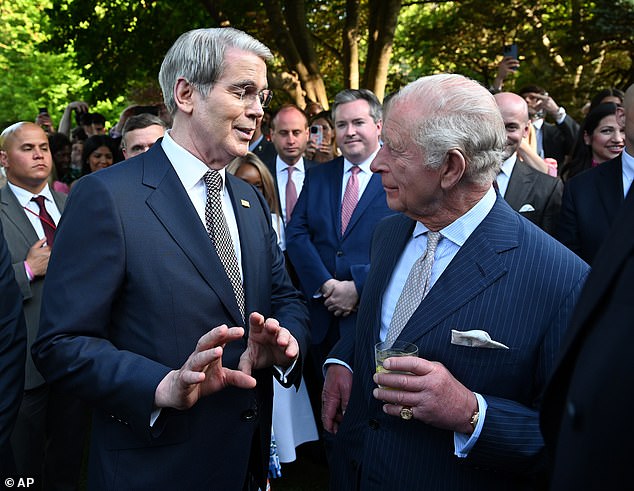
He maintains longstanding close friendships from his past, including with a cousin he’s known since birth and a Wall Street buddy who is godfather to his son, but he also is pals with King Charles III (Pictured: Bessent and King Charles at the British Embassy on April 27)

He is a natty dresser with a longtime passion for fixing up classic homes (Pictured at White House Correspondents’ Association Dinner on April 25)
His famous temperament – cool and measured, then suddenly hot – has led to some physical confrontations with colleagues, including former Trump advisor Elon Musk. As Bessent says, ‘I have a long fuse—but when it goes, it goes.’
Bursts of Bessent’s wrath notwithstanding, senior Republicans in Washington line up to shower the secretary with superlatives. ‘He’s one of the most talented people I have ever known and worked with,’ says Speaker Mike Johnson.
‘He can handle the politics, the policy, the interpersonal side of things. He has a way about him that calms the situation. He’s very much in charge. He has the respect of the people in the room. He has no agenda but the best interest of the county.’
Bessent has come to be viewed by the President and by his White House colleagues as the economic quarterback of the administration, a powerful television surrogate, a calmer of markets both in public and behind the scenes and the heavy lifter on some of Trump’s most important projects, including maneuvering the tax-cutting One Big Beautiful Bill through Congress on schedule, while also managing the country’s delicate relationship with China.
He keeps a punishing around-the-clock work schedule, intent on bringing his highest quality game to the administration and Trump, to whom he is keenly loyal.
Currently, it is Bessent and Marco Rubio who comprise the twin pillars of the upper echelons of the Trump cabinet. Both men function as department secretaries, but both, through happenstance and design, effectively operate at the very top of Trump’s core team, talking, texting, meeting regularly and influencing many important administration decisions.
Bessent’s long strides can take him from the Treasury building to the West Wing in a matter of minutes and he often can be found in the Oval Office at the President’s side. His office in the Treasury, meanwhile, is a space that reflects the man – orderly and tasteful, with a dash of personal imprint. A Japanese manga image of the secretary is a favorite, as are family photos and heirlooms.
Scott Bessent’s story begins in South Carolina, far from the Washington arena of marble and power and, in his telling, is shaped by an early instability that hardened his outlook and sharpened his ambition.

His famous temperament – cool and measured, then suddenly hot – has led to some physical confrontations with colleagues, including former Trump advisor Elon Musk (Pictured: Bessent, Commerce Secretary Howard Lutnick and Musk in May 2025)

Bessent has come to be viewed by the President and by his White House colleagues as the economic quarterback of the administration (Pictured: Bessent with Small Business Administrator Kelly Loeffler on April 15)

Bursts of Bessent’s wrath notwithstanding, senior Republicans in Washington line up to shower the secretary with superlatives (Pictured: Vice President JD Vance, Bessent and Defense Secretary Pete Hegseth with Trump on April 17)
His father, Homer Gaston Bessent Jr was a real estate developer whose finances veered from giddy abundance to insolvency and Homer’s relationship with Scott’s mother, Barbara, was ardent and volatile. (Homer and Barbara were married twice; he was her first and third husband out of five and said to be her true love).
Scott and his sisters, Paige and Wyn, were passengers on this rollercoaster; Scott attended posh boarding schools and debutante balls, but also worked as a busboy at age nine. For a time, he and his sisters lived in the guest house of the patrimonial home.
‘I can’t remember whether my dad had tuberculosis first or went to rehab first,’ says Bessent. ‘So, he was away for a long time. Then my great grandmother, who we lived with – and we lived in her house, which my dad was born in – died, and then the house got sold because there were so many grandkids and then my dad went bankrupt. That’s a lot.’
Instead of collapsing under the chaos, Bessent developed an elasticity and a cool presence of mind, which led him to choose Yale University over the Naval Academy when he was a teenager. In 1979, one could be court martialed for being gay, Bessent recalls, so despite a congressional appointment and financial pressures, he opted for Yale.
He paid his way, worked three jobs and thrived at the Ivy, thinking he ‘was going to be a journalist or a computer scientist.’ But by the end of college, he was ready for the financial world, with its gleaming armor of achievement and transparency.
Bessent, who eventually started his own hedge fund, quickly found mentors in two boldface billionaires, George Soros and Stanley Druckenmiller. His relationship with Soros influenced his philosophy – that outcomes matter more than narratives – which is reflected in his tenure as Treasury Secretary and presidential advisor.
From Soros came a feel for markets under stress; from Trump, a sense of timing and instinct. Both reinforced his core view: risk is not something to be feared, but understood and leveraged.

Bessent’s long strides can take him from the Treasury building to the West Wing in a matter of minutes and he often can be found in the Oval Office at the President’s side

It is Bessent and Marco Rubio who comprise the twin pillars of the upper echelons of the Trump cabinet
When Bessent ventured out under his own hedge fund shingle – tempted, he suggests, by peer encouragement and ego, he dove in fast and hard, making a few early mistakes and shelling out his own money to cover the losses. ‘That’s when I learned that you’ve got to pay a lot of attention to who you hire and who you have around you.’
Bessent’s span of professional turbulence in the early aughts was personally tumultuous as well. Bessent’s father died in January 2000, ‘young,’ notes Bessent, ‘he was 67.’ His mother’s marriage ‘fell apart at the same time’ and other close relatives were facing challenges.
The September 11 attacks had deep resonance for his family and friends – he himself watched the towers fall from the roof terrace of his New York City apartment. ‘My view was, well, hopefully I’ve seen the worst thing I’m ever going to see,’ Bessent says of that day.
Sure enough, Bessent’s professional trajectory soon headed into the stratosphere. Balancing risk and reward, he established himself as a leading figure on Wall Street and amassed a personal fortune, although he occasionally wonders if the example of his father’s financial ruin made him more cautious than he otherwise might have been.
Bessent also found constancy in his private life. He and his husband, John Freeman, a former prosecutor, married in 2011 and are doting parents to their two children. Bessent credits his cousin and Stan Druckenmiller as particularly inspiring parental role models.
‘As a dad, your job is to help them realize their dream,’ Bessent says. ‘I just want [them] to have all the choices.’ He follows a mantra of ‘[staying] in touch, [being] supportive not judgmental, [giving] tough advice if they need it.’
Bessent’s sanguine approach to parenting also can be linked to his evolving connection to his faith. ‘I think when you’re alone, when you’re a young person, part of it seems like a bother,’ he says, ‘and now it actually kind of seems like a treat.’
He says that ‘one of the things that really brought me back’ was a potential medical issue when his son was born, which, thankfully, turned out to be nothing. But afterwards, Bessent says, “I was just like, ‘I’ve got to re-engage here.” You can’t … ignore it until you need it. It’s actually been very calming.’

Bessent, who eventually started his own hedge fund, quickly found mentors in two boldface billionaires, George Soros (above) and Stanley Druckenmiller
Bessent’s initial connection to Donald Trump was through Trump’s brother, Robert Trump, a leading New York investor and businessperson and a prominent fellow traveler on the New York social circuit.
In 2023, Bessent recognized that Donald Trump would likely win the Republican nomination and reached out to offer his services as a fundraiser and member of the team. He quickly became indispensable and Trump tapped him for the coveted Treasury job on November 22, 2024.
Arthur Laffer, the noted economist and writer who personally has known Treasury secretaries all the way back to the Eisenhower years, met with Bessent in 2024 to talk about the state of the economy. Laffer came away impressed.
He says people in the private sector tell him all the time that Bessent is the best Treasury secretary of the modern era, with his established economic acumen combined with a newly buffed political and media savvy. ‘Unlike some of his predecessors,’ Laffer says, Bessent, ‘cares about the economics more than the deal.’
Bessent’s skills, domestically and internationally, have been honed for decades, these days with far more consequence. He has been meeting with politicians, finance ministers and central bankers since he was 30 years old. The difference now, he suggests, is simple: he is, always, in the room where it happens.
Bessent plays up the stability of the US-Chinese relationship, even amid geopolitical strain, citing the upcoming summit next month, more meetings planned throughout the year and multiple visits between Trump and Xi, including a September state visit for Xi, APEC in Beijing in November and the December G20 gathering at Doral, Trump’s Miami resort.
When it comes to achieving global predominance, Bessent believes technology is the decisive front, with an American imperative to win AI and quantum. To that effort, Bessent meets regularly with a team that sweats the AI details and says he is well aware of how big and fast the transformations are coming. He promises that the administration has the capacity to manage the dangers and maintain the United States’ advantages.
Bessent’s portfolio is sprawling – in addition to China and AI, he oversees elements of IRS oversight, congressional relations, housing, banking, Ukraine, Iran – and his opinions on all are quippy and direct.
‘Sanctions are like backgammon,’ he says. ‘You have to think about the move after the move, because when you put on a sanction, you create a new market.’ Bessent adds a jab. ‘The Europeans are very proud that they’re on their 20th sanctions package,’ he says. ‘I tell them that means the first 19 failed.’

Bessent’s skills, domestically and internationally, have been honed for decades, these days with far more consequence
While juggling all of these hardcore bureaucratic components, Bessent maintains a fluent relationship with his mercurial boss. As far as he is concerned, Trump’s instincts and views, mostly, ‘are normal. It’s just [that other] people don’t want to understand them.’
Bessent’s friends say he gets along so breezily with Trump because the two men have both spent years on the same elevated plane – living among business elites while maintaining a populist understanding of the real lives of real people.
Trump also has no need to needle his Treasury secretary about any presidential ambitions, Bessent has none, taking such a notion firmly and unambiguously off the table. His aspirations instead slant toward heading the Federal Reserve, where the Fed chairman can sit center stage and play a large role in shaping the world economy.
Bessent finds the kinship with Trump simple.
‘Never get ahead of him and do what he wants,’ he says. ‘Feel free to express an alternate opinion and tell him why and be honest with him [about] what you think.’