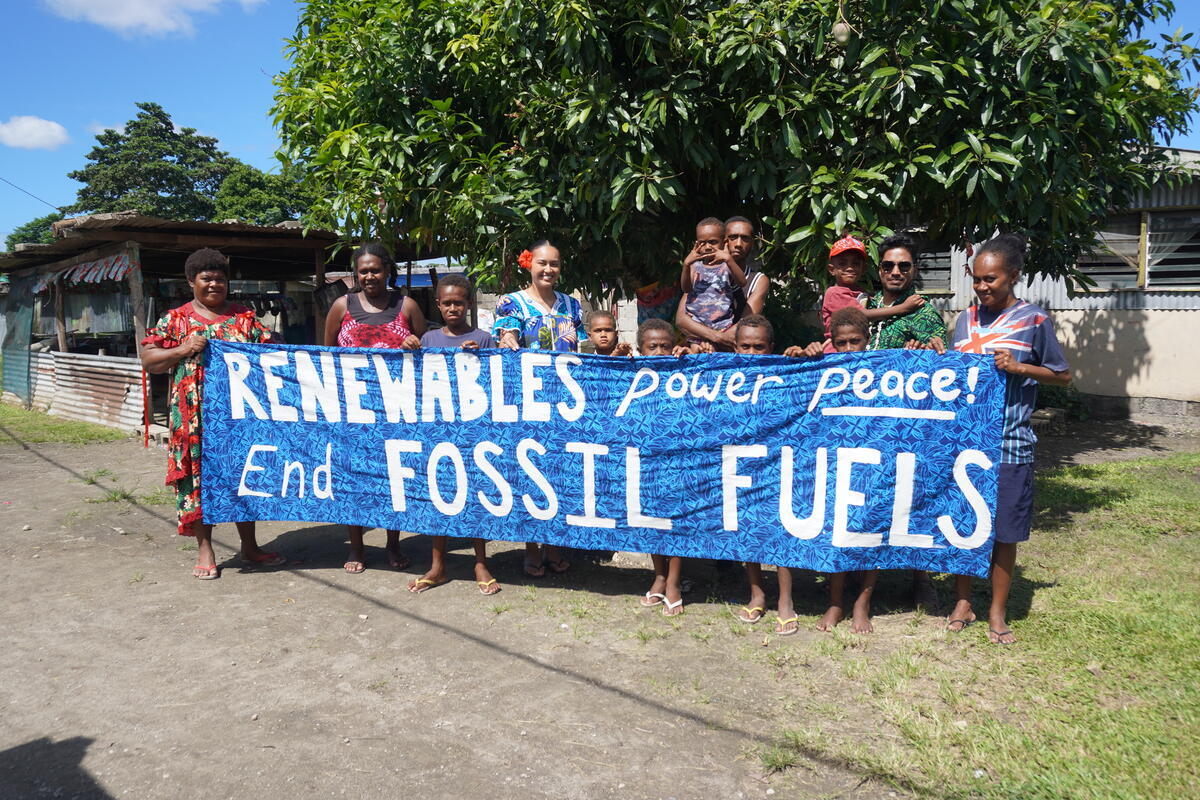
In 2026, the dangers of fossil fuel dependence have been laid bare like never before. The illegal invasion of Iran has brought pain and destruction to millions across the Middle East and triggered a global energy crisis impacting us all. Communities in the Pacific have been hit especially hard by rising fuel prices, and Australians have seen their cost-of-living woes deepen.
Such moments of crisis and upheaval can lead to positive transformation. But only when leaders act with courage and foresight.
There is no clearer statement of a government’s plans and priorities for the nation than its budget — how it plans to raise money, and what services, communities, and industries it will invest in.
As we count down the days to the 2026-27 Federal Budget, will the Albanese Government deliver a budget for our times? One that starts breaking the shackles of fossil fuels, accelerates the shift to clean energy, protects nature, and sees us work together with other countries towards a safer future for all? Or one that doubles down on coal and gas, locks in more climate chaos, and keeps us beholden to the whims of tyrants and billionaires.
Here’s what we think the moment demands, and what we’ll be looking out for when Treasurer Jim Chalmers steps up to the dispatch box on 12 May.
1. Stop fuelling the fire
2. Make big polluters pay
3. Support everyone to be part of the solution
4. Build the industries of the future
5. Build community resilience
6. Be a better neighbour
7. Protect nature
1. Stop fuelling the fire

In mid-April, Pacific governments and civil society met to redouble their efforts towards a Fossil Fuel Free Pacific. Moving beyond coal, oil and gas is fundamental to limiting warming to 1.5°C — a survival line for vulnerable communities and ecosystems. And as our Head of Pacific, Shiva Gounden, explained, it is “also a path of liberation that frees us from expensive, extractive and polluting fossil fuel imports and uplifts our communities”.
Pacific countries are at the forefront of growing global momentum towards a just transition away from fossil fuels, and it is way past time for Australia to get with the program. It is no longer a question of whether fossil fuel extraction will end, but whether that end will be appropriately managed and see communities supported through the transition, or whether it will be chaotic and disruptive.
So will this budget support the transition away from fossil fuels, or will it continue to prop up coal and gas?
When it comes to sensible moves the government can make right now, one stands out as a genuine low hanging fruit. Mining companies get a full rebate of the excise (or tax) that the rest of us pay on diesel fuel. This lowers their operating costs and acts as a large, ongoing subsidy on fossil fuel production — to the tune of $11 billion a year!
Greenpeace has long called for coal and gas companies to be removed from this outdated scheme, and for the billions in savings to be used to support the clean energy transition and to assist communities with adapting to the impacts of climate change. Will we see the government finally make this long overdue change, or will it once again cave to the fossil fuel lobby?
2. Make big polluters pay

While our communities continue to suffer the escalating costs of climate-fuelled disasters, our Government continues to support a massive expansion of Australia’s export gas industry. Gas is a dangerous fossil fuel, with every tonne of Australian gas adding to the global heating that endangers us all.
Moreover, companies like Santos and Woodside pay very little tax for the privilege of digging up and selling Australians’ natural endowment of fossil gas. Remarkably, the Government currently raises more tax from beer than from the Petroleum Resource Rent Tax (PRRT) — the main tax on gas profits.
Momentum has been building to replace or supplement the PRRT with a 25% tax on gas exports. This could raise up to $17 billion a year — funds that, like savings from removing the diesel tax rebate for coal and gas companies, could be spent on supporting the clean energy transition and assisting communities with adapting to worsening fires, floods, heatwaves and other impacts of climate change.
As politicians arrive in Canberra for budget week, they will be confronted by billboards calling for a fair tax on gas exports. The push now has the support of dozens of organisations and a growing number of politicians. Let’s hope the Treasurer seizes this rare window for reform.
3. Support everyone to be part of the solution
As the price of petrol and diesel rises, electric vehicles (EVs) are helping people cut fuel use and save money. However, while EV sales have jumped since the invasion of Iran sent fuel prices rising, they still only make up a fraction of total new car sales. This budget should help more Australians switch to electric vehicles and, even more importantly, enable more Australians to get around by bike, on foot, and on public transport. This means maintaining the EV discount, investing in public and active transport, and removing tax breaks for fuel-hungry utes and vans.
Millions of Australians already enjoy the cost-saving benefits of rooftop solar, batteries, and getting off gas. This budget should enable more households, and in particular those on lower incomes, to access these benefits. This means maintaining the Cheaper Home Batteries Program, and building on the Household Energy Upgrades Fund.
4. Build the industries of the future
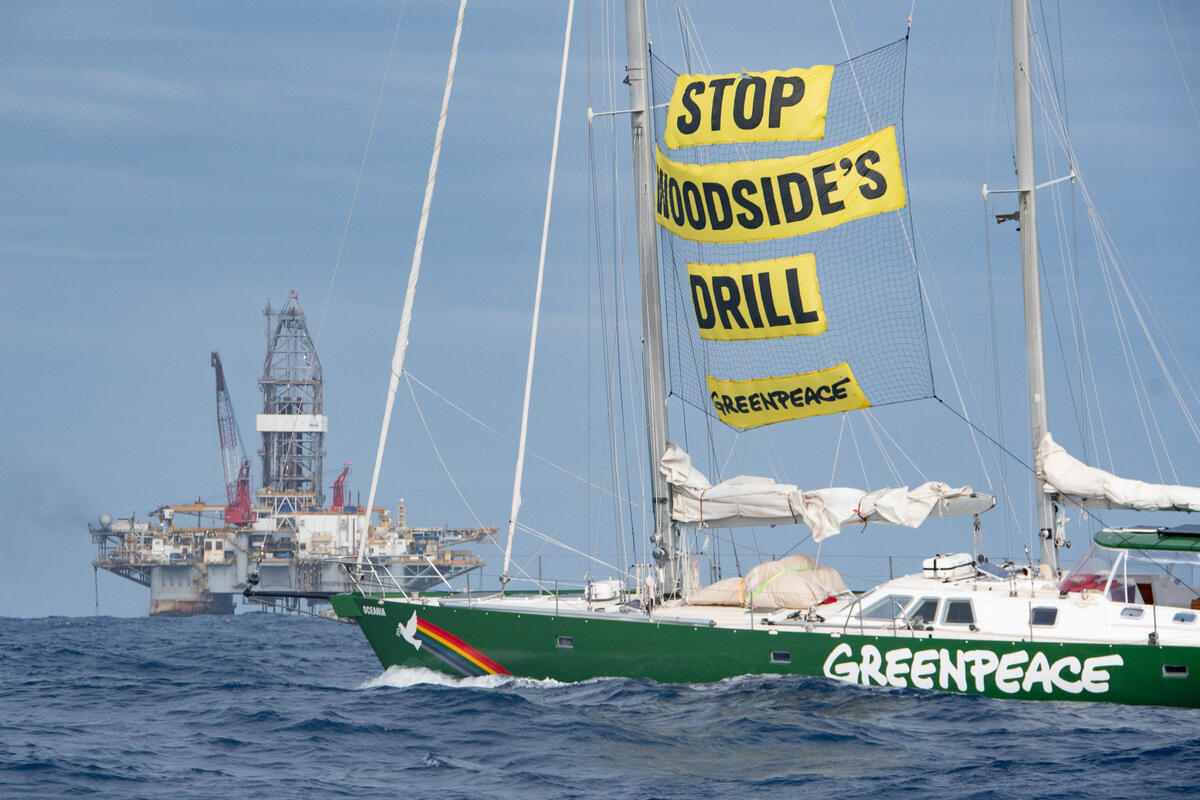
If we’re to transition away from fossil fuels, we need to be building the clean industries of the future.
No state is more pivotal to Australia’s energy and industrial transformation than Western Australia. The state has unrivaled potential for renewable energy development and for replacing fossil fuel exports with clean exports like green iron. Such industries offer Western Australia the promise of a vibrant economic future, and for Australia to play an outsized positive role in the world’s efforts to reduce emissions.
However, realising this potential will require focussed support from the Federal Government. Among other measures, Greenpeace has recommended establishing the Australasian Green Iron Corporation as a joint venture between the Australian and Western Australian governments, a key trading partner, a major iron ore miner and steel makers. This would unite these central players around the complex task of building a large-scale green iron industry, and unleash Western Australia’s potential as a green industrial powerhouse.
5. Build community resilience
Believe it or not, our Government continues to spend far more on subsidising fossil fuel production — and on clearing up after climate-fuelled disasters — than it does on helping communities and industries reduce disaster costs through practical, proven methods for building their resilience.
Last year, the Government estimated that the cost of recovery from disasters like the devastating 2022 east coast floods on 2019-20 fires will rise to $13.5 billion. For contrast, the Government’s Disaster Ready Fund – the main national source of funding for disaster resilience – invests just $200 million a year in grants to support disaster preparedness and resilience building. This is despite the Government’s own National Emergency Management Agency (NEMA) estimating that for every dollar spent on disaster risk reduction, there is a $9.60 return on investment.
By redirecting funds currently spent on subsidising fossil fuel production, the Government can both stop incentivising climate destruction in the first place, and ensure that Australian communities and industries are better protected from worsening climate extremes.
No communities have more to lose from climate damage, or carry more knowledge of practical solutions, than Aboriginal and Torres Strait Islander peoples. The budget should include a dedicated First Nations climate adaptation fund, ensuring First Nations communities can develop solutions on their own terms, and access the support they need with adapting to extreme heat, coastal erosion and other escalating challenges.
6. Be a better neighbour
The global response to climate change depends on the adequate flow of support from developed economies like Australia to lower income nations with shifting to clean energy, adapting to the impacts of climate change, and addressing loss and damage.
Such support is vital to building trust and cooperation, reducing global emissions, and supporting regional and global security by enabling countries to transition away from fossil fuels and build greater resilience.
Despite its central leadership role in this year’s global climate negotiations, our Government is yet to announce its contribution to international climate finance for 2025-2030. Greenpeace recommends a commitment of $11 billion for this five year period, which is aligned with the global goal under the Paris Agreement to triple international climate finance from current levels.
This new commitment should include additional funding to address loss and damage from climate change and a substantial contribution to the Pacific Resilience Facility, ensuring support is accessible to countries and communities that need it most. It should also see Australia get firmly behind the vision of a Fossil Fuel Free Pacific.
7. Protect nature

There is no safe planet without protection of the ecosystems and biodiversity that sustain us and regulate our climate.
Last year the Parliament passed important and long overdue reforms to our national environment laws to ensure better protection for our forests and other critical ecosystems. However, the Government will need to provide sufficient funding to ensure the effective implementation of these reforms.
Greenpeace has recommended $500 million over four years to establish the National Environment Agency — the body responsible for enforcing and monitoring the new laws — and a further $50 million to Environment Information Australia for providing critical information and tools.
Further resourcing will also be required to fulfil the crucial goal of fully protecting 30% of Australian land and seas by 2030. This should include $1 billion towards ending deforestation by enabling farmers and loggers to retool away from destructive practices, $2 billion a year for restoring degraded lands, $5 billion for purchasing and creating new protected areas, and $200 million for expanding domestic and international marine protected areas.
Conclusion
This is not the first time that conflict overseas has triggered an energy crisis, or that a budget has been preceded by a summer of extreme weather disasters, highlighting the urgent need to phase out fossil fuels. What’s different in 2026 is the availability of solutions. Renewable energy is now cheaper and more accessible than ever before. Global momentum is firmly behind the transition away from fossil fuels. The Albanese Government, with its overwhelming majority, has the chance to set our nation up for the future, or keep us stranded in the past. Let’s hope it makes some smart choices.