

‘Guilt-free’ holiday flights powered by carbon-free hydrogen are one step closer after Rolls-Royce built a NASA-tested engine which could be used in passenger planes.
In a world-first, a Rolls-Royce Pearl 15 aircraft engine usually used in private jets was powered with 100% hydrogen during several weeks of testing at NASA’s Stennis Space Center in Mississippi.
It is the first time an airline engine has been run on 100% hydrogen while simulating all the power surges required for a typical commercial flight, such as accelerating for take off.
The successful test marks the latest milestone in moving global aviation towards greener fuels and away from kerosene, with experts involved saying hydrogen-powered holiday flights could take off from British airports from the late-2030s to early 2040s.
The test was financially supported by airline easyJet, which has made multi-million pound investments in experiments around future aero engine technologies.
Adam Newman, Chief Engineer of Rolls-Royce’s Hydrogen Demonstrator Programme, was on the ground in Mississippi when the engine, built in Germany and finished in Derby, was tested during February and March.
Revealing that 50 tons of equipment was involved, he told the Daily Mail: ‘Literally nobody has achieved this before.

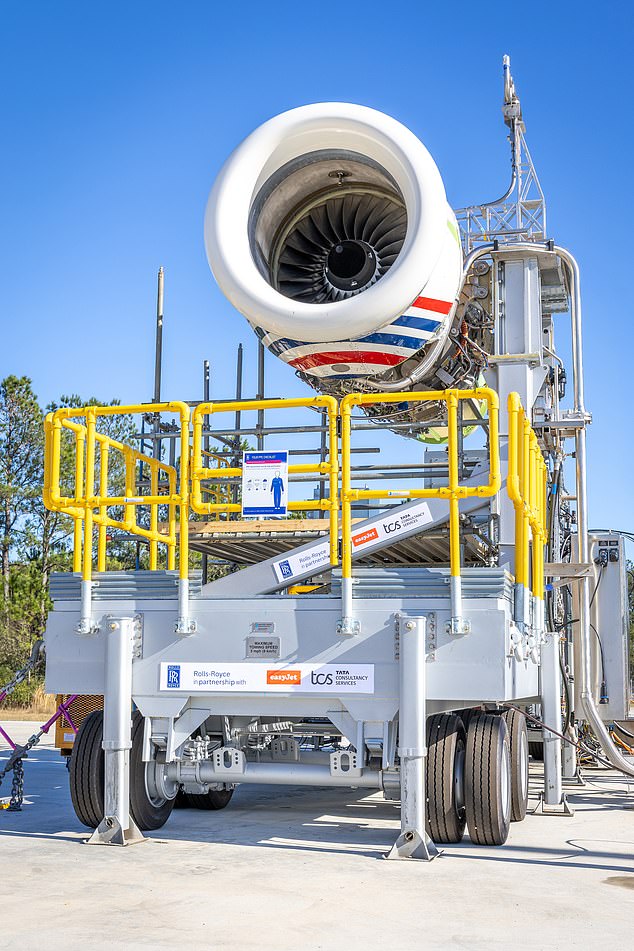
The Rolls-Royce Pearl 15 aircraft engine being tested at NASA ’s Stennis Space Center in Mississippi

Around 50 tons of equipment was involved in the test, which took place over February and March

The Rolls-Royce Pearl 15 aircraft engine being tested at NASA ’s Stennis Space Center in Mississippi. It was a ground test which simulated in-flight engine use
‘Nobody has run an aero gas turbine, as far as we’re aware, like we have.
‘I think we’ve had about 60 partners in the UK, about 100 globally, who’ve helped us bring this program together.
‘The effort we’ve had to bring into this program shows how hard it is and how much we’ve had to push the boundaries.’
Speaking of the test itself, he added: ‘Generally, the test program exceeded our expectations. By the time we got to the end of the program, the engine ran pretty flawlessly.’
He said ‘we’re talking a decade or more, so probably the 2040s,’ when asked when the first hydrogen-powered UK commercial flight could get off the ground.
He added that when they do finally hit the runway, fliers should ‘feel no difference’ in terms of the overall flight experience.
David Morgan, easyJet’s Chief Operating Officer at easyJet, added: ‘This industry-first is a real testament to the progress our partnership with Rolls-Royce has achieved, taking hydrogen from early concept through to full engine build and successful testing in just a few years.
‘Demonstrating 100% hydrogen operation at scale is a significant milestone and marks an important step towards easyJet’s net zero ambition, supporting the long-term transition to more sustainable aviation.’
For decades, hydrogen has traditionally been seen as an unattractive fuel for aviation thanks to its association with the Hindenburg airship disaster of 1937.
The flammable gas erupted in a fireball that killed 35 passengers and crew after a botched landing.

Hydrogen in gas form was used to power the the Rolls-Royce Pearl 15 aircraft engine during testing at NASA ’s Stennis Space Center

The Rolls-Royce Pearl 15 aircraft engine being tested at NASA ’s Stennis Space Center in Mississippi. It was a ground test which simulated in-flight engine use
However, the fuel is now being revisited for aviation as the industry looks to cut down on its carbon emissions.
This is because batteries, like those used in electric vehicles, would currently be too big and heavy to use in airplanes, particularly for long-haul flights.
The industry is therefore looking to other fuel sources to power flights sustainably.
Rolls-Royce and easyJet have previously teamed up to test hydrogen on airplane engines, including at the Ministry of Defence’s Boscombe Down airfield in 2022. But Mr Newman said those experiments were more preliminary and only tested whether the engine would ‘idle’ over.
By contrast, the NASA experiment was much more strenuous and tested the engine as though it were being used on a typical commercial flight.
Hydrogen can be a zero-carbon form of travel if the electricity used for the electrolysis process – when water is split into hydrogen and oxygen – comes from renewable sources.
Flying with greener, zero-carbon fuels such as hydrogen has previously been branded ‘guilt-free’ travel as there is little to no impact on the environment.
Christine Powell, NASA Stennis’s Acting Centre Director, said: ‘This milestone is a great example of how our infrastructure and expertise can be leveraged to advance future technologies and solve broader challenges.’