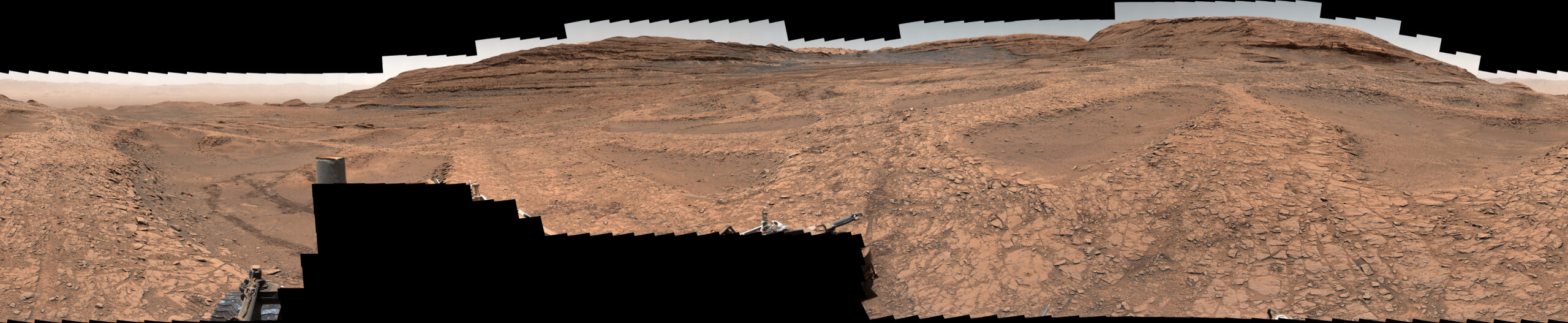
NASA’s Curiosity and Perseverance rovers have captured two 360-degree landscapes that highlight how the missions are revealing details of the Red Planet’s formation, watery past, and potential for life. Located 2,345 miles (3,775 kilometers) apart from each other on Mars — about the distance from Los Angeles to Washington, D.C. — both rovers are exploring areas that are billions of years old. But as the nearly 15-year-old Curiosity reaches ever-younger terrain in the foothills of Mount Sharp, the 5-year-old Perseverance is venturing into some of the oldest landscapes in the entire solar system. By time-traveling in opposite directions, the rovers are filling in missing details about the planet’s history.
Stitched together from 1,031 images taken between Nov. 9 and Dec. 7, 2025, Curiosity’s 360-degree panorama offers a detailed look into a region filled with a vast network of boxwork formations: Resembling giant spiderwebs in orbiter images, the low ridges were created by groundwater that once flowed through large fractures in the bedrock. The minerals left behind hardened the rock along the fractures, resulting in erosion-resistant ridges.
Perseverance’s panorama focuses on a place nicknamed “Lac de Charmes,” which sits outside the rim of Jezero Crater. Taken between Dec. 18, 2025, and Jan. 25, 2026, 980 images were stitched together for a 360-degree view capturing the Jezero rim and ancient rocks around the crater.
Today, both of these landscapes are frigid deserts, but evidence of a more dynamic past hides within. When Curiosity landed on the floor of Gale Crater in 2012, it set out to determine whether Mars once had the conditions to support life. Within a year, a sample drilled from an ancient lakebed confirmed those conditions had been present, including the right chemistry and potential nutrients for microbes.
Since 2014, Curiosity has been ascending Mount Sharp. Towering 3 miles (5 kilometers) above the crater floor, the mountain first began forming when layers of sediment were deposited in a series of lakes. Long after those lakes dried up, ponds and streams returned several times, leaving a record in the mountain’s layers that formed in drier eras. Because the lowest layers are oldest and higher layers are youngest, Curiosity is essentially progressing back through geological time as it slowly climbs the mountain.
Last year, Curiosity’s team documented how they found that the mineral siderite might be storing carbon dioxide that once was part of a thicker, early atmosphere. Scientists had long suspected that carbonate minerals such as siderite formed when carbon dioxide dissolved into ancient lakes, but such deposits had only rarely been found.
The mission also announced the detection of three of the largest organic molecules ever found on Mars in a sample it had drilled in 2013. The discovery of these long-chain hydrocarbons — possibly the remnants of fatty acids — are a milestone in the search for more complex, prebiotic chemistry on the Red Planet.
And this year, they announced that a rock Curiosity drilled and analyzed in 2020 includes the most diverse collection of organic molecules ever found on the Red Planet. Of the 21 carbon-containing molecules identified in the sample, seven of them were detected for the first time on Mars.
Perseverance landed in Mars’ Jezero Crater in 2021 to study the origin of ancient rocks within the crater and to hunt for evidence that microbial life once existed. Billions of years ago, molten rock cooled to form the floor of Jezero Crater. A river then fed a lake in the crater, leaving behind sediments where traces of microbes could have been preserved. In 2024, the mission discovered a rock nicknamed “Cheyava Falls” that was dotted with “leopard spots,” a pattern formed by chemical reactions that microbes are known to create in rocks here on Earth.
While Curiosity pulverizes its rock samples for analysis, Perseverance collects samples as intact rock cores, each about the size of a piece of blackboard chalk, and stores them in metal tubes. Aside from a backup set of 10 tubes Perseverance deposited in a sample depot, the rover keeps all its samples (23 so far) on board in its interior. Scientists hope to get these samples into labs on Earth where they can investigate them more fully with instruments far bigger and more complicated than those that can be sent to Mars.
Meanwhile, Perseverance continues to investigate other aspects of the Red Planet. For instance, this past fall, mission scientists shared the first recordings of electrical sparks in passing dust devils — a phenomenon that had only been theorized before Perseverance’s microphones caught them. A separate study detailed how one of Perseverance’s sensitive cameras was able to capture the first visible light auroras from the surface of another planet.
Both missions are looking forward to the next discoveries as they continue to unravel the secrets of Mars. Curiosity has left the boxwork region behind as it continues to explore a mountain layer enriched in salty minerals called sulfates; Perseverance will keep heading toward locations that hold exceptionally old terrain, including one called “Singing Canyon.”
Managed for NASA by Caltech, NASA’s Jet Propulsion Laboratory in Southern California built and manages operations of both Curiosity and Perseverance on behalf of the agency’s Science Mission Directorate as part of NASA’s Mars Exploration Program portfolio.
To learn more about NASA’s exploration of Mars, visit:
https://science.nasa.gov/mars
News Media Contact
Andrew Good
Jet Propulsion Laboratory, Pasadena, Calif.
818-393-2433
andrew.c.good@jpl.nasa.gov
Karen Fox / Alana Johnson
NASA Headquarters, Washington
202-358-1600 / 202-358-1501
karen.c.fox@nasa.gov / alana.r.johnson@nasa.gov
2026-025