


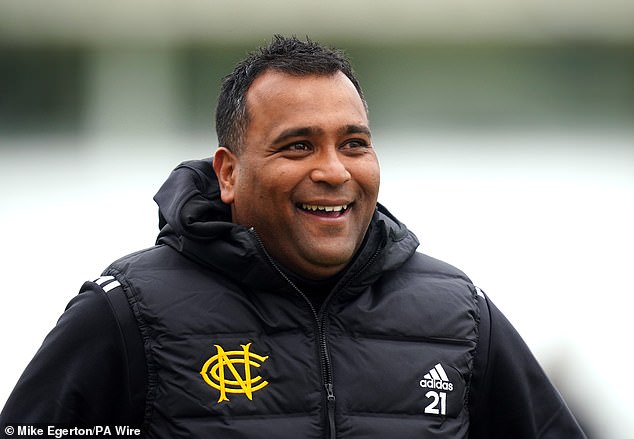
Samit Patel is sat an under-arm lob away from the County Championship trophy, a competition he won twice as a player, reflecting upon a career in English cricket that began last century and came to a juddering halt this week.
As revealed by Daily Mail Sport earlier this week, Patel, 41, has been banned from playing professionally in this country in 2026 after featuring in a ‘disapproved’ tournament – the World Legends Pro League held in India earlier this year.
The bombshell news came last week in the form of an ECB email warning that should he find a county to employ him for a 24th straight season in the Vitality Blast – stretching back to Twenty20’s embryonic days of 2003 – he would be ineligible.
Patel admits frustration at a ruling that has also prevented his former club Nottinghamshire fielding Peter Siddle as an overseas player this summer, but places the burden of responsibility at his own door for not checking the league’s status before heading to Goa in January. ‘It’s my mistake really, never assume,’ he says.
Having explored the possibility of opportunities at Kent and Warwickshire following a two-year spell as Derbyshire’s white-ball captain, he will now split his time playing for Hoylandswaine in the Huddersfield League at weekends, be open to franchise postings overseas and watch his 12-year-old son Rahil, a chip off the old block who bowls left-arm spin and bats right-handed, in action for Nottinghamshire’s age group teams.
Intriguingly, Patel has also applied to succeed Luke Wright as England’s national selector following encouraging chats with men’s director Rob Key.

Samit Patel’s career in English cricket came to a shuddering halt earlier this week

Patel won every domestic pot during his career, while he was capped against all formats for England and featured in the historic 2012-13 Test series win in India
Holding court in Trent Bridge’s newly-opened Gold Bar, nestled behind the pavilion, he says: ‘I think I’ve got a good enough eye for talent, so, who knows?’
Patel made his second XI Championship debut for the county aged 14 in 1999, became the first Englishman to the Twenty20 double of 5,000 runs and 250 wickets on the way to winning every domestic pot including the Hundred, was capped across all formats and featured in the historic 2012-13 Test series win in India.
Reminding us that he has always been his own man, he weighs into the debate over whether England’s No 3 Jacob Bethell would be better served playing in the County Championship ahead of June’s Test series against New Zealand, as suggested by Alastair Cook, or be working behind the scenes as a bench warmer at the Indian Premier League with Royal Challengers Bangalore, as advocated by Kevin Pietersen, saying: ‘I’m with Kev. He’s still hitting balls, and he’s with the best coaches around the world.
‘His coach is Andy Flower, who knows English cricket. Surely, Flower’s in his ear saying: “You’ve got a big Test series coming up, do some work.”
‘Jacob Bethell’s experience in English cricket is not much, he’s not played that much county cricket, but he’s got one of the best batters ever, Virat Kohli, who he can just talk batting to, so, I don’t think it’s such a bad thing.’
So, how different would an England team consigned to a humiliating 4-1 Ashes defeat last winter looked under Patel’s watch?
‘The style of cricket, I like. It’s more exciting. Good viewing. When did you ever see England teams knock off 350 before? It was unheard of when I started playing four-day cricket. We would just shut up the shop, wouldn’t bother, but now we actually go for it, like when Ben Stokes and Jonny Bairstow knocked off the runs against New Zealand here,’ he says.
‘That was from the same regime. We just got done in the Ashes by skill level. Nothing else. We didn’t pick the wrong blokes. Skill levels just weren’t up to scratch.
‘Who else would you have picked? If it wasn’t Zak Crawley? Or Ben Duckett? Or Brydon Carse? There wasn’t anybody out of the circle. We could’ve probably picked Chris Woakes because I don’t think he was done and we needed someone like him: holds an end, handy with the stick, knows what he’s doing, an experienced Test cricketer.

Patel recalls the ‘frightening’ experience of featuring in the million dollar showdown with West Indies in Antigua organised by the disgraced American financier Allen Stanford in 2008
‘I know Keysy won’t like this, but we got done by a wicketkeeper standing up to the stumps to Scott Boland and Michael Neser. We were outskilled.’
As he discusses his own highs and lows, Patel unwittingly reminds us of his long-standing ability to swat away set-backs, recalling his first-ever bowl in T20 cricket 23 years ago.
‘It was at Headingley in front of a full house on Sky. I was still at school. I told all my boys to watch it. Patel comes in, first over – first ball, no ball, six, and the free hit goes for six as well. One ball and I’ve gone for 14,’ he chuckles. ‘It can only get better after that, can’t it? Can’t get any worse.’
Despite starting first match figures of 1-0-28-0, Patel established himself as one of the most effective limited-overs bowlers in the land and hangs up his boots as the second most prolific bowler in Blast history, behind Sussex’s Danny Briggs.
By 2008, he was considered to be in the best XI England could muster, featuring in the winner-takes-all, million dollar showdown with West Indies in Antigua organised by the disgraced American financier Allen Stanford.
An experience that lingers in Patel’s memory for lots of wrong reasons.
‘It was frightening how people were so desperate to play in that million-dollar game,’ he says.
‘We had this open net session and it was so heated, it was like we weren’t a team.
‘Who didn’t want that kind of cash? We obviously didn’t want it enough! Because the West Indies boys had been having a camp for a month and they had bigger black bats than we did. Because our black bats were not going anywhere when we hit it. When they hit it, they were getting out of town.’
A cheque with multiple zeros on did his head his way in 2017, though, when he claimed the £10,000 prize as the Professional Cricketers’ Association’s MVP and was voted the domestic scene’s player of the year by his peers.
His influence on a white-ball trophy double that summer included a man-of-the-match award in the Twenty20 final victory over Warwickshire at Edgbaston and an unbeaten hundred in an English 50-over record chase of 371 to beat Essex in the semi-final at Chelmsford.
‘All the Essex boys had gone home at half time to get their going out gears, and I said to Peter Moores: “Leave this one with me, I’m going to bring us home here.” And I did.
‘Steven Mullaney took all the pressure off me, just let me bat, and I could just knock us to victory.’
There were also back-to-back double hundreds in the Championship that season for a player who consistently set the highest bar at domestic level, but faced perennial accusations of not being fit enough to merit international selection.
Yet he still appeared 60 times for his country and leaves the stage with one regret: never having played a Test match on home soil.