April 22, 2026
4 min read

NASA’s Roman Space Telescope will begin its revolutionary mission in September
Ahead of schedule and under budget, the Nancy Grace Roman Space Telescope will launch in early September. The mission aims to map the universe in unprecedented detail
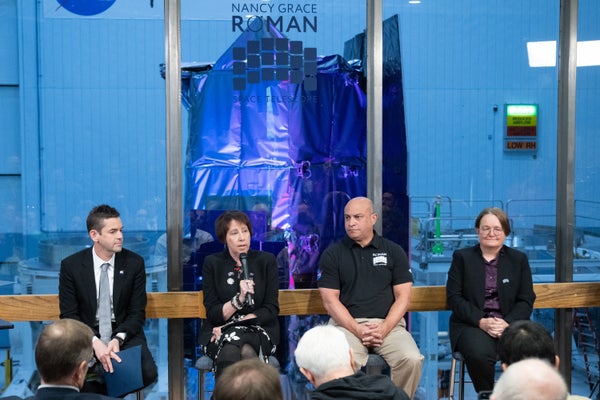
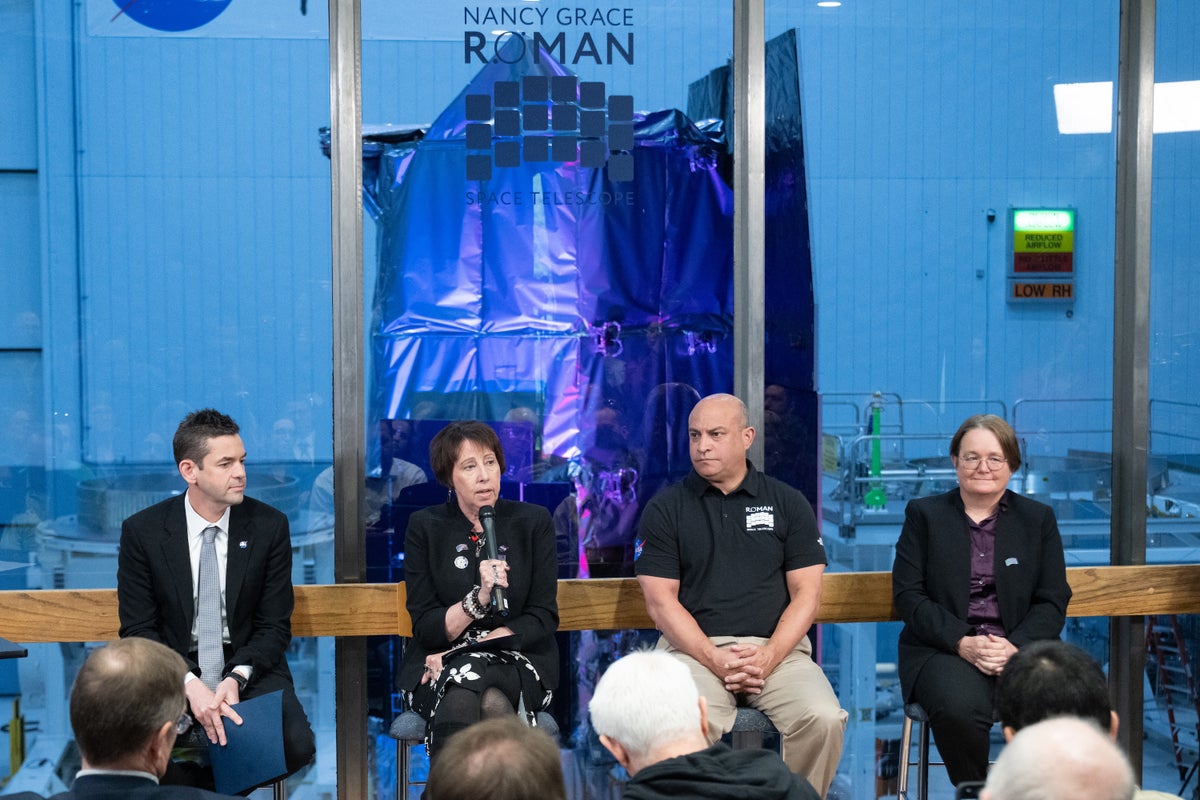
Left to right: NASA’s Jared Isaacman, Nicky Fox, Jamie Dunn and Julie McEnery sit in front of the Nancy Grace Roman Space Telescope on April 21, 2026.
SAUL LOEB/AFP/Getty Images
GREENBELT, Md.—On Tuesday NASA administrator Jared Isaacman set an early September launch window for the Nancy Grace Roman Space Telescope—a multibillion-dollar “flagship”-class observatory that is poised to probe the accelerating expansion of the universe and chart vast numbers of distant planets, stars and galaxies.
“Roman will give the Earth a new atlas of the universe,” Isaacman said during a news conference at NASA’s Goddard Space Flight Center. Behind him loomed the completed space telescope, standing more than 42 feet tall and 14 feet wide in a testing bay of a cavernous Goddard clean room. “What would take Hubble 2,000 years to process, Roman can do in a year,” he said, referring to the space agency’s aging but active Hubble Space Telescope.
The new telescope’s mirror is the same size as Hubble’s but offers a more panoramic field of view—so sprawling, in fact, that no screen now in existence can display a single Roman image at full resolution. (Roman is named for NASA’s former chief astronomer, who is often credited as the “mother of Hubble” for her critical work to launch that iconic telescope.)
On supporting science journalism
If you’re enjoying this article, consider supporting our award-winning journalism by subscribing. By purchasing a subscription you are helping to ensure the future of impactful stories about the discoveries and ideas shaping our world today.
The $4.3-billion spacecraft will ship in mid-June to NASA’s Kennedy Space Center in Florida for launch preparations. In a rare flourish for the space agency, which has seen many of its largest science missions suffer delays and ballooning costs, Roman is months ahead of schedule and under budget. Having completed space vacuum and temperature tests, the observatory only has a few assays left. Those involve the deployment process in which it will unfold antennas in space, says NASA’s Jackie Townsend, Roman’s deputy project manager, as well as minor tasks such as small repairs on a few solar panels. Once those are completed, Roman will be packed up for shipment and will finally launch onboard a SpaceX Falcon Heavy rocket in September.
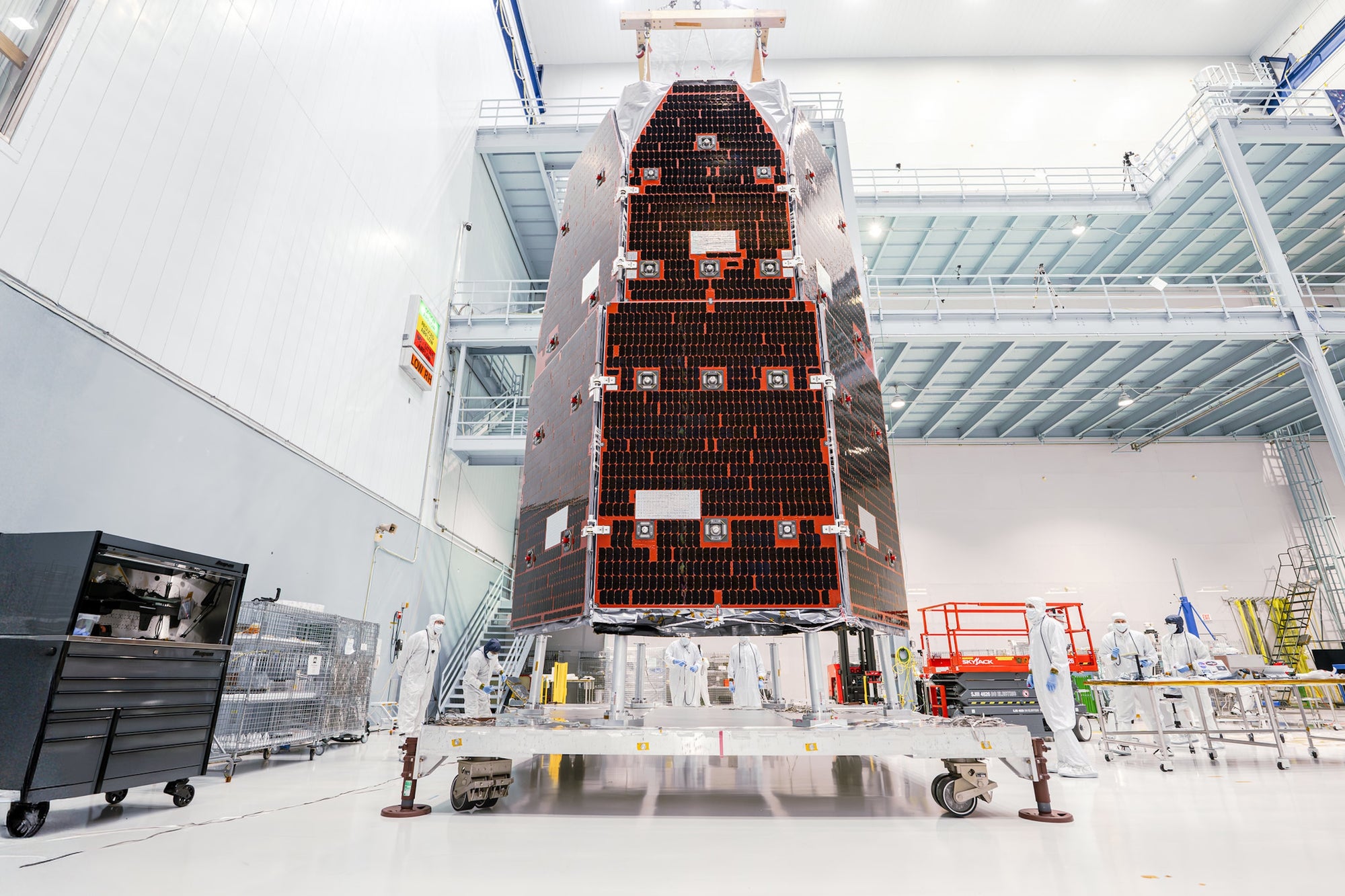
A view of NASA’s Nancy Grace Roman Space Telescope inside a clean room at the space agency’s Goddard Space Flight Center.
Astronomers have so far cataloged about 6,000 planets orbiting nearby stars, noted Nicola Fox, associate administrator for NASA’s Science Mission Directorate, at the news event. In its five-year primary mission, Roman is expected to discover tens of thousands of new planets, she said, as well as billions of galaxies and tens of billions of stars. But what most excites astrophysicists is Roman’s potential for answering some of their biggest questions about the universe itself.
“Current observations hint that our standard model of the universe is incorrect,” said NASA’s Julie McEnry, a telescope senior project scientist, pointing to the open astrophysical questions of dark matter holding many galaxies together and “dark energy” powering their expansion from one another at an increasing rate—cosmological puzzles that have remained unsolved for decades. By probing the structure and distribution of galaxies across cosmic history, “we’ll also study how the universe itself has expanded over time,” McEnry said. “These are the keys to unlocking the fundamental nature of dark matter, dark energy and the fabric of the universe itself.”
Roman’s studies will be critical accompaniments to other large telescopes that are chasing these cosmic mysteries. Such instruments include the European Space Agency’s Euclid mission and the ground-based Vera C. Rubin Observatory.
In 2012, as NASA was struggling with development of its James Webb Space Telescope (which subsequently launched in 2021), the U.S. National Reconnaissance Office, an intelligence agency, donated two surplus wide-field telescopes and optics to the space agency. That kick-started development of what became the Roman telescope, which had previously borne the unwieldy name of WFIRST (Wide-Field Infrared Survey Telescope) based on a 2010 astronomy panel report from the National Academies of Sciences, Engineering, and Medicine that recommended its creation. It would be “wrong” to suppose the spy agency’s donation led to Roman’s successful scheduling and budget performance, however, says Jamie Dunn, a project manager for Roman, in answer to a question from Scientific American. Adapting the donated hardware to NASA’s needs “posed its own challenges,” he says. “It did not make it easy.”
That’s partially why, rather than following a smooth, direct path to the launchpad, Roman endured years of a hard budget “cap” on the project’s funding. This tied future congressionally appropriated dollars to key milestones that Roman’s development would need to hit in its schedule and budget performance. The guarantee of future money, Townsend says, allowed NASA to “buy down risk” on various new technologies without fearing budget cuts and led to steady work on its development.
Last year Roman survived a severe budget cut proposed by the White House, thanks to Congress keeping its funding. At the Goddard news conference on Tuesday, Isaacman said the agency would look to the mission for “lessons learned” in building future flagship-class missions. (He offered no answers to questions about the latest White House budget, which calls for sharp cuts to NASA’s science, and deferred to a congressional appropriations hearing on Wednesday.)
Equipped with a broad-viewing, 7.9-foot-wide primary telescope mirror, Roman’s surveying capabilities are more than 1,000 times faster than the storied Hubble Space Telescope, Isaacman noted, and can capture 200 times more of the sky in a single image. Once Roman is launched, the first 45 days of its mission will consist of deploying its solar panel and antennas. The next 45 days will be devoted to calibrating its optics, which include a first-of-its-kind, high-contrast coronagraph designed to block light from stars to reveal otherwise-hidden orbiting planets.
Much like Roman itself, whose overachievements in cost and schedule pave the way for even bigger projects, this coronagraph is a crucial demonstration for NASA’s next ambitious flagship: the Habitable Worlds Observatory, which will seek to image Earth-like planets around nearby stars.
“I very much hope, and in fact expect, that the most exciting science from Roman is going to be the things that we didn’t expect, that we couldn’t predict, that will set the new deep questions for future missions,” McEnry said.