
More than 160,000 people will lose access to the NDIS by 2030 as the government cuts back the program, with Australians who have lower support needs set to be moved off the scheme.
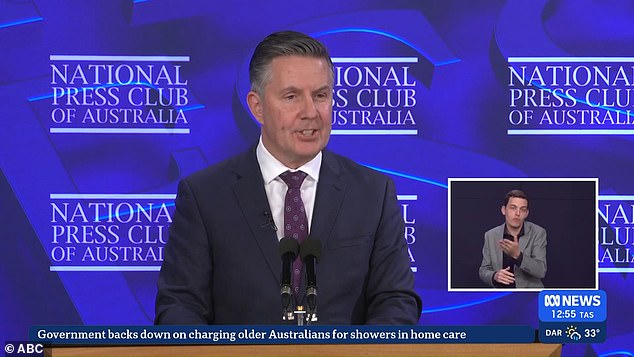
NDIS and Health Minister Mark Butler used a National Press Club address on Wednesday to outline a major overhaul that will tighten eligibility rules, cut spending on some support categories, reduce third‑party management costs, and introduce new provider standards.
‘The NDIS was originally intended to support around 410,000 people with a disability. Today, there are 760,000 people on the scheme,’ Butler said.
‘While new eligibility rules need to be worked through, our initial modelling will see the number of people on the scheme reduce to around 600,000 by the end of the decade, instead of growing to well over 900,000.’
A key focus of the reforms is the scheme’s social and community participation budget, which Butler said has blown out from $4 billion a year five years ago to $12 billion this year.
‘Today, that one stream of NDIS is costing about the same as what we spend in net terms on the entire Pharmaceutical Benefits Scheme,’ he said.
Butler said average participant spending on social and community participation had also jumped sharply, rising from $14,000 five years ago to about $31,000 today.
‘Over the next two years, our changes will bring that figure down to about $26,000 per participant, back to where it was in 2023,’ he said.
‘Without these changes, that figure would have been closer to $33,000.’
Butler said Labor would be ‘moving quickly to improve the quality and reduce the cost of the huge number of intermediaries in the scheme – those third parties who manage the majority of NDIS plans and claims.’
He said the current market‑driven model had encouraged some providers to prioritise profits over care.
‘Market models are designed to create competition, but too often in the NDIS, we see that competition play out with third parties cutting costs and cutting corners to get as many plans on the books as possible rather than trying to win clients based on quality of their services.
‘Instead of this contest continuing, our Government will identify a short list of accountable, quality providers, which people can then choose from.’
‘While many support workers provide valuable supports, too many participants tell us their support workers are spending more time on their phones than engaging with them and providing support.
‘We’ve received reports of participants falling out of their wheelchairs while a support worker is scrolling on their phone. There’s no connection there. There’s no participation, there’s no inclusion.
‘This is not only a failure to show respect and dignity, it’s also a safety issue. This approach hasn’t just led to the decline of genuine community support, it’s also become extraordinarily expensive.’
The government will also establish a $200 million Inclusive Communities Fund to help community organisations provide alternatives outside costly NDIS‑funded supports.
Another major reform will reduce spending on plan managers and third‑party intermediaries by 30 per cent.
‘Many of these people provide valuable support to participants. But others have no qualifications or background in disability services and seem more interested, too often, in clipping the ticket,’ he said.
Labor will also tighten access to the NDIS, following the Thriving Kids reform that redirects mildly autistic children away from the program.
‘The bill I intend to introduce in the budget sittings will allow us to introduce standardised, evidence‑based assessments of a person’s functional capacity to determine access to the scheme,’ Butler said.
‘In line with the scheme’s original intent, access will be based upon a significant reduction in a person’s functional capacity that impacts their day‑to‑day living. It will also remove the use of lists that decide on a participant’s eligibility based on diagnosis alone.’
Butler criticised providers accused of rorting the system and cited research showing 60 per cent of Australians held negative views of the NDIS, driven by concerns over spending and fraud.
‘When we talk about fraud in the NDIS, we are not talking about people with disability, we are not talking about families who have been put on a plan or offered support,’ Butler said.
‘The fraud in the NDIS is being perpetrated by lowlifes who are scamming both the taxpayer and people with disability.
‘Australians expect the NDIS to support people with a disability and their families and to continue to transform their lives in the way we’ve seen happen over the past 13 years.
‘Not for it to be an atm for shonks and drifter, fraudsters and crooks.’
The legislation to control the scheme’s growth will be completed by the end of the year, with new rules to be in place by January 2028.
‘In terms of eligibility, that is something we need to work through much more carefully with the community and with states,’ he told the National Press Club.
‘I’d like to see that work done by the end of this calendar year so that we can then start putting in place new eligibility rules that people all understand and building that assessment tool.
‘I’d see that starting on January 1, 2028, for new entrants or new applicants for the scheme, and then … ongoing reassessment for existing participants over a period of time as their plans came out for renewal.’

Butler (pictured) said that 160,000 would likely lose access to the scheme under new plans

Mark Butler (pictured) announced the changes on Wednesday at the National Press Club

Butler said that the government would crackdown on bad carers within the NDIS (file)