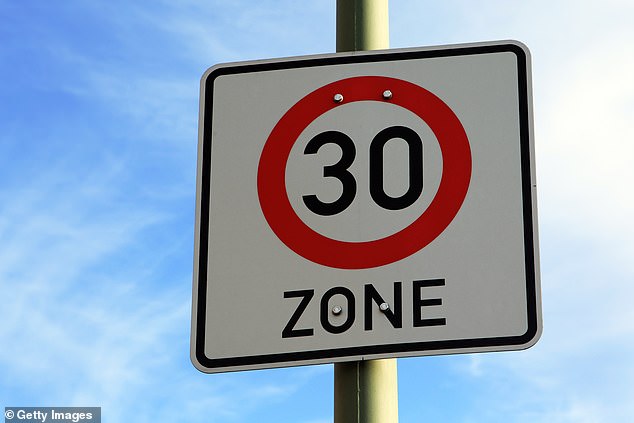
A plan to slash speed limits to 30km/h in suburban streets has been slammed as ‘nanny state’ interference, though experts say it could save countless lives.
The contentious plan, which is part of a 30-year blueprint released by Victoria’s infrastructure advisory body, has also been slammed as a ‘cash grab’.
The strategy would start with reducing speed limits in residential streets which already have 40km/h hour zones, such as around schools, playgrounds and kindergartens.
Eventually any local street that currently has a 50km/h limit would be turned into 30km/h zones.
Dr Jonathan Spear of Infrastructure Victoria said ‘slower speeds make streets safer’ and the recommendation was designed to help have more people walking or riding bikes.
‘A pedestrian hit by a car at 50km/h has an 85 per cent chance of dying. At 30km/h this falls to 10 per cent,’ he said.
But the proposal was immediately slammed online, with one person writing “Is the state Labor party getting in early for April Fools’ Day? Surely this is a joke”.
Road safety expert Professor Raphael Grzebieta, previously told Daily Mail Australia that reducing speed limits would save lives, if only politicians had the will to do so.

A plan to slash speed limits to 30km/h in local streets has been slammed as ‘nanny state’ interference, though experts have pointed out that cutting speed saves lives (stock image)
While Prof Grzebieta did not call for a 30km/h limit, he said for suburban streets, speed limits should be set to a maximum of 40km/h.
‘At the moment, the default is 50. In the Northern Territory it’s a crazy 60,’ he said.
‘It’s just too high and it should be set to 40km/h, because at night when you’re driving your car in a built-up area, you have to set it to low beam.
‘The major feeder roads have sufficient lighting, but in residential streets the lighting’s not so good and you won’t see a pedestrian with low beam.’
A pedestrian’s chances of surviving being hit are 10 times higher if the speed limit was reduced from 50 to 40, he said.
‘If you set the speed at 40, which is a reasonable speed for such residential streets, you will spot the pedestrian just in time to apply your brakes and reduce the speed of your car to 30,’ Prof Grzebieta said.
Amid strong opposition, one commenter said it was a ‘Labor grab for cash’, while another declared Victoria a ‘nanny state’.
Many of those outraged by Infrastructure Victoria’s 30km/h proposal said it was unacceptable as it would increase their commute times.

Dr Jonathan Spear of Infrastructure Victoria said ‘slower speeds make streets safer’ (stock)
But Monash University researcher Lauren Pearson said data showed local street speed limits ‘do not increase our times on the road at all’.
‘Not only do we have traffic lights which really slow us down, but we also know that through implementing (lower speed limits) we get more people that are able to use walking and bike riding instead of having to take the car,’ she told the ABC.
‘You actually end up with less cars on the road, particularly around these peak times.’
Despite fears that Infrastructure Victoria’s plan is a ‘cash grab’, Local Government Minister Melissa Horne said a roll out of a 30km/h limit on residential streets and near schools and kindergartens, was not going to happen any time soon.
But she told the Herald Sun that the government would work with councils to decrease speed limits in particular area, adding she was currently in ‘active conversations’ with more than a dozen councils.