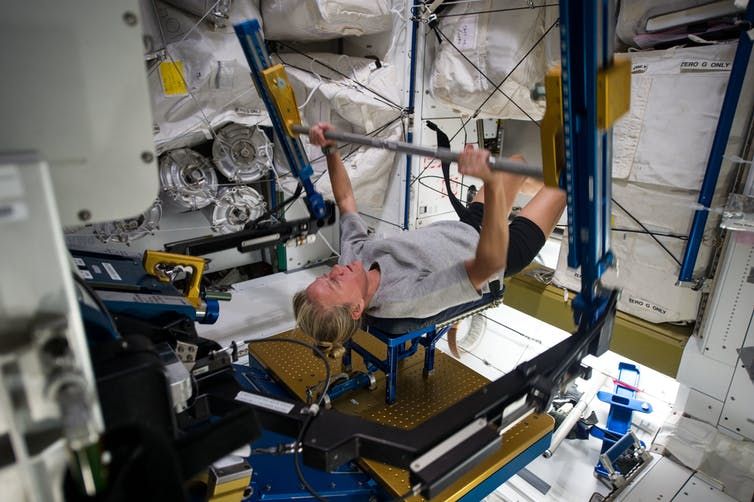
It turns out that living in space can have a lasting impact on how your brain works, researchers have found.
In space, astronauts have to learn to live without gravity — whether they’re aboard the International Space Station (ISS) or on a journey to the moon, such as with NASA’s Artemis 2 mission. While space adventurers do experience microgravity conditions beyond Earth, that gravitational influence is so minimal that you can think of it as a virtually weightless environment. But while floating around might sound fun, even simple tasks like holding an object can post unique challenges. So, scientists have wondered, how does the brain adapt to this kind of lifestyle?
In a new study, researchers from the Université catholique de Louvain and Ikerbasque, the Basque Foundation for Science, explored how astronauts’ brains adapt to weightlessness. The team studied changes in how astronauts grip objects when going from Earth to space and then back to Earth again.
Article continues below
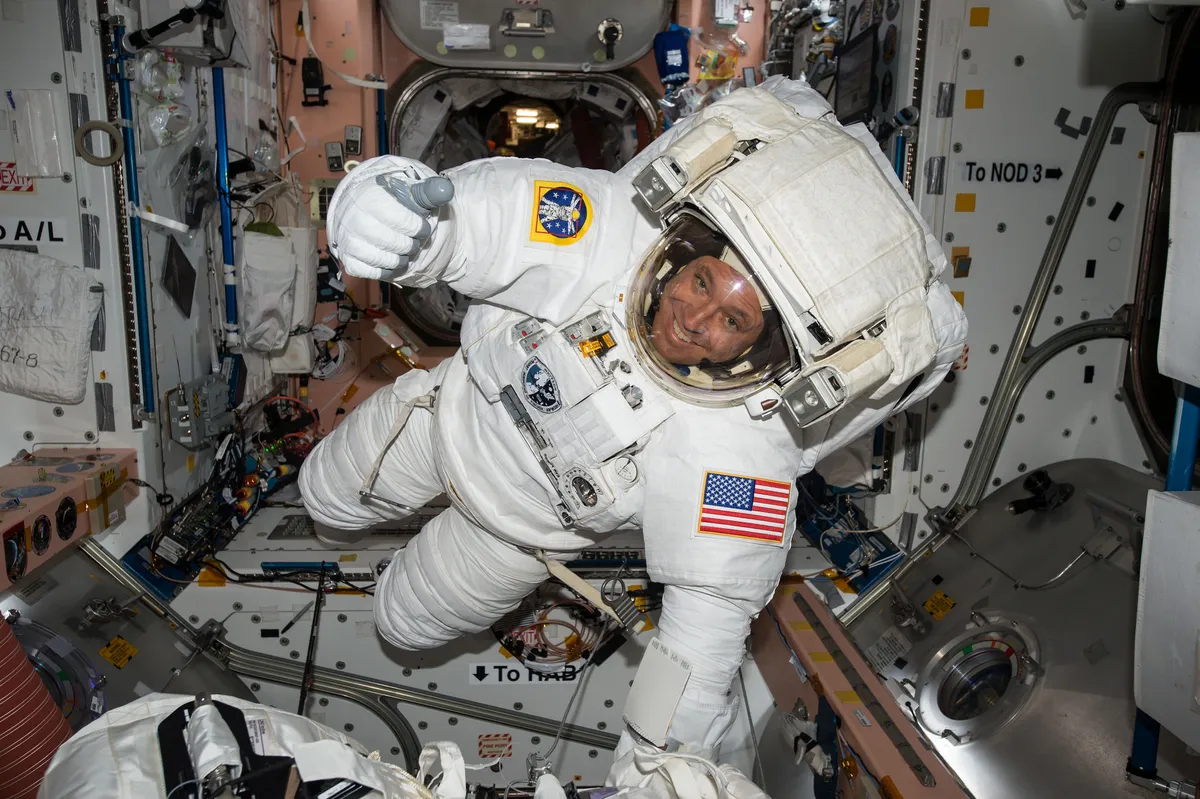
The results were a little stranger than you might expect, and could have serious consequences for future astronaut safety.
“What we observed was totally unexpected,” lead author Philippe Lefèvre, a Professor of Biomedical Engineering, Université catholique de Louvain, told Space.com.
The researchers found that months after returning to Earth from space, astronauts had trouble exerting the correct amount of force to properly grip an object. In fact,their brains were so used to gripping weightless objects in space that it took them months back on Earth to readjust.
Similarly, the team also found that, while in space, astronauts actually exerted more force than necessary to grip objects because their brains still expected the presence of gravity.
Essentially, both during a mission in space and after returning to Earth, astronauts “misinterpret sensory feedback,” Lefèvre said.

Grip vs gravity
To conduct their study and investigate the ways human brains adapt to major changes in gravity, researchers analyzed grip force and movement in a total of 11 European Space Agency astronauts both on Earth and in space. In both scenarios, the astronauts performed repetitive movements while gripping an object, which were later studied by the team (back on Earth).
Living on Earth with the force of gravity, we know that if we let go of an object, both inertia and the weight of the object (a combination of mass and gravity) will cause it to fall. In space, only inertia causes objects to move. For instance, simply letting go of an object won’t make it “fall,” but tapping down on it would have the same visual effect because you’ve added a manual force. But while we might know this intellectually, it turns out that it takes some time for our brains to catch up to our gravity (or gravity-less surroundings).

These findings, which show how astronauts in space and then again back on Earth exert an incorrect amount of force to grip objects, suggest it takes our brains time to gradually adjust to a sudden lack of or a return in gravity — at least, in terms of grip strength. This could have significant implications for future astronauts traveling to the ISS, the moon, and maybe even beyond someday.
Having the right grip on an object could be the difference between conducting a routine procedure without a hitch or having a piece of that experiment slip away and into something fragile aboard a spacecraft. The correct grip could be the deciding factor in whether an astronaut correctly maneuvers a robotic arm or successfully performs a medical procedure.
Understanding how the brain and grip are affected by gravitational changes could also have safety implications, especially during events like spacewalks or even moonwalks. Even exercising aboard the ISS could be dangerous if someone’s grip were to slip.
“Even if the risk of slippage is low, the consequence of slippage would be really dramatic,” Lefèvre explained. “If you move at high speed [with] a big object onboard the ISS, and you lose the grip, the object will keep going. It’s gonna hit something, and it could be dramatic in terms of safety.”
Both in space and on Earth, it’s important to keep a grip on things.
A study about these results was published Today (April 20) in the Journal of Neuroscience.