Iran peace talks are on a knife-edge as Donald Trump refused to end his blockade and warned bombs will ‘start going off’ if a deal is not reached by tomorrow.
Tehran has also said it is ‘prepared for military confrontation’ and will ‘punish the US’ if the President fails to pause his naval siege and enter talks.
The warring parties are due to meet in Islamabad, the capital of Pakistan, today, but it is unclear if the summit will go ahead after American forces seized an Iranian tanker and the regime closed the Strait of Hormuz again.
US Vice President JD Vance was expected to depart last night to lead the US side, but Mr Trump said he would ‘not be rushed into making a bad deal’. He said it was ‘highly unlikely’ he would extend the deadline, and warned PBS News that if no deal is reached, then lots of bombs start going off’.
Mr Trump also denied reports that he was considering lifting the blockade of Iranian ports, saying: ‘They want me to open it. The Iranians desperately want it opened. I’m not opening it until a deal is signed.’
However, he simultaneously said the truce will now expire by ‘Wednesday evening Washington time’ – 24 hours later than the original deadline.
He also insisted in a separate interview that Mr Vance and peace envoys Steve Witkoff and Jared Kushner would land in Islamabad overnight, and he could even go himself to sign a deal.
Tehran views the US naval siege as a ‘fundamental obstacle to negotiations’, with hardliners saying entering talks while it remains in place would be a ‘strategic mistake’.

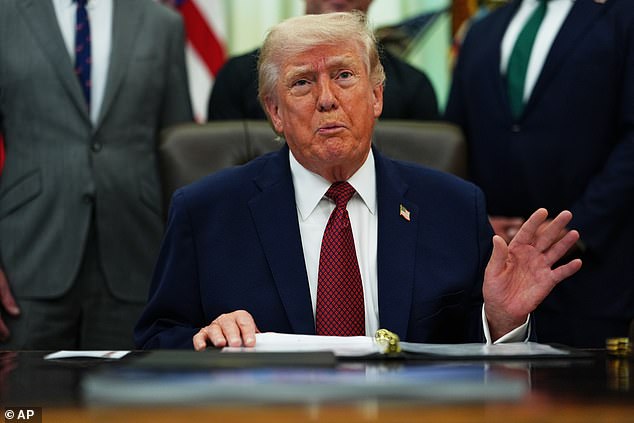
Donald Trump refused to end his blockade and warned bombs will ‘start going off’ if a deal is not reached by tomorrow

Tehran has also said it is ‘prepared for military confrontation’ and will ‘punish the US’ if the President fails to pause his naval siege and enter talks

Tehran said it was planning to attack US force in retaliation for the Navy’s raid on an Iranian tanker which tried to breach the American blockade on Sunday

US Vice President JD Vance was expected to depart last night to lead the US side, but Mr Trump said he would ‘not be rushed into making a bad deal’
They have said that the US ‘did not fulfil its promise’ by keeping it in place after Iran opened the strait last week as part of the ceasefire arrangement. Iran retaliated by closing the Strait again before the US seized an Iranian-linked oil tanker.
Hardliners in the Islamic Revolutionary Guard Corps (IRGC), which runs the country behind the scenes, take a harsher stance than some public-facing politicians. A senior official in the regime yesterday said it was ‘positively reviewing’ its participation in talks. However, an IRGC-affiliated news agency later said that Tehran has not ‘altered its decision to abstain’ from talks.
It said that the US messages to Iran ‘contain further excessive demands that cloud the prospects for the upcoming talks’.
Iranian foreign ministry spokesman Esmaeil Baqaei warned: ‘We have no plans for the next round of negotiation, and no decision has been made. The US is carrying out behaviours that do not in any way indicate seriousness in pursuing a diplomatic process.’
Iranian president Masoud Pezeshkian warned that a ‘deep historical mistrust’ persists.
He said that honouring commitments ‘is the basis of meaningful dialogue’ and that ‘unconstructive and contradictory signals’ signal that the US in fact ‘seek Iran’s surrender. Iranians do not submit to force’.
Mr Trump yesterday once more insisted that any deal would have one non-negotiable – that Iran must ‘get rid of their nuclear weapons’. The last round of talks in Islamabad reportedly collapsed after the US insisted Tehran stop enriching uranium for a minimum of 20 years, while the regime insisted on five years.
But there appeared to be some movement last night, as officials close to the talks told the Wall Street Journal that a ten-year pause could break the impasse.
The blockade remained in place last night, with just three ships passing through the strait. The US military says it has directed 27 ships to turn around or return to Iranian ports since the start of the blockade a week ago.
There will be a second round of talks between Israel and Lebanon on Thursday. A ten-day ceasefire began last Thursday.