


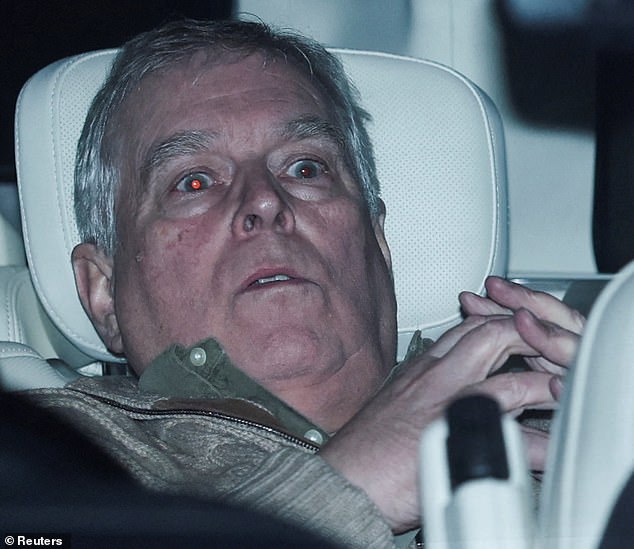
Andrew Mountbatten-Windsor’s lawyers blocked FBI investigators from interviewing him over his links to Jeffrey Epstein after being told he was a suspect in their inquiry, not a witness.
Emails buried in the Epstein Files expose how, from January 2020, Andrew’s legal team became embroiled in nine months of fraught negotiations with US authorities over his cooperation with their inquiry into the late paedophile financier.
In June that year, his legal team said he’d offered to assist the Department of Justice as a witness three times.
But the emails, unearthed by The Mail on Sunday, show he was being sought for interview not merely because he might have information about Epstein – but because he was under suspicion.
In a letter to US prosecutors in September 2020, his solicitor Gary Bloxsome wrote: ‘You have confirmed to us… that you regard our client not as a witness but as a subject.’ He said the designation had been relayed in January that year, through a liaison officer and again during subsequent meetings.
Prosecutors did not dispute the claim, continuing instead to press for an oral interview rather than the written statement Andrew’s team offered as a ‘compromise’.
A US legal source said last night: ‘If someone is a subject of a federal investigation it means investigators are looking at evidence and seeing whether they have enough to prove involvement in a criminal activity.
‘Under those circumstances no lawyer would allow their client to talk freely as they could end up incriminating themselves.’

Andrew Mountbatten-Windsor pictured on the day he was arrested on suspicion of misconduct in public office – although he is yet to be charged with a criminal offense

Then-Prince Andrew was pictured with Virginia Roberts, aged 17 at the time, at Ghislaine Maxwell’s London townhouse in 2001
The correspondence began in January 2020 when Mr Bloxsome wrote to the Department of Justice saying Andrew ‘has a strong desire to cooperate fully with the ongoing investigation’.
By June, however, his team said they could not ‘commit to a particular form of cooperation’ without assurances of confidentiality.
The following month, prosecutors offered limited confidentiality but warned they were ‘not able to provide a broader grant of immunity with respect to statements made by your client during a voluntary interview’.
In September, Mr Bloxsome proposed a written witness statement and further engagement through written questioning as ‘a fair compromise’.
But the DoJ rejected the offer and filed a request to the Home Office to compel Andrew to be interviewed. That attempt ultimately failed.
A second US legal source said last night that subject status ‘means that prosecutors believe they have evidence linking you to a crime. There was a very real concern from his legal side that he might be considered a subject or target. That is why they would not let him sit for a deposition.’
Mr Bloxsome, of London firm Blackfords, is nicknamed ‘Good News Gary’ for looking on the bright side for clients.
In February, Andrew was arrested on suspicion of misconduct in public office over Epstein. He has not been charged.
Andrew and Mr Bloxsome were approached for comment.