The car has always been complicit in climate change.
Over the years, its gas-guzzling engines have been redesigned, its exhaust filtered, but fossil-fueled transportation is still the third-largest source of global carbon pollution — even with the advent of electric vehicles.
Worse, the Trump administration is working to cancel fuel-efficiency standards, electric vehicle incentives, and solar and wind installations while promoting the extraction, piping, and burning of fossil fuels. But Trump’s boastful promises of cheap gas have been undone by his bellicose foreign adventures. The price of gas is the highest it’s been since October 2023. The high prices of oil and intervention could drive a return to more efficient machines and renewable-energy-friendly policies.
Read more: What the Iran conflict means for gas prices, clean energy, and the climate
Carbon pollution, however, is not the car’s only legacy. It has redesigned our cities and our landscapes. True carbon solutions for transportation will require that we rethink more than our fuels and engines.
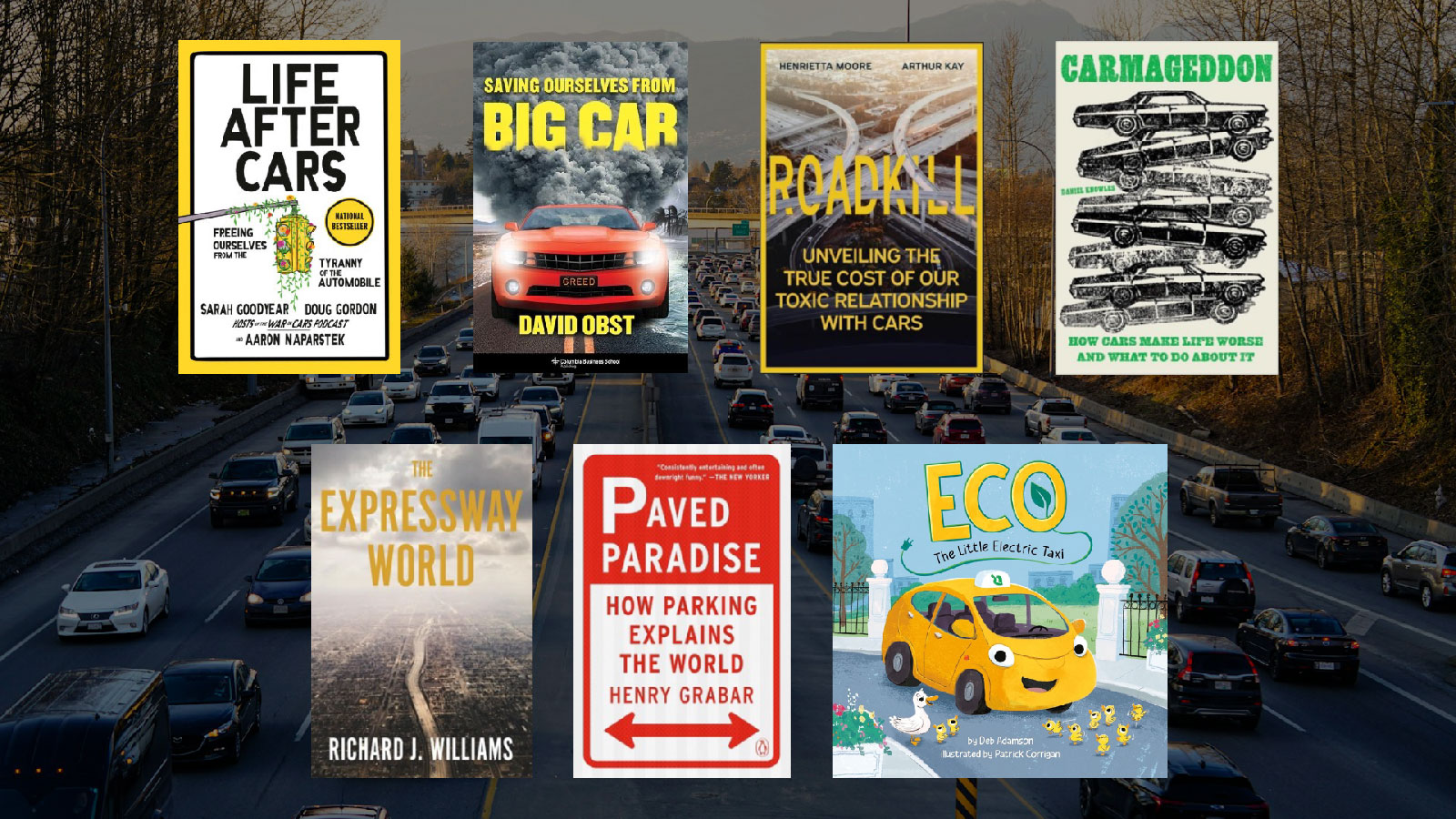
The six titles specially collected here, five of which were published within the last year, begin that work. Four address the car problem at large; the remaining two concentrate on the collateral impacts of cars: expressways and parking spaces.
As always, the descriptions of the titles are adapted from copy provided by their publishers. Where two dates of publication are listed, the second is for the paperback edition.

Life After Cars: Freeing Ourselves from the Tyranny of the Automobile by Sarah Goodyear and Doug Gordon (Thesis Books 2025, 304 pages, $28)
When the very first cars rolled off production lines, they were a technological marvel, predicted to make life easier and better for all Americans. A hundred years later, that dream is running on empty. Instead of unbounded freedom, the never-ending proliferation of automobiles has delivered a host of costs, among them the demolition of our neighborhoods, towns, and cities to make way for car infrastructure; an epidemic of violent death; countless hours lost in traffic; isolation from our fellow human beings; and the ongoing destruction of the natural world. Globally, SUVs alone now emit more carbon than the nations of Germany, South Korea, or Japan. It’s past time to radically rethink society’s collective relationship with the automobile. But with the tools provided by Goodyear and Gordon, we can create a better Life After Cars.

Saving Ourselves from Big Car by David Obst (Columbia Business School Publishing 2025, 286 pages, $27.95)
This book exposes how “Big Car”—the complex of companies in the automobile, oil, insurance, media, and concrete industries that promote and entrench car dependence —has pursued profit at the expense of the common good. David Obst explores how Big Car gained almost immeasurable influence over our lives, weighing the benefits and the costs of reliance on private automobiles. He details how industry covered up the harms of lead additives, fought against seatbelts, and continues to fund climate-change denialism. Obst considers the future of mobility, surveying how cities—from Taipei to Tempe—are experimenting with forms of transportation that challenge the dominance of cars. Provocative and comprehensive, Saving Ourselves from Big Car is a powerful wake-up call for us to change how we use cars before it’s too late.

Roadkill: Unveiling the True Cost of Our Toxic Relationships with Cars by Henrietta Moore & Arthur Ray (Wiley Books 2025, 304 pages, $28)
While the car has been marketed as a symbol of “freedom”, urban designers Henrietta Moore and Arthur Kay convincingly argue that it has limited the flourishing of our cities and restricted our choices. Their book explores the philosophical implications of car culture, as well as the practical impacts it has on your money, your taxes, your neighborhood, your planet, your health, and your happiness. How can we fix our toxic relationship with cars? The authors offer a new way of thinking that promises to multiply your choices, improve your city, and expand your freedoms. Roadkill: Unveiling the True Cost of Our Toxic Relationship with Cars is a persuasive and illuminating call to action for city dwellers, drivers, environmentalists, and policy-makers―for anyone interested in practical ways to improve life and expand freedom.

Carmageddon: How Cars Make Life Worse and What to Do about It by Daniel Knowles (Abrams Press 2023/2025, 256 pages, $18 paperback)
The automobile was one of the most miraculous inventions of the 20th century. It promised freedom, style, and utility. But sometimes, rather than improving our lives, technology just makes everything worse. Over the past century, cars have filled the air with toxic pollutants and fueled climate change. Cars have stolen public space and made our cities uglier, dirtier, and more unequal. Cars have caused millions of deaths and injuries. They have wasted our time and our money. In Carmageddon, journalist Daniel Knowles outlines the rise of the automobile and the costs we all bear as a result. Weaving together history, economics, and reportage, he traces the forces and decisions that normalized cars and cemented our reliance on them. With looks at Amsterdam, Copenhagen, Tokyo, and NYC, Knowles shows that there are better ways to live.

The Expressway World by Richard Williams (Polity Books 2025, 240 pages, $29.95)
Dividing neighborhoods, depressing land values, concentrating atmospheric pollutants, and now increasingly crumbling into the ground, is there anything more toxic than the expressway? How did we build the expressway world in the first place? And what are we going to do now with it now? This eye-opening book explores these questions partly through the great expressway abolitions of recent years. But the book also uncovers the hidden stories of expressways that have become weird attractions in their own right, celebrated in art and literature. Williams proposes, counterintuitively, that we find ways to live with the expressway world and to adapt it to a different future. Engaging with case studies across the world and recent architectural theory, this is an invitation to reconsider the most maligned structures of the urban past.

Paved Paradise: How Parking Explains the World by Henry Grabar (Penguin Press 2023/2024, 368 pages, $18 paperback)
Parking, quite literally, has a death grip on America: each year a shocking number of Americans kill one another over parking spots. Since the advent of the car, we have deformed our cities in a Sisyphean quest for car storage; much of the nation’s most valuable real estate is now devoted to empty vehicles. Parking determines the design and fates of buildings, the patterns and viability of traffic and transit, neighborhood politics, municipal finance, and the quality of public space. Is parking really more important than everything else? In a beguiling and hilarious mix of history, politics, and reportage, Slate staff writer Henry Grabar shows how the nation’s parking crisis exacerbates our most acute problems— from housing affordability to global climate change—and then explains how we can free our cities from parking’s cruel yoke.
Bonus Children’s Selection!

Eco: The Little Electric Taxi by Deb Adamson, illustrated by Patrick Corrigan (Penguin Workshop 2026, 32 pages, $18.99)
For fans of Little Blue Truck and Goodnight, Goodnight Construction Site comes an adorable electric taxi cab who saves the day in this sweet picture book—with an eco-friendly twist! Eco, the little electric taxi, and his driver, Charlie, work day and night—helping people get where they need to go. On the way to a school drop-off, Eco and Charlie find themselves stuck in a huge traffic jam—there are ducks stranded in the middle of the road! Will Eco be able to help lead them to safety? With themes of environmental conscientiousness, rhyming text, and delightful art, Eco is perfect for Earth Day celebrations, or as a gift to any car-loving kid looking for a new read-aloud!