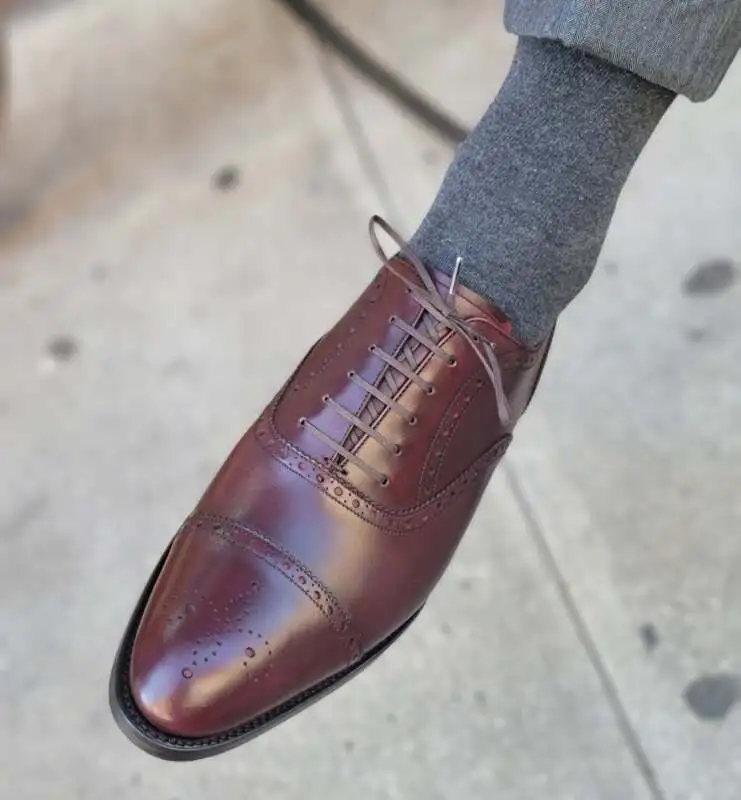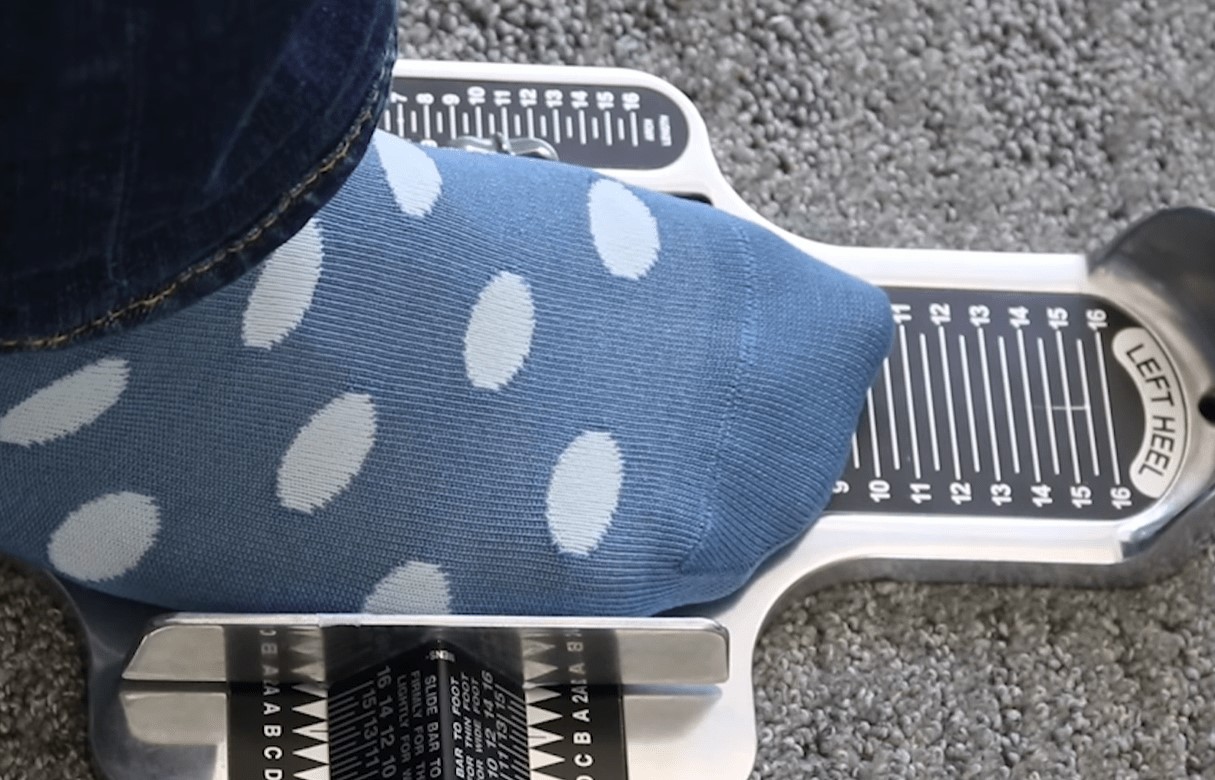
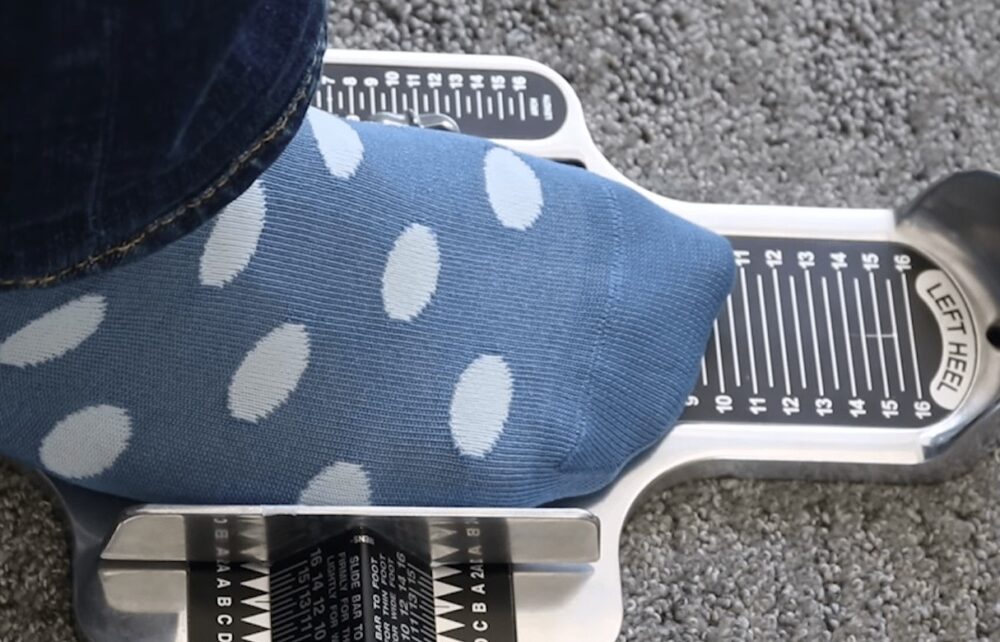
I have fit and measured thousands—literally tens of thousands—of people in my life looking to buy dress shoes. And in doing so, I’ve learned a lot about fit, how it differs from person to person, culture to culture, and why the Brannock Device as a shoe sizing method is not what it’s cracked up to be.
The Brannock Device is often treated like the holy grail of shoe sizing. It’s not. It has its place. But that place should only be a guideline—a starting point—and nothing more.
Feet Are More Complex Than Two Numbers
Feet are not simple. They are one of the most complex parts of the body when it comes to fit. You have length. You have width. But beyond that, you also have inside arch, outside arch, instep height, ankle height, toe thickness, heel girth—and the list goes on.
All of these factors affect how a shoe fits. The problem is simple: your foot is three-dimensional. The Brannock Device is not.
And what does it actually measure? Length and width… and supposedly arch length. I say “supposedly” because I never fully trusted that measurement.
For example, I measure at an arch length of around a US11, yet the length is 8/8.5. My feet are semi-flat, long, narrow, and shallow. So, if I put on a US9 shoe—which is already pushing it—my arch feels like it’s being overworked. Imagine me in a US11. I would be literally swimming in it.
I know this from experience. When I was younger (and dumber), I wore larger shoes based on my Brannock Device length. Big mistake. My feet paid the price as I was wearing shoes too big. This caused plantar fasciitis, and it only went away after I sized down.


Why Width Measurements Can Be Misleading
Even width, which people tend to rely on heavily, can be deceptive.
I’ve measured customers at 3E width and watched them swim in the shoes. I’ve measured others at E who fit perfectly into a standard D., and I’ve seen the opposite—someone measuring E but needing 3E due to the depth/girth/instep of their foot, not the width.
That’s something the Brannock Device doesn’t properly account for: volume.
A foot can be wide side-to-side, or it can be thick top-to-bottom. Those are very different fits—but they often get treated the same. Yet the Brannock device can only measure one of them: side-to-side. So are people who measure US9 in length, D in width, but have fleshy feet in height, supposed to follow the Brannock? No, they wouldn’t even be able to enter a US9D shoe.
The Biggest Mistake: Thinking You’re One Size
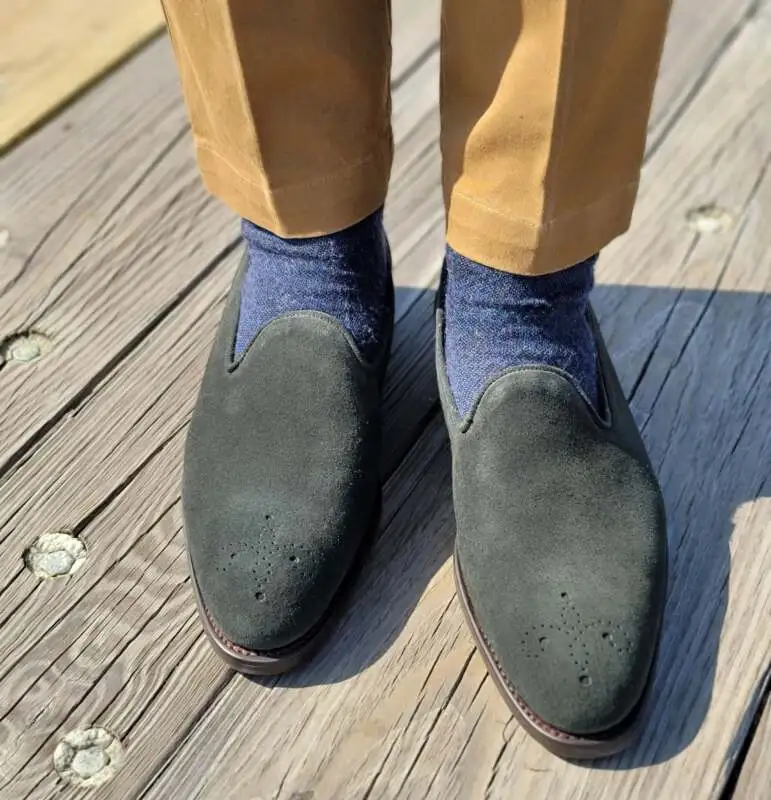
While the Brannock Device is the focus here, it’s not the only issue. The bigger problem is believing you are one fixed size.
You might be a US9D in Nike.
But in Allen Edmonds, you’re a US8.5.
In Santoni, you’re a US8.
And in Paul Parkman, you might be a EU40.5 (US7.5).
So what does your Brannock measurement really tell you? A theory. Not a fact.
It always drove me crazy when American guys were like, ‘I am a US10. In everything.’ Like, okay bro, sure thing. They were a size US10 in everything, but fit poorly in 80% of it.
Fit Is Also Cultural
This is something most people never think about. Fit is not universal—it’s highly cultural.
Many French clients don’t want a single molecule of extra space in their shoes. They will wear shoes that look smaller than their feet. Dominicans are the same. Meanwhile, many Americans want their dress shoes to feel like sneakers—roomy and forgiving. They go the opposite direction and are often wearing shoes ½-1 size too large. You have all seen this. It is so obvious when a guy is wearing a shoe too large.
Many Asian people will get shoes too large so they can easily slip them off, as it is a very strict cultural rule not to wear shoes in someone’s house, and they don’t want to constantly bend over. They will also very loosely lace their oxfords to be able to kick them off and slip them on without bending over.
I once helped a gentleman from Northern Europe—one of the Nordic countries. He told me he was a size 42 (US9). I measured him at a US11.5. So I brought out everything from 11.5 down to 9.
Guess what he bought? The US9. It baffled me. I didn’t even understand how he could get his feet into the shoes. But he did, and he was happy.
That moment stuck with me. Because it made one thing very clear: what someone prefers can override what any measuring device says.
Despite the naysayers out there, especially in the US, who swear by Brannock Devices, the reality is that the US holds worldwide market dominance for orthotics sales, at 42% in 2024. That is a staggering number.
There are two reasons why: Customers wearing the wrong size (likely from a misdiagnosed fit by a Brannock and a bad salesman), and the fact that Americans are so easily sold by some slick-talking salesmen (selling Superfeet) or doctors who upsell them on their problems to keep them as clients for life.
Why does this matter? Because it shows that we are clearly being fit incorrectly. And here, in the US, the average American swears by ‘his Brannock’ size.


Ego, Habit, and Personal Preference
And then there’s ego.
I’ve measured countless American men at smaller sizes, only for them to insist on going up at least one size. They walk out with shoes too big, slopping around, but feeling better about the number.
On the flip side, in places like the Dominican Republic, I’ve seen the opposite—men wearing shoes clearly one to two sizes too small, toes practically pressing through the front.
And yet, that’s what feels right to them. So who is actually wrong? Neither of them. Not really. Because fit is personal. So long as it doesn’t cause real problems.
–Shoes too large can cause plantar fasciitis. This will be uncomfortable to walk in. Usually works itself out in 4-6 painful months. Sometimes never.
–Shoes too small can cause curled toes, bunions, and corns.

What You Should Do Instead
The takeaway is simple: Do not put all of your faith in the Brannock Device.
Use it as a starting point—but don’t let it dictate your size. The moment you do, you’re already limiting your chances of finding the right fit. Don’t get stuck on the number. Don’t let it define you. It’s okay to be different sizes in different brands. In fact, it’s normal.
The best thing you can do—especially when buying a new brand—is research how that brand fits compared to others you already know. If your knowledge is limited, go to a store like Nordstrom Rack, where you can try on a bunch of different brands without wasting the salesman’s time. Jot down the brands and your sizes, and take note of how different brands fit differently.
That will give you far better guidance than blindly trusting a measurement and hoping for the best.
Final Thought
The Brannock Device, as your only shoe sizing method, is going to let you down. The Brannock Device gives you a reference point. But your feet—and your preferences—determine the truth. And that truth won’t always be the same size across all shoes.
—Justin FitzPatrick, The Shoe Snob
Shop · Marketplace · J.FitzPatrick · Patreon