April 3, 2026
2 min read

Where is Artemis II now? NASA mission is committed to the moon
The second day of the Artemis II moon mission saw the crew perform a series of maneuvers that put the Orion capsule on course for the lunar far side
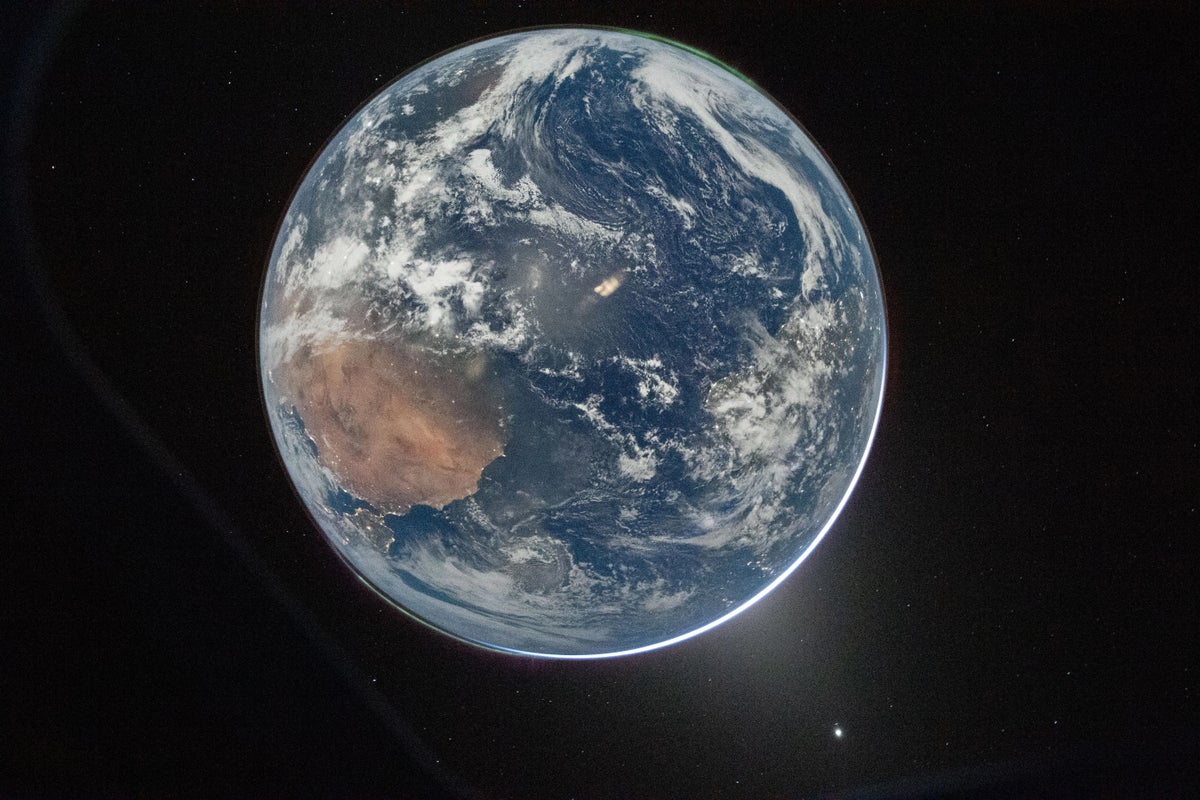
An image of Earth taken by NASA astronaut and Artemis II commander Reid Wiseman from the window of the Orion spacecraft after the crew completed a translunar injection burn. The photograph includes two auroras (top right and bottom left), and zodiacal light (bottom right) can be seen as Earth eclipses the sun.
NASA has launched four astronauts on a pioneering journey around the moon—the Artemis II mission. Follow our coverage here.
Artemis II, NASA’s first crewed mission to the moon since Apollo 17 in 1972, is on track to make good on that promise.
As of 10 A.M. EDT on Friday, the mission’s Orion spacecraft is about 88,000 miles from Earth, 170,000 miles away from the moon and traveling around 4,260 miles per hour.
On Thursday the astronauts onboard—Reid Wiseman, Victor Glover, Jeremy Hansen and Christina Koch—actually got some sleep. Then they performed a series of maneuvers that allowed them to leave Earth’s orbit and head to the moon.
On supporting science journalism
If you’re enjoying this article, consider supporting our award-winning journalism by subscribing. By purchasing a subscription you are helping to ensure the future of impactful stories about the discoveries and ideas shaping our world today.
The most crucial of these was the translunar injection (TLI) burn, which occurred at 7:49 P.M. EDT and lasted for about five minutes and 50 seconds, accelerating the spacecraft to 22,670 miles per hour. At the time, the spacecraft was just 115 miles above Earth.
This fuel burn sets Orion on a path around the moon called a free return trajectory, which essentially means the spacecraft will enter the moon’s gravitational influence (but won’t orbit our natural satellite) and will swing around its far side. That route also places Orion on track to return to Earth on the 10th day of the mission: April 10.
At a post-TLI press conference, Lori Glaze, acting associate administrator for NASA’s Exploration Systems Development Mission Directorate, said that the burn appeared successful and that “from this point forward, the laws of orbital mechanics are going to carry our crew to the moon, around the far side and back to Earth.”
The astronauts also tried out the space capsule’s flywheel exercise machine—Wiseman’s movements managed to make the live feed of the Orion capsule appear to wobble. He said he felt it was a great cardio drill—but he developed a slight static charge.
“It is a really good piece of gear, and we can actually get a nice workout,” Wiseman said.
Aside from some likely welcome stress relief and a chance to move, such workouts are vital for the astronauts to stay healthy in the zero-g conditions of their capsule. The crew also tested Orion’s water dispenser.
Also on the docket for day two was figuring out how to use Artemis II’s toilet. Shortly after reaching Earth orbit, the astronauts saw a fault alarm for the facilities, but after troubleshooting by Koch, who dubbed herself the mission’s “space plumber,” it turned out there wasn’t enough water in the toilet’s pump, NASA officials said at the press conference.
Day three, April 3, will see the Orion spacecraft perform other moves to make sure it is on the right track to the moon while the crew members perform a series of demonstrations and tests. Glover, Koch and Hansen will do a CPR demo, and Wiseman and Glover are set to check out the mission’s medical kit, which includes, among other things, a thermometer, a blood pressure monitor and a stethoscope.
Koch will also test the capsule’s emergency communications system, beaming signals to NASA’s ground-based Deep Space Network, which is a huge array of radio antennas located at different places on Earth that allows for near-continuous communications with spacecraft.
“We got eight days of work ahead,” Glaze said on Thursday.
It’s Time to Stand Up for Science
If you enjoyed this article, I’d like to ask for your support. Scientific American has served as an advocate for science and industry for 180 years, and right now may be the most critical moment in that two-century history.
I’ve been a Scientific American subscriber since I was 12 years old, and it helped shape the way I look at the world. SciAm always educates and delights me, and inspires a sense of awe for our vast, beautiful universe. I hope it does that for you, too.
If you subscribe to Scientific American, you help ensure that our coverage is centered on meaningful research and discovery; that we have the resources to report on the decisions that threaten labs across the U.S.; and that we support both budding and working scientists at a time when the value of science itself too often goes unrecognized.
In return, you get essential news, captivating podcasts, brilliant infographics, can’t-miss newsletters, must-watch videos, challenging games, and the science world’s best writing and reporting. You can even gift someone a subscription.
There has never been a more important time for us to stand up and show why science matters. I hope you’ll support us in that mission.