There is a lot of confusion when it comes to shoe pricing. I see it constantly—people expecting $300 shoes to perform like $1,200 ones, or assuming that a higher price automatically guarantees better quality. The reality sits somewhere in between, and unless you’ve seen how shoes are actually made, it’s easy to get it wrong.
So let’s simplify it. In this shoe pricing guide, I want to break down what actually determines the price of a pair of shoes, and more importantly, what you should expect in return for what you spend.
Because that’s really the key—understanding expectation.
The Three Things That Actually Set the Price
At its core, a shoe’s price is built from three variables:
- The leather (and materials)
- The labor involved
- The markup required to sell it
That’s it. Everything else—brand story, country of origin, marketing—is layered on top of those fundamentals. And while that sounds simple, each of those variables can swing wildly.

Leather: The Biggest Variable Most People Don’t Understand
Leather is where pricing can change dramatically, and it’s also the part most consumers misunderstand. Shoes aren’t made from pre-cut panels. They’re made from hides. And those hides vary in quality, size, and usable area.
A single hide might yield six or seven pairs… or fewer if the maker is being selective. And that’s where pricing starts to separate. If a brand uses the entire hide, including the less attractive sections, the cost per pair drops. If they discard large portions to ensure cleaner uppers, the cost per pair rises. Simple as that. Because no matter what, the entire hide price is going into the shoes price, whether it is entirely used or not.
A factory making the same quality of shoe, but choosing to cut one pair per hide versus six, can end up with an entirely different retail price. It will also likely produce a very different-looking shoe, simply based on where those pieces were taken from the hide.
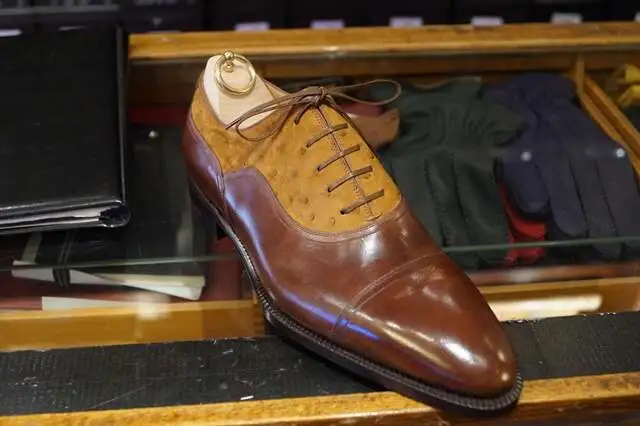

To give you a real-world example, it was once reported that a very famous shoemaker would buy third-grade leather only and cut just one pair from each hide. The logic was simple: even a third-grade hide will usually have at least one “perfect” section. By doing this, they reduced their raw material cost while still producing visually clean uppers.
So while the hide might cost $200, that one pair was effectively treated as if it contained $200 worth of leather—even though only a fraction of the hide was used for it. The rest could then be allocated elsewhere, whether for factory seconds, outlet models, or other products.
That’s the kind of nuance people don’t see.
At higher price points, what you’re often paying for is not just “better leather,” but how much of that leather is rejected in pursuit of a cleaner end result. And that has a very real cost attached to it.

Labor: Where Geography Changes Everything
Labor is the second major factor, and this is where geography starts to play a huge role in pricing.
Each country pays its workers differently, and even within a country, wages vary depending on the region. For example, a factory closer to Florence will typically have higher labor costs than one in Marche, simply due to differences in cost of living. Minimal difference but everything adds to the shoe’s retail price.
To put that into perspective, in Almansa, Spain, a three-bedroom apartment might cost around €500 per month. In Kettering, UK—where Gaziano & Girling is based—that same apartment could run anywhere from £700 to £1,000. Naturally, wages follow that reality. A factory in England is going to have to pay more than one in Spain.
And then you zoom out further.
Look at countries like Vietnam or China, where labor costs are significantly lower. You can have a shoe made to a very similar standard, but the cost to produce it will be dramatically different simply because of where it’s made. This is why Spain tends to offer strong value in welted footwear, and why hand-welted shoes coming out of Asia can often be a fraction of the price of those made in Europe.
But labor cost isn’t just wages—it’s also taxation.
In Italy, for example, if a factory worker earns €1,000 per month, the employer may have to pay roughly that same amount again in taxes and social contributions. In other words, the true cost of that worker to the factory is closer to €2,000. That’s not an outlier either—that type of burden exists across much of Europe in different forms.
And all of that gets baked into the final price of the shoe, and most people who do not live in Italy are none the wiser since they cannot know this fact. A great reason why ‘Made in Italy’ costs you more!
Shoe Pricing Markup
This is naturally the most important component to understand in this shoe pricing guide, and really what you are paying for.
In the shoe industry, the common markup sits somewhere between 2.5x–3x the cost (or wholesale price). Therefore, the greater the cost to make the shoe, the greater the absolute value of the markup you are paying.
Let’s make that very clear with simple math:
- If a shoe costs €100 to make and there is a 3x markup, you are paying €200 in markup
- If a shoe costs €150, you are paying €300 in markup (again at 3x)
Same multiplier, but a very different end result. And so it goes on.
When Wholesale Gets Involved
Now, it’s not always that simple.
If a brand intends to sell through other retailers, there is another layer added in—wholesale markup. For example, if you pay a factory €100 to produce a shoe, you might wholesale that shoe at €120–€130. From there, the retailer applies their own markup (typically around 2.7x–3x).
So that same €100 shoe quickly turns into a €300–€350 retail product, not because of greed, but because multiple parties need to make a margin—and you cannot undercut your retailers without destroying your own distribution.
How Markup Really Expands
Markup can also be, quite frankly, a bit egotistical. ‘Heritage brands’ are also charging for history and not just the countable expenditures.
Certain countries or brands that perceive themselves as superior will carry higher markups simply based on that perception. But more often than not, markup is driven by brand value, history, and demand. The stronger the brand, the higher the markup it can command. Why do you think Gucci charges what they do and gets away with it?!
This is why designer brands can easily operate at 7x–10x markups, sometimes even more. And it doesn’t stop there.
Markup also depends heavily on the micro-industry within footwear. That 2.5x–3x range applies largely to welted shoes. Once you move into Blake-stitched or glued footwear, the numbers can be far more aggressive.
Take a designer shoe retailing for $1,000+. There is a very real chance that its ex-factory price is around $150 or less (ex-factory meaning what the brand pays the factory—not the true cost, which only the factory knows). That’s roughly a +6.5x markup. Seeing the math changes how you view the product.
When creating a product, there are generally two paths:
- Low volume, high margin
- High volume, low margin
Think Nike as the latter, and Hermès as the former. While Hermès is a global brand, the number of units it sells compared to Nike is significantly smaller. The trade-off is margin.
But here’s the catch—when you operate on a low-volume, high-margin model, your costs grow with your business. Rent, wages, operations, even the smallest overhead like office supplies—all of it has to be absorbed within that margin.
And that is where pricing starts to climb.
Final Thought
There is a lot that goes into the price of a shoe that you will never see or think about. This guide should at least give you a clearer understanding of how that price is built from the ground up.
There are, of course, more variables, but these are the core components. The bigger the company, more variables. When you pay for your accounting, it comes out of your margin, when you pay for toilet paper in the bathrooms, it comes out of your margin. When people ask for free shipping because Amazon does it, it comes out of the margin. Now think about that carefully.
If you’ve enjoyed this shoe pricing guide, I recommend exploring some of the other educational pieces here on the blog—you’ll start to see how all of this connects.
—Justin FitzPatrick, The Shoe Snob
Shop · Marketplace · J.FitzPatrick · Patreon