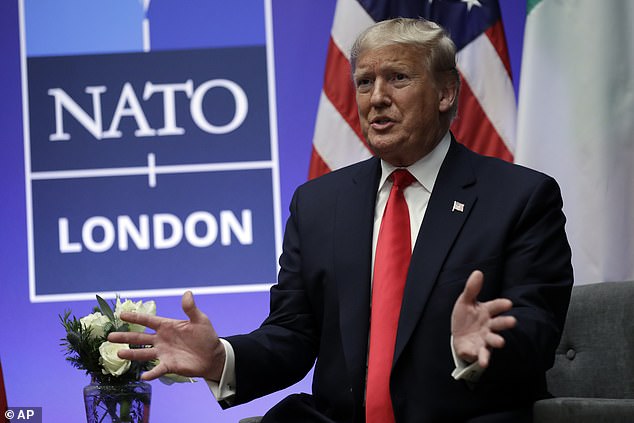
Donald Trump’s bizarre speech to the American people in the early hours of yesterday revealed what a terrible mess he has backed himself into with this war – and how difficult it will now be to get out of it.
At one moment the President was threatening to bomb Iran ‘back to the Stone Age’ while in the next he was claiming the gallant US military had already won.
Meanwhile Tehran has closed the Strait of Hormuz, cutting off much of the world’s oil supply, with governments from Europe to Asia and beyond facing a forthcoming crisis likely to dwarf the crippling oil shocks of the 1970s.
Yes, the American military performance has been outstanding, with 11,000 targets struck, the enemy leadership decimated and its navy destroyed. But there has been no regime change in Tehran, and the mullahs keep fighting.
Yet, that may soon change, as Trump has in recent history reserved his boldest military actions for the weekend. This is when the markets are closed and stock prices at their least volatile. It was in the early hours of a Saturday that the president began his assault on Tehran that killed Ayatollah Khamenei, as was his capture of Venezuelan president Nicolas Maduro. To that end, as the three-day Easter break begins, some experts are predicting a similarly bold strike.
Trump was elected promising to end foreign wars – but now he must fear that he has started one, and without getting allies on side beforehand, that risks making Uncle Sam’s recent misadventures in Iraq and Afghanistan look like Scout jamborees. The truth is he has zero good options – so what can and should he do?

Trump previously promised to end foreign wars – but now he must fear that he has started one, and without getting allies on side beforehand
Declare victory and leave
This is what Trump’s core supporters would prefer: A quick withdrawal, with the President likely claiming ‘total victory’. It would stop the immediate bloodshed, but the rest of the world would be left to restore some semblance of order to the region.
The problem is everyone would also see an obvious truth: That America, for all its power and bravado, would have effectively lost the war to a fourth-rate military power with a failed economy. Vladimir Putin and Xi Jinping would relish the humiliation and factor it into their strategies for the months and years ahead.
Trump would leave Iran in control of the Strait of Hormuz, which would likely become a pay-for-passage maritime toll-booth for the mullahs, netting them millions of dollars a day.
The regime would still be in control, its terrorist proxies Hezbollah and the Houthis still armed and dangerous, the people of Iran still subject to arbitrary torture and death from the religious police.
There’s nothing Trump hates more than a ‘loser’.
Walking away from this ill-conceived conflict would see him ridiculed as one by history, which means he will do everything he can to avoid doing so.
Invade mainland Iran
A full-scale invasion of Iran would theoretically allow Trump to achieve several key objectives: Fully destroying the regime, seizing its nuclear materials and perhaps harnessing its resources to recoup some of the costs of the war he started. But the operation would be an enormous undertaking with a terrible price in blood and treasure.
Iran is essentially a vast mountain fortress with a young, well-armed and belligerent population of 83million. Though its military has been degraded, it retains a chilling capacity for guerilla warfare and drone attacks. This conflict has so far cost American taxpayers about £35billion, with 15 US troops killed and several hundred wounded.
A full invasion would cost hundreds of billions, even more than $1trillion. At heart, Trump surely knows he needs to end the war, not inflame it.

Tehran has closed the Strait of Hormuz, cutting off much of the world’s oil supply, with governments from Europe to Asia and beyond facing a forthcoming crisis
Cease fire… negotiate
Trump knows this is his best option. A ceasefire and one of his beloved ‘deals’ would allow him to save face and spin a victory to his followers. But America and Iran could not be further apart.
It’s now obvious Tehran has been planning for an attack like this for decades. The mullahs know they have several advantages over America’s awesome military machine, not least their stranglehold over much of the global oil supply and the vulnerability of the US’s regional allies in the Gulf, who have been hit hard by Iranian strikes.
Tehran has thus set tough, probably impossible conditions even for talks to take place. A cessation of hostilities and an end to the killing of Iranian officials are reasonable enough demands, but ‘reparations’ for damage caused by US bombing and a guarantee of Iranian sovereignty over the Strait of Hormuz will be too much for Washington to stomach.
Again, Trump cannot agree to Iran’s terms without being seen as a loser – so he would only take this step if backed into a corner.
Take Strait of Hormuz
Currently, any ships passing through the Strait are vulnerable to land-based missiles and shore-launched drones. Realistically, therefore, any military operation to assume control of the Strait would require America to seize a foothold along the Iranian coastline. Thousands of troops would be needed to take and hold 100 miles of shoreline – and thousands more to push ten, 20 or 30 miles inland. This could swiftly become a bloodbath.
Iran is the source of the Shahed-136 kamikaze drones with which Russia has terrorised Ukraine. These unmanned aircraft carry a 50kg explosive payload and can fly, often in horrifying swarms, for more than 1,000 miles to their target. Russia has been supplying Iran with new drones boasting a 90kg payload.
I know that when US generals have war-gamed conflicts with Iran over the past 20 years, the closure of the Strait of Hormuz has been a central feature of every scenario. I also have it on good authority that concerns about this chokehold were ignored or overruled by America’s gung-ho Defence Secretary Pete Hegseth and the Chairman of the Joint Chiefs of Staff, General Dan Caine.
Block Persian Gulf
Theoretically, with a vast navy and air support, it should be possible to mount a blockade of the entire Persian Gulf, striking a hammer blow to Iran’s oil exports and further crippling the regime’s finances.
Yet the global oil crisis would escalate to levels unseen in at least a century. Prices could soar to $200 per barrel and beyond.
China, Japan, Australia and much of Asia depend on Middle Eastern oil, while Europe, though less exposed, remains highly sensitive to a spike in oil prices. Nor would a blockade reassure Gulf states to resume shipping through the Strait, keeping the world starved of its exports of oil and liquified natural gas – the latter being crucial to the manufacture of fertilisers that US farmers rely on. This would be an expensive escalation for little gain.

At heart, Trump surely knows he needs to end the war, not inflame it – but at the same time he cannot agree to Iran’s terms without being seen as a loser
Invade Kharg Island
it seems to me all too likely that the next phase of this conflict will see America try to seize Iran’s biggest oil-export hub by force. Once again, the biggest problem is the Strait of Hormuz, where drones and missiles render an amphibious landing impossible.
That means America would likely have to take the island with paratroopers from the 82nd Airborne Division, more than 2,500 of whom have been flown to the region.
The Iranians will defend the island to the death – and defenders in war always enjoy advantages over the attacker. Yes, after several days or weeks, American firepower is likely to prevail but dozens, even hundreds, of American soldiers will inevitably come home in body bags.
Once taken, the island would have to be resupplied by air rather than sea, preventing the installation of the bulky air-defence systems needed to secure it.
And if America takes the island and the Iranians still don’t surrender, what then? How long will US troops stay there under constant barrage? Would a further stalemate make an American invasion of the mainland more likely? The conclusions are chilling.
Sir Richard Shirreff is former Deputy Supreme Allied Commander Europe, Nato.