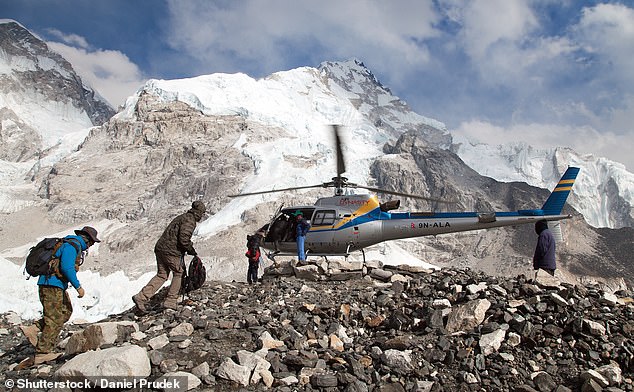
Mount Everest guides are ‘poisoning’ foreign climbers to trigger a helicopter rescue as part of a sophisticated network of insurance fraud.
The ‘fake rescue’ scheme has grown in Nepal, where mountain guides stage a medical emergency for a climber, check them into a hospital, then file a false insurance claim to reap the payouts.
Many foreign hikers trekking near Mount Everest, in Kathmandu, Nepal, fall victim to the scam.
An investigation by the Kathmandu post exposed the hefty $20 million racket. Scammers use two tactics to trigger the operation.
The first tactic is scaring hikers at high altitudes, where sickness is possible, into believing they’re in fatal danger and need immediate airlift.
The other instance involves guides encouraging tired tourists to fake an illness so a helicopter will rescue them instead of walking back.
In some cases, the guides will go as far as lacing hikers’ food with baking powder to make them sick, the outlet reported.
Investigators also revealed that hikers were given Diamox (Acetazolamide) pills, meant to prevent altitude sickness, along with large amounts of water to deliberately trigger symptoms and prompt a helicopter rescue.

Many foreign hikers trekking near Mount Everest, in Kathmandu, Nepal, fall victim to the scam

A Bottle of Prescription Acetazolamide, used to prevent altitude sickness
Once the pretend rescue starts, scammers make more money by charging each passenger as if they had their own helicopter, turning a $4,000 flight into $12,000.
False flight and medical records were used to inflate insurance claims, with hospitals faking treatment for patients who weren’t actually receiving care.
And here’s how the profit was tied together: hospitals paid 20 to 25 percent of the insurance money to the trekking companies and another 20 to 25 percent to chopper operators, in exchange for patient referrals, per the outlet.
Sometimes tourists are offered some bucks to join in on the scheme.
In between 2022 and 2025, investigators found a staggering 4,782 foreign patients serviced at implicated hospitals, with 171 cases verified as fraudulent rescues, the outlet reported.
Era International Hospital raked in over $15.87 million, while Shreedhi International Hospital brought in more than $1.22 million, the outlet reported.

Some guides the guides went as far as lacing hikers’ food with baking powder to make them sick

The ‘fake rescue’ web has grown in Nepal, where mountain guides stage a medical emergency for a climber, check them into a hospital, then file a false insurance claim to reap the payouts
Everest Experience and Assistance was allegedly connected to 71 shady rescues across 601 flights, generating a whopping $11.04 million in claims.
Last month, Nepal Police’s Central Investigation Bureau charged 32 people with organized crime and offenses against the state.
Nine people were arrested, while others remain at large, the outlet reported.