

For years, stonemason Alan Slater had been warning his colleagues about the fake quartz worktops that were becoming Britain’s No 1 choice in the kitchen.
‘I must have been with 15 companies and at each of them I was saying ‘We shouldn’t be working with this stuff – it’s dangerous’,’ he says.
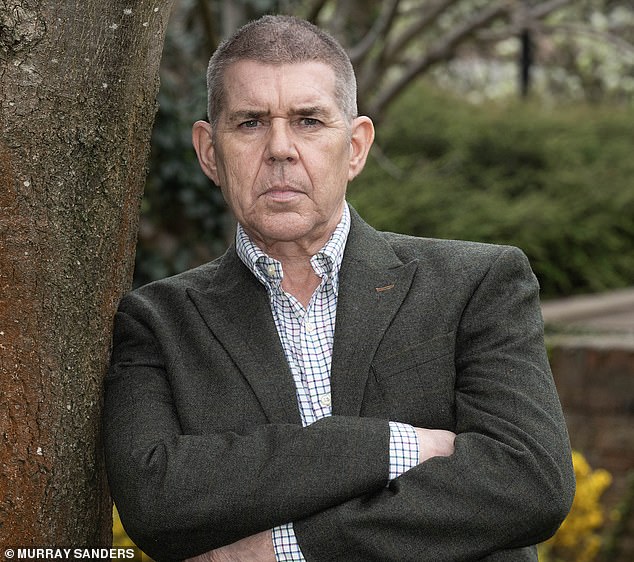
‘But I was just told to get on with my work and everything would be fine.’ Unfortunately for Alan, 56, everything isn’t fine. He is one of a growing number of tradespeople who have developed silicosis, an incurable lung disease caused by breathing in dust from the ‘engineered’ stone he was so concerned about.
Engineered stone is a manufactured composite material containing high concentrations of silica (silicon dioxide), a mineral commonly found in the Earth’s crust.
The artificial stone is manufactured by binding finely crushed crystalline silica with polymer resins and pigments to create a hardened, shiny surface. The end product contains 90 to 97 per cent silica, compared with natural granite or marble which contain about 30 per cent and 5 per cent respectively.
Such high concentrations are leading to stonemasons developing silicosis younger and the disease is progressing faster – a condition known as ‘accelerated silicosis’.
According to the online interior design website Houzz, 42 per cent of us now use engineered quartz surfaces in our kitchen. They are perfectly safe once fitted but can come at a cost to the stonemasons preparing them for installation.
When the artificial stone is cut and shaped in the workshop, microscopic particles containing ‘respirable crystalline silica’ (RCS), are thrown off that can seriously scar the lungs if breathed in over even short periods of time. This results in severe breathlessness, weight loss, fatigue, persistent coughing and, in some cases, death.

Stonemason Alan Slater had been warning his colleagues about the fake quartz worktops that were becoming Britain’s No 1 choice in the kitchen
‘I’ve been a stonemason since 1986 and as the years have gone on, it’s become less granite, marble and Portland stone and more of this engineered stone,’ says Alan, from Brentford, Essex. ‘With the real stone, you’d have a mask on and use an airline [blower] to get all the dust out of your hair and off your clothes after you’d cut it.
‘But with the engineered stone you can’t do that because it’s so fine and after you take off your mask, you can see the particles still floating in the sunlight – it’s on your clothes, it doesn’t get out of your hair. It’s a nightmare to get rid of. I kept saying to the bosses that it was deadly but they just told me to get on with it.’
Silicosis is as old as working with stone itself. When caused by traditional stone and dust from sandblasting or brickmaking, it is slow to develop, appearing after decades as lung damage, usually among retired workers.
However, exposure to engineered stone is causing illness among stonemasons who have worked with it for just a few years. And instead of being in their 50s, 60s and 70s, these new victims are showing up in their 20s, 30s and 40s.
Britain’s first cases of silicosis caused by engineered stone were confirmed as recently as 2023 by Dr Johanna Feary, consultant in occupational lung disease at the Royal Brompton Hospital in London.
She studied eight cases where the average age of sufferers was just 34. Since then, the number of patients has increased to more than 50, a dozen of which are classed as having accelerated silicosis. The average age of all 50 silicosis patients is 43. The average age of the accelerated silicosis patients, just 30. Of the original eight cases, three have died.
‘If you’ve had more than ten years of exposure to silica, then we call it chronic silicosis and if you’ve had less than ten years, we call it accelerated silicosis or acute silicosis,’ says Dr Feary. ‘A lot of the people we are seeing have got accelerated silicosis and therefore are really quite young. They are often fit men who became very ill, very quickly. Some are in their early to mid-20s and they have newborn babies, and I’m telling them that they’ve got this condition. It’s really hard for them.’

Alan, 56, is one of a growing number of tradesmen who have developed silicosis, an incurable lung disease caused by breathing in dust from the ‘engineered’ stone
Alan first noticed his symptoms two years ago. ‘ I used to go the gym a lot and then I started noticing that I was getting breathless,’ he says.
‘I was thinking, what’s going on? I’d been going to the gym for about 20 years and usually smashed my way through my routines, but suddenly, I couldn’t.’
After being wrongly diagnosed several times with chest infections, Alan was admitted to Chichester hospital when he fell ill during a visit to his partner in West Sussex.
‘They told me I had pneumonia and I thought that was weird – I was a fit and healthy guy – why would I have pneumonia?’, he says. ‘I was then given lung function tests at the West Middlesex hospital, where they said I had silicosis, probably from my job. But I thought that was bizarre as I had worn a mask all during my career. It turns out that was no protection for the fine dust thrown off by engineered stone.’
Alan, who is now under the care of Dr Feary, knows that there is no cure for the disease. He also knows that lung scarring can continue to spread even after giving up working with stone. Treatments are limited to inhalers, bronchial dilators and, in severe cases, oxygen. A handful of patients are understood to be awaiting lung transplants.
‘The worst thing is not knowing whether the illness will progress, and whether I’ll get worse,’ says Alan. ‘Most people don’t understand what this is and that it’s potentially fatal, so I don’t talk about it very much, particularly to my family because I don’t want to worry them. But it’s on my mind all the time.’
Most people diagnosed with silicosis will not die from it, particularly if it is caught early, but they may have a reduced life expectancy. As many as 500 former construction workers out of a workforce of 600,000 are thought to die each year from some form of silicosis but there is no national breakdown that separates chronic from accelerated silicosis.
Anecdotally, accelerated silicosis deaths from artificial stone are thought to be on the increase.
Australia embraced engineered stone earlier than the UK and banned it in 2024. A parliamentary report into the substance in December last year warned: ‘Around 10,390 Australians are predicted to develop lung cancer in their lifetime as a direct result of being exposed to the dust.’
Thompsons personal injury solicitors, which represents victims, and the Trades Union Congress are at the forefront of calls for engineered stone to be banned. Shelly Asquith, the TUC’s Health and Safety Policy Officer, says: ‘Silica dust is known to be a killer and workers’ lives are being put at risk every day from cutting engineered stone.
‘While measures to improve protections and lower exposure are welcome, elimination is the most effective way to prevent the disease. Britain should follow the example of Australia, where the supply and cutting of engineered stone has now been banned. This will save lives.’

When the artificial stone is cut and shaped in the workshop, microscopic particles containing ‘respirable crystalline silica’ (RCS), are thrown off that can seriously scar the lungs
The TUC has held talks with the Health and Safety Executive (HSE) over an outright ban, but the HSE is not in favour of one, arguing that laws and processes already exist to safeguard workers – they just need to be enforced.
These include water-suppressed cutting of stone to damp down dust and the provision of proper breathing apparatus.
‘We will issue updated guidance to raise wider awareness of the correct controls for those working with engineered stone,’ the HSE says. ‘And we will deliver targeted inspections of workplaces and take enforcement action where we find workers are at risk.’ All of which comes too late for Marek Marzec, a Polish stonemason who died in London from accelerated silicosis in November 2024 at the age of just 48. He had been diagnosed with the disease only six months earlier.
B efore he died, he said: ‘I arrived in the UK to build a better life and wanting to make sure that my two young daughters [back home] were financially secure. Instead, because of the work I did cutting quartz worktops, I have been left unable to breathe and in terrible pain.
‘I cannot tell you how angry I am that I was allowed to work in these conditions and that my life has been cut short simply for doing my job. I am not the only person whose life has been put at risk by this lethal dust.
‘It is time for urgent action to stop these dangerous working conditions I had to face before other stone workers contract this terrible disease and die.’
Ewan Tant of Leigh Day solicitors, who is suing Marek’s former employers, says he was shocked by the speed of his client’s deterioration. ‘When I first visited him at home, he was living in a one-bedroom flat in Tottenham, north London,’ he says.
‘He was on the first floor and he was on oxygen, and he struggled to climb down the stairs to let me in. He was on his own and it felt brutal to see him like that.
‘I went again a month later and this time he couldn’t use the stairs. He just dropped his keys out of the window. I found that devastating – he was only a bit older than me. To see him struggle to make it up and down a flight of stairs was like watching someone with lung disease in their 70s or 80s. But only a few months earlier, he’d been a fit and healthy young man.’
Possibly because of a lack of awareness of silicosis among the public, consumers still want their engineered quartz kitchen surfaces – but how can they buy them with a clear conscience?

Next month the British Occupational Hygiene Society (BOHS) are launching a kitemark-style certification scheme for engineered stone worktops that have been produced safely
Until now they haven’t been able to – but next month the British Occupational Hygiene Society (BOHS), which campaigns for workplace safety, and the Worktop Fabricators Federation, which represents 60 per cent of companies in the sector, could change that.
They are launching a kitemark-style certification scheme for engineered stone worktops that have been produced safely.
‘Manufacturers in the scheme will have their workplaces inspected and monitored by registered occupational hygienists, specialists in the control of workplace health risks,’ says Professor Kevin Bampton, chief executive of BOHS.
‘The scheme will allow consumers to see where a worktop has been fabricated in a healthy working environment and who the manufacturer is.
‘We want consumers to make the choice to have the product they want – but not at the price of some young worker’s health.’
Perhaps the last word should go to Nigel Fletcher, operating officer for the worktop federation, who says his members are keen to weed out ‘cowboys’ in the industry who put their workers at risk.
‘Like in all industries, there are those that care and those who just want to make pure profit – I call the guys who don’t care ‘cowboys’,’ he says. ‘If the cowboys aren’t prepared to spend thousands of pounds on keeping their workers safe, they can sell a worktop at more than £1,000 cheaper than those who do care.
‘So if you’re offered something that seems ridiculously cheap, you can buy it but you could be putting someone’s life at risk.
‘And that’s up to you and your conscience.’