


April 1, 2026
2 min read

NASA Artemis II astronauts “safe” and “secure” as they journey toward the moon, officials say
NASA launched the Artemis II moon mission on Wednesday, April 1—a date that will enable the crew to observe the moon pass in front of the sun from space
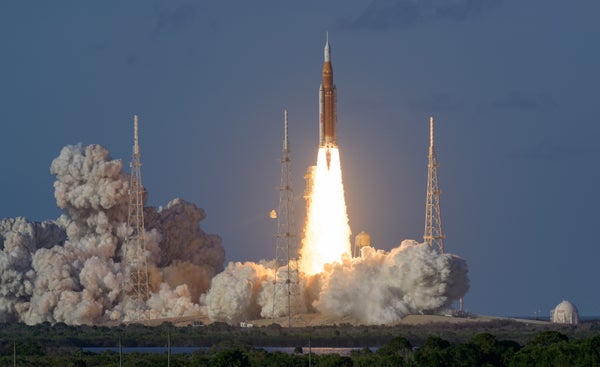
NASA has launched four astronauts on a pioneering journey around the moon—the Artemis II mission. Follow our coverage here.
NASA officials on Wednesday hailed the successful launch of the Artemis II mission to the moon. The ten-day flight, which lifted off at 6:35 P.M. EDT from the Kennedy Space Center in Florida, will take four astronauts on a path further from Earth than any human has gone before, around the far side of the moon and back.
The Artemis II crew is made up of Reid Wiseman, Christina Koch, Jeremy Hansen and Victor Glover. NASA administrator Jared Isaacman at a press conference following the launch praised the astronauts, adding that the crew aboard the Orion spacecraft had briefly lost communication with Earth-based control but that it had been re-established.
“[They’re] safe, they’re secure, and they’re in great spirits,” Isaacman said. The four are the first astronauts to head toward the moon for more than fifty years.
On supporting science journalism
If you’re enjoying this article, consider supporting our award-winning journalism by subscribing. By purchasing a subscription you are helping to ensure the future of impactful stories about the discoveries and ideas shaping our world today.
After about a day in Earth’s orbit, the crew plans to conduct a lunar flyby on April 6 and is set to return to Earth on April 10. Along the way, the crew will test systems aboard the Orion spacecraft (including a cutting-edge space toilet), perform a series of test maneuvers of the Artemis II crew capsule, measure how their own bodies adapt to microgravity, and observe and image the moon in preparation for future moon missions. They will likely see parts of the far side of the moon that no human has ever directly observed before, as well as going further into space than ever before.
They will also get to experience an eclipse—as the moon passes in front of the sun, leaving only the star’s corona visible, said Lori Glaze, the acting associate administrator for NASA’s Exploration Systems Development Mission Directorate. “It’ll be pretty cool and unique opportunity.”
For now, the crew is concentrating on making sure the Orion capsule, named Integrity, is on the correct trajectory to pull off a maneuver in the next day called the trans-lunar injection burn, which will place them on the correct path toward the moon. As of 9:14 P.M., the spacecraft was coasting after performing an apogee raise burn—a move that stabilized its orbital path around Earth.
Ahead of the launch, Isaacman called the mission the “opening act” for lunar exploration. Artemis II’s astronauts will not land on the moon. But Artemis IV, planned for 2028, does include a pit stop on the lunar surface. Ultimately, NASA hopes to build a permanent base on the moon.
“After a brief, 54-year intermission, NASA is back in the business of sending astronauts to the moon,” Isaacman said.
This is a breaking news story and may be updated.
It’s Time to Stand Up for Science
If you enjoyed this article, I’d like to ask for your support. Scientific American has served as an advocate for science and industry for 180 years, and right now may be the most critical moment in that two-century history.
I’ve been a Scientific American subscriber since I was 12 years old, and it helped shape the way I look at the world. SciAm always educates and delights me, and inspires a sense of awe for our vast, beautiful universe. I hope it does that for you, too.
If you subscribe to Scientific American, you help ensure that our coverage is centered on meaningful research and discovery; that we have the resources to report on the decisions that threaten labs across the U.S.; and that we support both budding and working scientists at a time when the value of science itself too often goes unrecognized.
In return, you get essential news, captivating podcasts, brilliant infographics, can’t-miss newsletters, must-watch videos, challenging games, and the science world’s best writing and reporting. You can even gift someone a subscription.
There has never been a more important time for us to stand up and show why science matters. I hope you’ll support us in that mission.