Senior doctors are now threatening to strike as the British Medical Association escalates its pay dispute with the government.
The union will ballot consultants and specialist, associate specialist, and specialty doctors from May 11 to secure a mandate for industrial action.
It comes as resident doctors prepare to walkout for six days from April 7 to April 13 – just after the Easter bank holiday weekend.
The BMA said the ballot raises the prospect of all secondary care doctors in England taking industrial action during the same period in a major blow to patients and Labour’s pledge to tackle long waiting lists.
It blamed the move on a lack of progress in talks between senior doctors and ministers and an ‘inadequate’ pay award of 3.5 per cent.
Consultants – who last year earned an average of £147,000 – say their pay has been eroded by 26 per cent in real terms since 2008/9 and they want ‘meaningful progress’ towards restoring this in a multiyear deal.
That would require an uplift totalling 35 per cent.
The announcement came on the same day the BMA dared Sir Keir Starmer to follow through on his threat to ditch thousands of training places if resident doctors refuse to agree a pay deal and stage their own strike in pursuit of a 26 per cent rise.

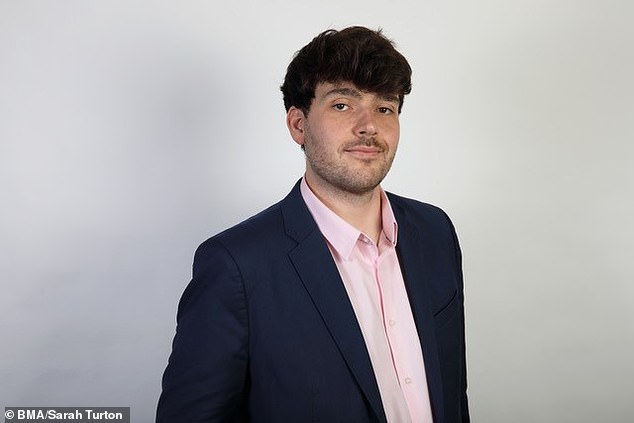
Dr Jack Fletcher, chairman of the BMA’s resident doctors’ committee, said it is the government’s ‘prerogative’ to withdraw the jobs but warned patients will suffer as a result.
Dr Jack Fletcher, chairman of the BMA’s resident doctors’ committee, said it is the government’s ‘prerogative’ to withdraw the jobs but warned patients will suffer.
The prime minister has accused resident doctors of ‘recklessly’ walking away from an offer that would have seen some earn more than £100,000 a year.
Last week the RDC rejected an offer worth up to 7.1 per cent for this year without even putting it to members for a vote.
The proposed deal would have taken their total pay rise over the past three years to 35 per cent.
The ‘hypocritical’ union has said that inflation caused by the Iran war means they need a bigger rise despite offering its own staff an uplift of just 2.75 per cent.
On Monday, Sir Keir gave the BMA 48 hours to call off the strikes before the Government withdraws an offer to create at least 4,000 new specialty training posts in the NHS, for which resident doctors can apply after their first two years of training.
Speaking on BBC Radio 4’s Today programme, Dr Fletcher said: ‘Making threats about withholding jobs from doctors and essentially stopping doctors from caring for patients, I don’t think is a realistic way or a credible way of ending this dispute.
‘It will end in a negotiating room.

Sir Keir Starmer said it would be ‘reckless’ for resident doctors to walk away from the offer.
‘If the PM and the health secretary would like to withdraw those thousand jobs then that is their prerogative.
‘What we are saying is we think it is bad for patients, we think it is bad for doctors.’
Health secretary Wes Streeting said the pay offer meant that ‘for the most experienced resident doctors, basic pay would have increased to £77,348 and average earnings would have exceeded £100,000’.
First-year doctors fresh out of medical school would earn on average £52,000 a year, £12,000 more than three years ago.
This is more than many NHS staff in other roles will earn at the peak of their career.
NHS England boss Sir Jim Mackey confirmed that the offer to expand training places will ‘come off the table’ without reaching an agreement.
He told LBC Radio: ‘The reality is that those extra training places cost money.
‘If we’re going to be spending money on managing industrial action, pay for their colleagues, extra cover shifts, that money will disappear.’

Tory leader Kemi Badenoch said the government should not be using training places as a ‘bargaining chip’.
Writing in The Times on Monday, Sir Keir said the offer was made after ‘months of collaboration with the BMA’ and their refusal to now accept will leave patients ‘paying the price’.
Tory leader Kemi Badenoch said of Sir Keir: ‘I don’t think he should be using training places as a bargaining chip. I don’t really understand why he’s doing that.
‘I’d like to hear an explanation, because those training places, my understanding is that they are for patients, they are to increase patient support, patient safety, patient welfare.’
Mike Prentice, national director for emergency planning at NHS England, said that the timing of the strike will lead to ‘significant strain’ as many other staff will be on Easter holidays.
The Department of Health and Social Care said basic pay for new senior doctors has increased by 28.5 per cent over the past four years.