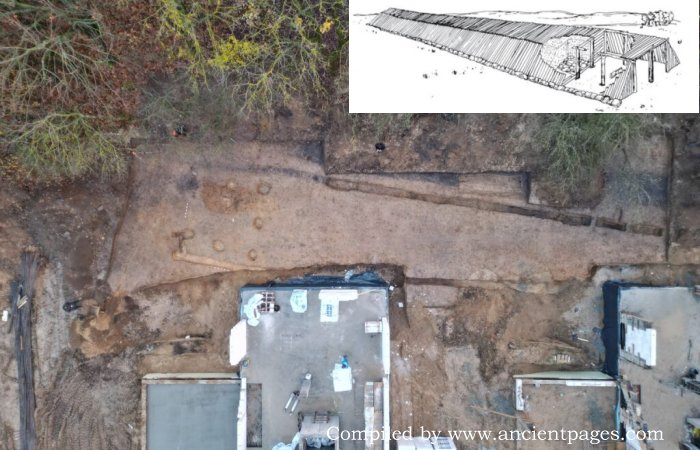
Jan Bartek – AncientPages.com – Archaeologists excavating in the city of Lublin, Poland, have made a fascinating discovery. A Polish team has unearthed a giant megalithic tomb that predates even the Egyptian pyramids. This Neolithic structure, built around 6,000 years ago, sheds new light on the traditions and burial customs of our distant ancestors.

Credit: Lubelski Wojewódzki Konserwator Zabytków
Since 2025, rescue archaeological research has been underway on Sławinkowska Street in Lublin, ahead of the construction of single-family homes. Led by Archeja Jacek Tkaczyk, this work was required because the planned development lies within an archaeological site.

Credit: Lubelski Wojewódzki Konserwator Zabytków
What began as a routine precaution has turned into a powerful reminder of how the past can emerge unexpectedly beneath our feet.
Earlier, the first traces of ancient communities in this area were found during construction on Willowa Street. Now, current research is revealing even more, transforming the region from an ordinary modern neighborhood into a place where thousands of years of human history converge.
The beginnings of agricultural settlement in what is now Poland reach back to the 6th millennium BC, when communities first took the courageous step of cultivating land, raising animals, and shaping clay into pottery.
Among the most important cultures of this era was the Funnelbeaker culture, which flourished from the 4th to the early 3rd millennium BC. These people did not just live—they built monuments that carried their beliefs and memories forward through time.
They created monumental burial structures known as megaliths: elongated, striking tombs that could stretch over 100 meters. In southern regions, where large stones were scarce, they adapted with ingenuity, building wooden “megadendrons” from piles driven into the ground and covered with an earthen embankment. Even then, humans were finding creative ways to honor their dead and give meaning to life.

Credit: Lubelski Wojewódzki Konserwator Zabytków
At Sławinek, researchers have now uncovered the remains of just such a structure. The tomb was about 42 meters long and over 5 meters wide in its eastern section, narrowing toward the west. No burials were found inside, suggesting it may have been a cenotaph—a symbolic tomb. Even in the absence of human remains, the structure itself stands as a testament to the values, rituals, and imagination of the people who built it.
On the southern side, archaeologists revealed a nearly 30-meter-long ditch, a typical feature of such monuments. They also recovered fragments of ceramic vessels and flint artifacts made from Sieciechów and chocolate flint—small, tangible pieces of a world that once thrived where modern houses now rise. Each shard and tool reminds us that human creativity and resilience are not new; they are ancient.
These discoveries fit into a broader pattern of research in this part of Lublin, ongoing since the 1960s. At least three or four megalithic tombs had already been identified nearby on Willowa Street. The newly discovered structure may be another, possibly the fifth, element of this ancient cemetery. What once seemed like isolated finds is now revealing itself as a carefully planned sacred landscape.

Credit: Lubelski Wojewódzki Konserwator Zabytków
Archaeological research in Sławinek continues, and with it the promise of deeper insight into the lives and burial customs of the Neolithic communities that lived here thousands of years ago. Their voices may be silent, but through their monuments, tools, and traditions, they still speak.
See also: More Archaeology News
This discovery is more than a scientific milestone—it is a reminder. It invites us to see our own lives as part of a much longer story, to recognize that the urge to build, remember, honor, and create has been with humanity for millennia. Beneath modern streets and future homes lies a powerful truth: we are all connected across time, and every generation leaves something behind for the next to uncover, learn from, and be inspired by.
Source: Lubelski Wojewódzki Konserwator Zabytków
Written by Jan Bartek – AncientPages.com Staff Writer